



Robot Machine Tending: How a Cobot Keeps Your CNC Running 24/7
- Apr 29
- 4 min read
Your CNC machine can run all night. Your operator cannot.
That is the core argument for robot machine tending, and it holds up in facilities of almost any size. When a cobot handles the load and unload cycle, your machine runs longer, parts come out more consistently, and your skilled machinists spend their time on work that actually requires judgment.
What surprises most manufacturers is the price. A capable cobot for machine tending does not require a six-figure budget or a dedicated integration team. Blue Sky Robotics carries cobots starting well under $15,000 that are deployed in real production environments today.
What Is Robot Machine Tending?
Machine tending is the process of loading raw material into a machine, waiting for the cycle to complete, removing the finished part, and repeating that sequence hundreds or thousands of times per shift.
It is exactly the kind of task a cobot was built for: defined motion paths, consistent part geometry, and zero need for improvisation.
In practice, robot machine tending covers:
CNC lathe and mill loading and unloading
Injection molding part removal
Stamping press and press brake tending
Heat treatment and oven loading
Post-machining quality inspection
The robot handles the physical transfer. The machine runs its cycle. The human operator is freed for programming, setup, or managing a second machine entirely.
Which Cobots Work Best for Machine Tending?
The right cobot depends on part weight, reach requirements, and how much variation exists in how parts are presented. Here is how the Blue Sky Robotics lineup maps to common machine tending scenarios.
Light Parts and Compact Cells
For parts under 3 kg in a tight CNC cell, the Fairino FR3 ($6,099) is a compact 6-axis cobot with a 622 mm reach and 0.02 mm repeatability. It fits where larger arms cannot and is a practical entry point for shops new to automation.
Mid-Range Production
The Fairino FR10 ($10,199) handles up to 10 kg with a 1,300 mm reach, making it versatile across lathes, mills, and press brake applications. For facilities running mixed part sizes across multiple machines, this is the range to consider.
Heavy Parts
The Fairino FR16 ($11,699) steps up to a 16 kg payload and 1,034 mm reach. If you are loading raw billets, castings, or multi-part fixtures into a horizontal machining center, this is the appropriate range. It also carries explosion-proof certification for facilities where that matters.
Not sure which one fits your cell? Use the Cobot Selector to narrow it down based on your payload and reach.
The ROI Case for Machine Tending Automation
The math is straightforward.
A machinist in the U.S. earns roughly $45,000 to $55,000 per year fully loaded. A Fairino FR10 at $10,199, including a gripper and basic integration, might run $15,000 to $18,000 all-in for a standard machine tending deployment.
If that robot extends your machine utilization from 60% to 85% on a single shift, or enables lights-out production for even a few hours each night, the payback period is typically under 12 months.
That is not a theoretical number. It is the kind of figure that surprises first-time buyers who assumed automation required a multi-year capital project.
Use the Automation Analysis Tool to run the numbers for your specific application.
What a Basic Machine Tending Cell Requires
A machine tending deployment does not require a full integration team or a dedicated automation engineer. Most Blue Sky Robotics customers set up a basic tending cell with:
A cobot arm mounted on a pedestal or directly to the machine base
A pneumatic or electric gripper matched to part geometry
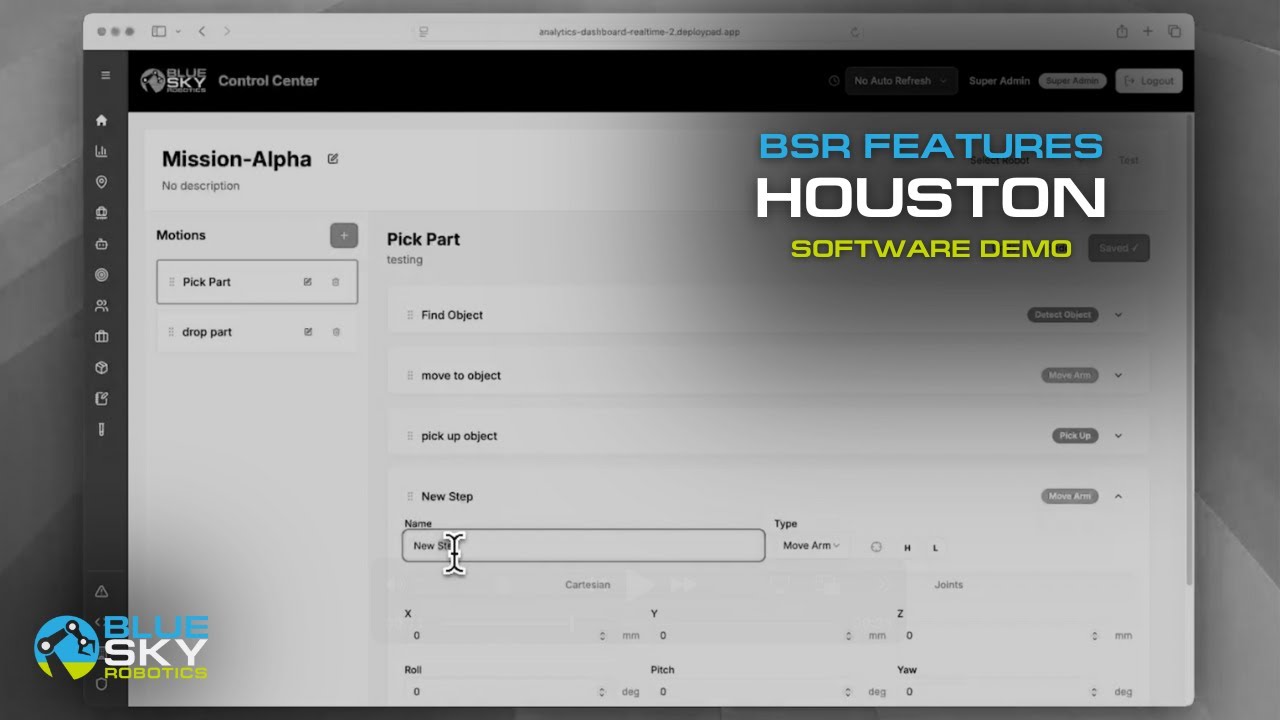
Mission-building software to define pick, load, and unload positions
A parts staging area: infeed and outfeed trays, or a short conveyor
For applications where parts do not arrive in a fixed, consistent position, Blue Sky's computer vision software handles detection and orientation automatically. To learn more about computer vision, visit Blue Argus.
Book a live demo to see a machine tending cell in action, or explore the full robot catalog to compare options side by side.
Conclusion
Robot machine tending is one of the highest-ROI applications for a cobot, and with arms starting under $15,000, it is accessible to job shops and production facilities alike. The machine runs longer, the parts come out better, and your operators do more valuable work.
Whether you are running two CNCs or twenty, there is a cobot in the Blue Sky Robotics lineup built for the job.
Frequently Asked Questions
What is robot machine tending?
Robot machine tending is the use of a robotic arm to automatically load raw material into a CNC machine, press, or other equipment and unload finished parts, repeating the cycle without human intervention.
What payload do I need for machine tending?
It depends on part weight. Parts under 3 kg suit the Fairino FR3. The FR10 covers parts up to 10 kg, and the FR16 handles up to 16 kg for heavier castings and billets.
How much does a machine tending robot cost?
Blue Sky Robotics cobots suited to machine tending range from $6,099 for the Fairino FR3 to $11,699 for the FR16. All-in deployment costs including a gripper and integration typically run $15,000 to $20,000.


