



Robot Machine Tending: How to Automate CNC Loading and What It Actually Costs
- Apr 13
- 6 min read
Every CNC machine has a problem that most shop owners quietly accept: the spindle stops when the operator stops. A machinist loads a part, walks away, and comes back to find the machine waiting. Or they stand there watching a cycle they cannot speed up. Either way, the machine's productive hours are dictated by someone's schedule, attention, and physical presence.
Robot machine tending removes that constraint. A cobot arm loads raw parts, initiates the cycle, waits, unloads finished parts, and repeats without breaks, without distraction, and without leaving at 5pm. The CNC runs through second shift, third shift, and overnight without adding headcount.
This post covers how robot machine tending works, which machines it applies to, what the full system costs, and which robot arms deliver the best value for shops of every size.
What Robot Machine Tending Actually Does
Machine tending is the process of loading raw material into a machine, initiating the machining cycle, removing the finished part, and staging it for the next operation. Done manually, it occupies an operator continuously, limits how many machines one person can run, and creates cycle time variability from human inconsistency.
A robot machine tending cell replaces the manual load/unload cycle with a programmed robot arm. The robot picks a raw part from an infeed tray or conveyor, opens the machine door (or waits for it to open automatically), loads the part into the fixture or chuck, signals the machine to begin its cycle, waits, removes the finished part when the cycle completes, and places it on an outfeed tray or conveyor. Then it repeats.
The machine interface is the critical integration point. The robot and the CNC need to exchange signals: is the door open? Is the spindle clear? Is the cycle complete? Is the fixture clamped? This handshake happens through digital I/O signals, M-codes, or fieldbus protocols depending on the CNC controller brand. Most modern CNCs from Fanuc, Siemens, Mitsubishi, and Haas support this kind of interface without modification to the machine itself.
Which Machines Can a Robot Tend?
Robot machine tending applies to any machine that follows a repeatable load/unload cycle with a defined start and end state. The most common applications are the following.
CNC lathes and turning centers - The most common machine tending application. The robot loads a blank into the chuck, the lathe turns the part, and the robot unloads the finished piece. Dual grippers that simultaneously pick a finished part and load a raw blank cut cycle time significantly.
CNC mills and machining centers - Vertical and horizontal machining centers with automatic doors are straightforward tending targets. The robot loads a part into a vise or fixture, the mill completes its program, and the robot unloads and replaces.
Injection molding machines - The robot removes hot parts from the mold at the end of each cycle. This keeps cycle time consistent, prevents heat-related handling issues for operators, and allows post-mold operations like trimming or inspection to happen inline.
Grinders and EDM machines - High-precision machines where consistent part placement directly affects output quality. A robot loads to the same position every cycle, which improves dimensional consistency compared to manual loading.
Laser cutters and press brakes - Sheet metal operations where the robot feeds raw blanks and removes cut or formed parts. For press brakes, the robot can hold the sheet during bending for consistent results.
The determining factor is whether the machine can communicate a cycle complete signal and accept a cycle start command from the robot controller. Most industrial machines built in the last 15 years can.
Choosing the Right Robot Arm for Machine Tending
Payload and reach are the two specs that drive robot selection for machine tending. Payload must cover the part weight plus the gripper weight with margin. Reach must cover the distance from the robot's base to the machine's fixture or chuck, plus the infeed and outfeed staging areas.
For light parts under 5 kg (small turned components, medical parts, electronics housings), the Fairino FR5 ($6,999) is the natural choice. Five kilograms of payload, 924 mm reach, and 0.02 mm repeatability covers the majority of CNC turning and light milling applications cleanly.
For parts in the 5 to 10 kg range (larger castings, structural components, heavier turned parts), the Fairino FR10 ($10,199) is the workhorse. Ten kilograms handles most vertical machining center applications without requiring a jump to a significantly more expensive arm.
For heavy parts approaching 16 kg (large forgings, hydraulic components, heavy castings), the Fairino FR16 ($11,699) handles the payload at a price that still makes cobot economics work compared to a traditional industrial robot cell.
One practical rule: always size payload based on part weight plus gripper weight, not part weight alone. A pneumatic dual gripper setup adds 1.5 to 3 kg. Size up rather than risk running at the arm's limit, which degrades repeatability and accelerates wear on the joints.
What Does a Complete Robot Machine Tending Cell Cost?
Standard Bots' machine tending guide anchors their entry-level cobot setup at $40,000 to $75,000. HowToRobot quotes $100,000 to $250,000 for a complete traditional CNC robot cell. Both figures are accurate for their respective systems.
A machine tending cell built around a Fairino cobot looks different at every tier.
The robot arm itself starts at $6,999 for the Fairino FR5 and $10,199 for the Fairino FR10. Add a dual gripper, infeed/outfeed trays, machine interface wiring, a mounting stand, and integration labor, and a complete single-machine tending cell typically runs $20,000 to $45,000 depending on the complexity of the interface and whether secondary operations like part inspection or cleaning are included.
That is well below Standard Bots' floor and dramatically below what a FANUC or KUKA-based system costs. The hardware savings come from the Fairino arm's price point, not from cutting corners on capability. The arms use harmonic drive gearboxes, integrated encoders, and the same 0.02 mm repeatability specification found in arms costing three times more.
The ROI Math for Robot Machine Tending
The return on investment for machine tending automation is among the most straightforward in manufacturing because the labor savings are direct and the productivity gains are measurable.
A single machine tending operator running one CNC on a two-shift operation costs $55,000 to $70,000 per year fully burdened. A robot that tends the same machine runs both shifts and adds overnight production that did not exist before. Spindle utilization typically climbs from 60 to 70 percent under manual tending to 85 to 93 percent with a robot cell, because the machine does not wait between cycles.
On a $30,000 to $45,000 total cell investment, the math points to payback in 12 to 18 months on a two-shift operation. Shops running three shifts or lights-out production see faster returns. The freed operator does not disappear from the payroll; they manage more machines, handle setups and changeovers, and focus on work that actually requires human judgment.
Getting Started
The Cobot Selector matches robot arms to your part weight and machine geometry. The Automation Analysis Tool lets you model the ROI against your actual cycle time and labor cost before committing to anything.
Browse the full Fairino lineup with live pricing, or book a live demo with the Blue Sky Robotics team to see a machine tending setup running in real time. To learn more about robot machine tending and cobot automation solutions, visit Blue Argus.
FAQ
Can a cobot tend any brand of CNC machine?
Most modern CNC machines from Fanuc, Siemens, Haas, Mitsubishi, Okuma, and others support digital I/O or M-code communication that allows a robot controller to send and receive cycle signals. No modification to the machine itself is typically required. The integration work involves wiring the I/O interface and programming the signal handshake between the robot and the CNC controller.
How long does it take to set up a robot machine tending cell?
A simple single-machine cobot tending cell can be installed, wired, and calibrated in three to seven days. More complex cells with custom dual grippers, vision systems, or secondary operations like part inspection or cleaning typically take two to four weeks from delivery to production validation.
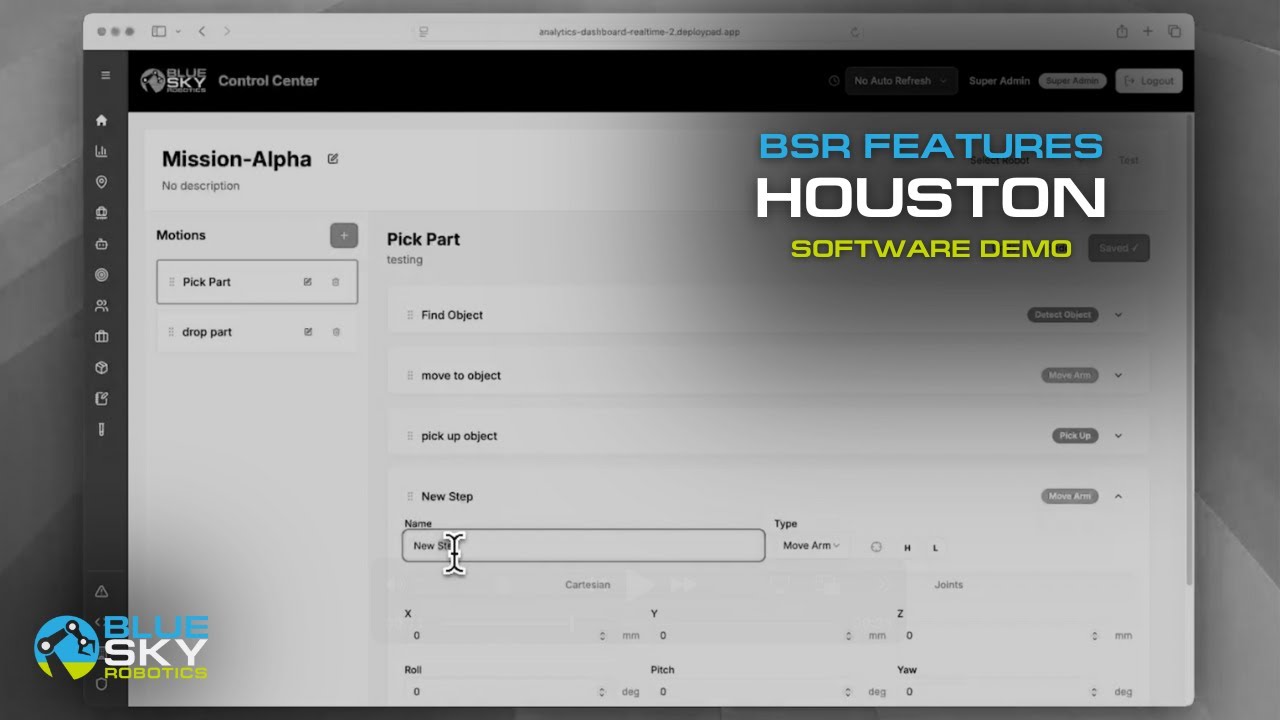
Does robot machine tending work for high-mix, low-volume shops? Yes, with the right approach to gripper and programming design. The key is designing grippers that handle a family of parts without full tooling changeover, and using a programming environment that allows quick re-tasking between part numbers. Blue Sky Robotics' automation software supports mission-based programming that simplifies changeovers compared to traditional robot teach pendant programming.


