



Fleet Robot Management: How to Coordinate Multiple Robots in a Warehouse
- Mar 30
- 4 min read
Updated: Apr 13
One robot in a warehouse is a deployment. Ten robots is a fleet, and a fleet introduces a different set of problems. Which robot handles which task? What happens when two robots need the same aisle at the same time? How do you keep track of what each robot is doing, when it needs maintenance, and whether it's actually delivering the throughput you expected?
Fleet robot management is the software and operational layer that answers those questions. As more operations move from single-robot pilots to multi-robot deployments, understanding how fleet management works, and what it requires, becomes as important as choosing the right hardware.
What fleet management software actually does
At its core, fleet management software is a centralized platform that assigns tasks to individual robots, monitors their real-time status, and coordinates their movement to prevent conflicts. When a pick order comes in from a WMS, the fleet manager identifies which robot is best positioned to handle it, based on proximity, current task load, battery level, and payload capacity, and dispatches it accordingly.
Traffic management is where the software earns its keep. In a busy facility with multiple robots operating simultaneously, the software monitors real-time positions and applies path optimization algorithms to prevent collisions, resolve bottlenecks, and keep the fleet moving at maximum throughput. MIT research published in March 2026 demonstrated a deep reinforcement learning approach to this problem that achieved roughly a 25% throughput gain over conventional routing methods, the margin between a well-managed fleet and a poorly-managed one is significant.
Battery management runs in the background continuously. Fleet software monitors each robot's charge level and routes it to a charging station during off-peak moments, using what's called opportunity charging, keeping the fleet available around the clock without dedicated charging breaks that cut into productive time.
Vision systems in a multi-robot context
Vision becomes more important, not less, as fleets scale. In a single-robot cell, a camera above a pick station gives the robot the ability to handle variation in part position and orientation. In a multi-robot environment, vision extends to spatial awareness across the facility, cameras and sensor data help the fleet management layer understand where robots are relative to each other, where humans are on the floor, and whether the environment has changed since the last mapping pass.
For picking applications specifically, each robot in the fleet still needs its own onboard or station-mounted vision system to handle the actual pick. Blue Sky Robotics integrates computer vision directly with UFactory and Fairino robot arms, which means vision-guided picks are handled at the individual robot level while the fleet management layer handles coordination above that.
When fleet management becomes necessary
A single robot operating at a fixed workstation doesn't need fleet management software, UFactory Studio or Fairino's WebApp handles programming and monitoring at the individual arm level. The fleet management layer becomes relevant when you're coordinating multiple robots across shared space, especially when those robots are mobile or when task allocation needs to happen dynamically based on incoming orders.
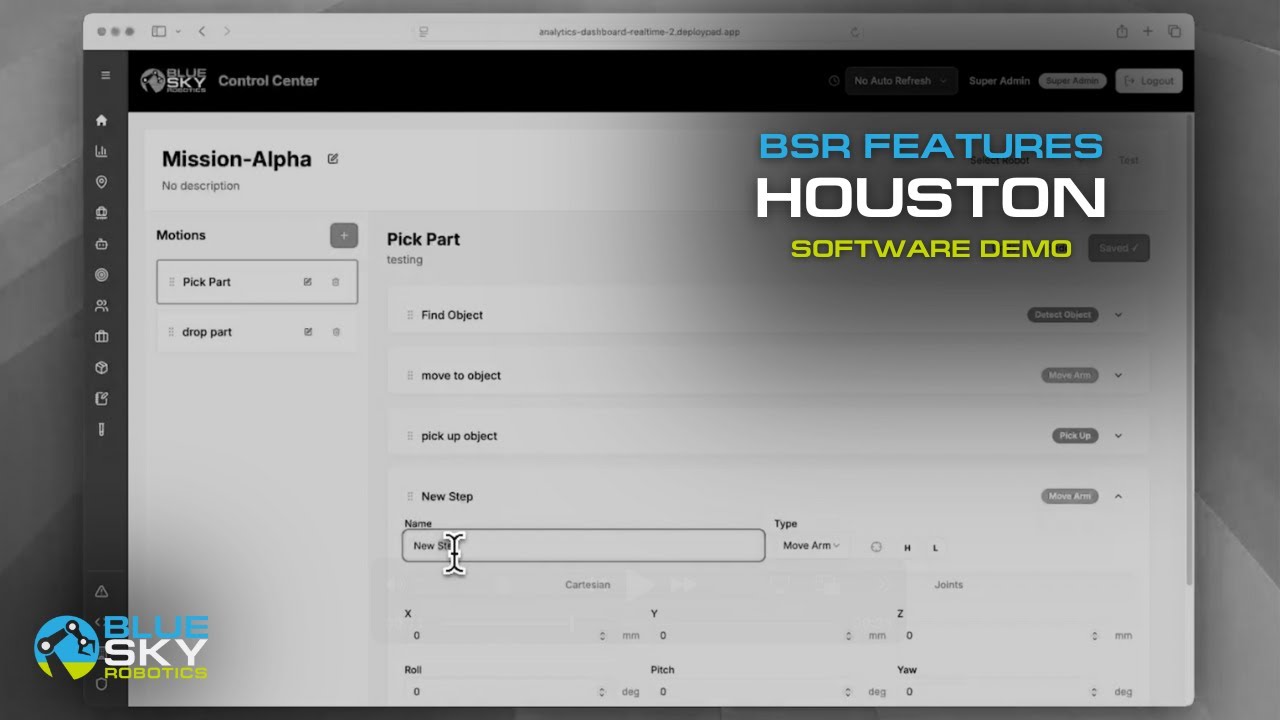
For manufacturers running two or three robot arms at separate workstations with defined, non-overlapping tasks, a simple mission-based software layer like Blue Sky Robotics' automation platform is usually sufficient. For operations running ten or more AMRs across a large warehouse floor, a dedicated fleet management platform that integrates with the WMS and handles real-time traffic control becomes necessary.
The right answer depends on the scale and complexity of the deployment, not on the hardware alone.
Building toward a fleet
The most effective fleet deployments start small. One robot, one well-defined task, fully optimized. Add a second robot when the first is consistently running at capacity and the next bottleneck is clear. Fleet management software is easiest to implement when the individual robot tasks are already working reliably, bolting fleet coordination onto a poorly-configured single-robot deployment doesn't fix the underlying problems, it amplifies them.
If you're at the stage of evaluating your first robot and thinking about eventual scale, the Cobot Selector helps match hardware to your current application. The Automation Analysis Tool can model the ROI for a single deployment and project what additional robots would add to the picture. To learn more about computer vision software, visit Blue Argus.
FAQs
Q: What is the difference between a WMS and fleet management software?
A: A Warehouse Management System handles inventory, it knows what needs to be picked, where it is, and where it needs to go. Fleet management software handles the robots, it decides which robot executes each task and coordinates their movement. The two systems communicate through APIs, with the WMS generating orders and the fleet manager dispatching robots to fulfill them.
Q: Do I need fleet management software for a small number of robots?
A: Not necessarily. Two or three robot arms operating at fixed, non-overlapping workstations can be managed individually through each robot's native software. Fleet management becomes important when robots share space dynamically, particularly with mobile robots navigating the same floor, or when task allocation needs to happen automatically based on incoming order volume.


