



Automated Picking: The Complete Guide for Manufacturers and Distributors
- Mar 30
- 4 min read
Every operation that ships product has a picking problem. Whether it's a manufacturer pulling parts for assembly, a distributor fulfilling orders, or a food producer kitting SKUs for retail, picking is almost always the most labor-intensive and most error-prone step in the process. Automated picking doesn't eliminate the need for people, but it removes the repetitive, physical burden of the task and replaces it with something faster, more consistent, and available around the clock.
This guide covers how automated picking works, where vision fits in, what it costs, and how to decide whether it makes sense for your operation.
How automated picking works
A robotic picking system combines three things: a robot arm that provides the physical motion, a vision system that tells the robot what it's looking at and where to grip, and an end effector that does the actual work of picking. These three components work together in a continuous loop, camera captures the scene, vision software processes it, robot executes the pick, software logs the result and calls the next task.
The robot arm handles positioning. A six-axis cobot can approach a target from any angle within its working envelope, which matters when items are in awkward orientations or when the pick location is partially obstructed. The end effector handles contact, vacuum grippers work well for flat or packaged items, two-finger grippers handle a wider range of shapes, and soft grippers are used for fragile or deformable products. End effector selection is often the most application-specific decision in the whole system.
Why vision is what makes modern picking viable
The limitation of earlier robotic picking systems wasn't the robot, it was the inability to handle any variation in part position or orientation. If something wasn't exactly where the robot expected, the pick failed. That constraint made robotic picking impractical for most real production environments.
AI-driven computer vision removed that constraint. A 2D or 3D camera mounted above the pick location captures the scene before each pick. Vision software identifies the target item, calculates its position and orientation, and determines the best grip point, all in real time, before the robot moves. The robot executes based on what it actually sees, not a fixed programmed position.
3D vision adds depth perception on top of 2D identification, which is what enables bin picking, picking randomly oriented, overlapping parts from an unsorted bin. Without 3D, bin picking is unreliable. With it, the robot can identify the most accessible item in the pile, calculate a collision-free approach path, and execute the pick cleanly.
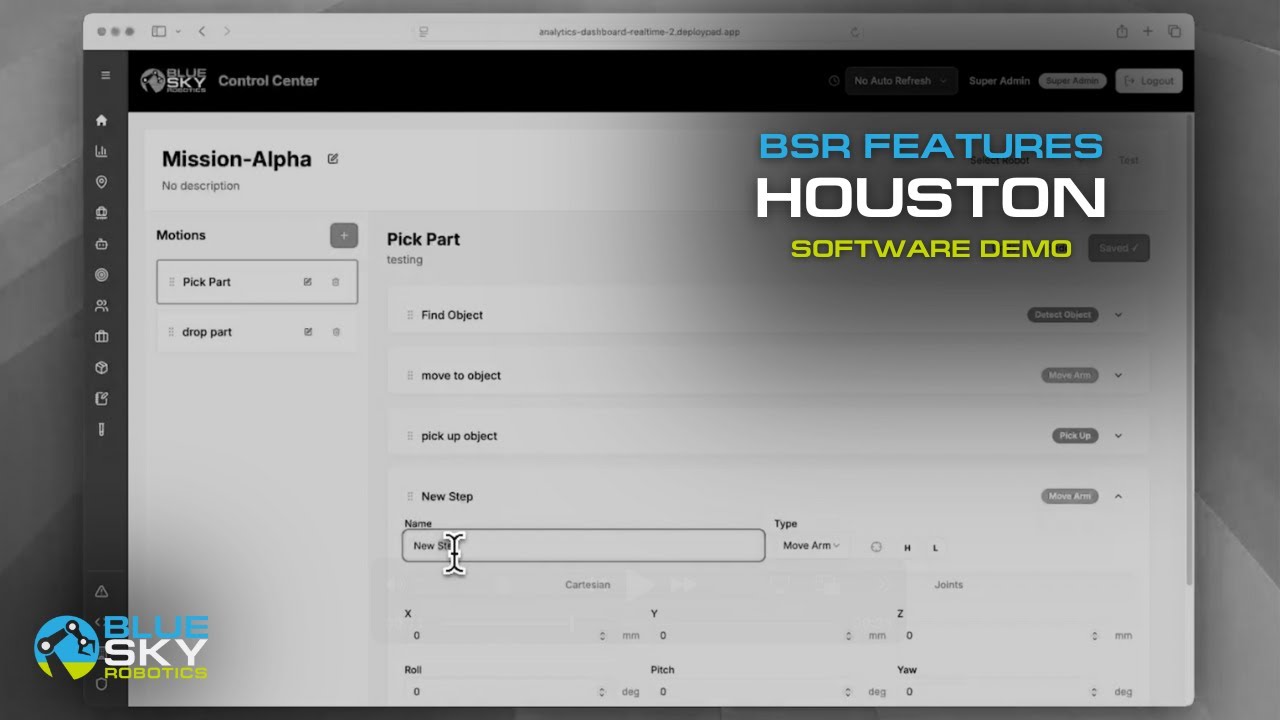
Blue Sky Robotics integrates computer vision directly with UFactory and Fairino robot arms as part of their automation software platform. Vision, motion control, and mission building are handled in a single system, there's no separate vision vendor to coordinate with and no custom integration work required to get a vision-guided cell running.
Automated picking vs. manual picking: where the gap shows up
The productivity difference between automated and manual picking is most visible in three places. The first is consistency, a robot picks with the same speed and accuracy on the 10,000th cycle as it does on the first, regardless of shift length or workload. Human pickers slow down and make more errors late in a shift or during peak periods.
The second is throughput. A single robotic picking cell can sustain pick rates that would require multiple human pickers to match, and it runs 24/7 without overtime costs.
The third is quality. A picking robot with vision doesn't just pick, it inspects. The vision system can verify the correct item, check label orientation, confirm dimensions, and flag non-conforming parts before they enter the order stream. That quality control function often justifies the automation on its own, independent of the labor savings.
What it costs
Robot arms for picking applications from Blue Sky Robotics range from the UFactory xArm 5 at $6,000 for simple, light-duty picking up to the Fairino FR10 at $10,199 for 10 kg payload and 1,400 mm reach. The UFactory xArm 6 ($9,500) is the most common choice for general production picking at 5 kg payload, it covers the majority of applications without overspeccing on reach or payload.
A complete picking cell, arm, end effector, vision hardware, and basic integration, typically runs $15,000–$40,000 for a straightforward first deployment. At $35/hour loaded labor cost, that investment usually pays back in 12–18 months on a single shift. Running two shifts cuts payback closer to six to nine months.
Use the Automation Analysis Tool to run the numbers for your specific process, or the Cobot Selector to identify the right arm for your payload and reach requirements.
FAQs
Q: What is the difference between pick and place and bin picking?
A: Pick and place assumes parts arrive in a known, consistent position, the robot moves to a fixed coordinate and picks. Bin picking uses 3D vision to identify and pick randomly oriented parts from an unsorted bin, which requires real-time grip point calculation and collision-free path planning. Bin picking is the harder problem and requires a capable vision system.
Q: How accurate is automated picking compared to manual?
A: Robotic picking with a vision system typically achieves higher accuracy than manual picking on repetitive, high-volume tasks, particularly late in a shift when human error rates increase. The robot executes the same motion with the same parameters on every cycle, and the vision system verifies the pick before execution.


