

Explosion-Proof Paint Robots: What Every Component Manufacturer Needs to Know
- Feb 25
- 4 min read
Updated: Mar 4
You've done the research on robotic painting. You've found a cobot that fits your budget. And then you discover that you can't legally or safely put it in your paint booth, because your standard cobot isn't rated for a solvent environment.
This is one of the most common and most frustrating stumbling blocks for component manufacturers trying to automate their finishing process. Explosion-proof certification isn't a technicality you can work around. It's a hard requirement for any coating environment where flammable vapors are present, and that covers the vast majority of industrial paint, lacquer, and primer applications.
This post explains what explosion-proof certification actually means, why it matters for your operation, and how to get a robot that meets the requirement without blowing your automation budget.
Why Standard Cobots Can't Go in a Paint Booth
A standard collaborative robot arm contains electric motors, servo drives, circuit boards, and wiring connectors, all of which can produce sparks, heat, or electrical arcs under normal operating conditions. In a clean factory environment, this is perfectly safe. In a spray booth where solvent vapors accumulate, a single spark can ignite those vapors. That's not a theoretical risk. It's the reason industrial explosion-proof standards exist.
Solvent-based paints, lacquers, primers, and many powder coatings create flammable or combustible vapor concentrations in enclosed or semi-enclosed spray environments. The threshold for ignition is often well below what a human operator would detect by smell. A cobot running normal operations in that environment is a genuine hazard.
Water-based coatings are generally less hazardous, but if your process uses any solvent-based material at any stage, including cleaning solvents for purging between colors, explosion-proof equipment is the correct and required choice.
What Explosion-Proof Certification Actually Means
An explosion-proof robot is engineered to prevent its internal electrical components from igniting the surrounding atmosphere. This involves sealed enclosures that contain any internal sparks, pressurized or purged cavities that prevent flammable vapors from entering the arm, and wiring and connectors rated for hazardous locations.
In the United States, the relevant standard for hazardous location equipment is the National Electrical Code (NEC) Class I, Division 1 classification, which covers environments where flammable gases or vapors may be present under normal operating conditions, exactly what a spray booth is. European markets use the ATEX directive (Atmosphères EXplosibles), which classifies hazardous zones and specifies equipment requirements for each.
When a robot manufacturer claims explosion-proof certification, they're stating that their arm has been tested and rated for deployment in these environments. It's not a marketing term, it's a specific technical and regulatory designation.
The Problem with Most Cobot Lines
Most collaborative robot manufacturers offer their explosion-proof variants as separate, specialty products, distinct SKUs with distinct pricing, often sourced through a different channel than the standard product line. This creates friction for component manufacturers trying to build out a paint automation cell.
You find a cobot that fits your application and your budget. You spec it out. Then you discover the explosion-proof version is a different model, costs significantly more, has a longer lead time, and may require third-party integration to work with finishing equipment. The accessible automation you thought you found suddenly looks a lot less accessible.
This is the gap the Fairino line addresses directly.
Fairino: Explosion-Proof Across the Entire Line
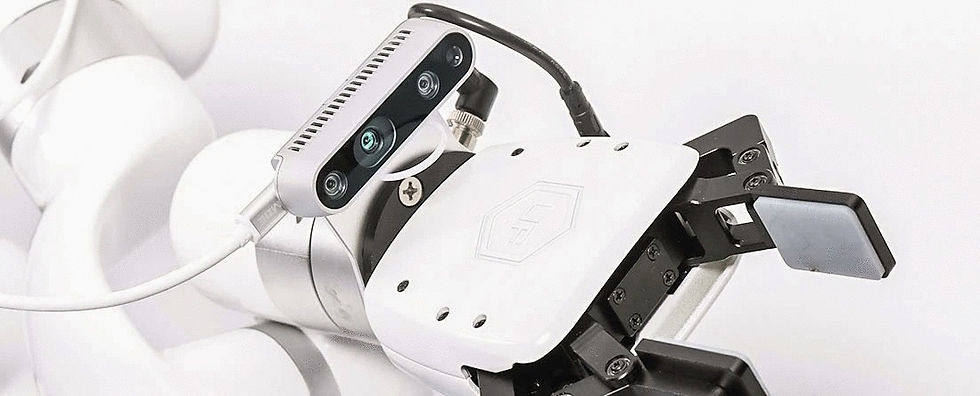
Blue Sky Robotics offers the Fairino collaborative robot line with the explosion-proof option available across every model: the FR3, FR5, FR10, FR16, FR20, and FR30. Whether your application calls for a compact arm handling small components or a higher-payload arm managing larger parts and heavier spray equipment, there's a Fairino configuration rated for your paint environment.
Pricing for the Fairino line starts at accessible levels compared to traditional industrial paint robots, and the explosion-proof option is built into the product rather than treated as a premium specialty item. You're not navigating a different catalog or waiting on a specialty order. You're choosing the explosion-proof configuration of a standard, in-production robot.
Browse the full Fairino robot lineup or use the Cobot Selector to match the right model to your payload, reach, and application requirements.
Pairing an Explosion-Proof Fairino with the AutoCoat Kit
An explosion-proof arm is the foundation, but it's not the complete finishing cell. You also need the spray tooling, applicator mounting, and process configuration that turns a robotic arm into a functional paint robot. That's what the AutoCoat System provides.
AutoCoat is a finishing kit, not a standalone robot, that adds spray coating capability to your existing or newly purchased robotic arm. It starts at $9,999 and is configured through a consultation process to match your specific coating material, part geometry, and production volume. The Fairino explosion-proof arm and the AutoCoat kit are the natural pairing for a component shop building a paint cell from the ground up.
Blue Sky Robotics customers who've made this combination have achieved a 70% reduction in paint usage and ROI in as little as three months, primarily from eliminating the overspray that manual spraying makes inevitable.
Practical Checklist: Is Your Paint Environment Hazardous?
If you're unsure whether your coating environment requires explosion-proof equipment, work through these questions:
Do you use solvent-based paints, lacquers, primers, or clear coats? If yes: explosion-proof required.
Do you use solvent-based cleaning agents to purge spray lines or guns between colors? If yes: explosion-proof required.
Is your spray area enclosed or semi-enclosed, limiting natural air circulation? Higher risk of vapor accumulation.
Are you applying powder coatings? Powder in suspension is also combustible, explosion-proof equipment is the correct choice.
Are you exclusively using water-based coatings with no solvent cleaning agents? Lower risk, but still worth discussing with your equipment supplier.
When in doubt, specify explosion-proof. The cost difference between a standard and explosion-proof Fairino configuration is not the kind of expense that should be the deciding factor, but deploying the wrong equipment in a hazardous environment absolutely can be.
Getting Started
The explosion-proof requirement is one of the first things Blue Sky Robotics works through during the AutoCoat consultation process. When you book a session, come prepared to describe your coating materials and spray environment. That information directly determines which Fairino configuration is right for your application and how the AutoCoat kit gets spec'd.
You can also use the Automation Analysis Tool to assess the feasibility and ROI of automating your specific finishing process before you get on the phone.
For a broader overview of robotic painting for component shops, read the full guide: Paint Robots for Automotive: The Practical Guide for Component Shops.