

Paint Robots for Automotive: The Practical Guide for Component Shops
- Feb 25
- 9 min read
Updated: Mar 4
When most people picture a paint robot in the automotive industry, they imagine a cathedral-sized booth at a Volkswagen plant, a row of explosion-proof arms swinging in choreographed arcs over a conveyor of car bodies, and a price tag somewhere north of $150,000. That image is real. But it's only half the story, and it's the half that doesn't apply to most manufacturers.
The other half is a bracket fabricator spraying 400 parts per shift with two employees and a respirator. It's a sign manufacturer running base coats on large batches by hand, watching paint drift past the part and onto the booth walls. It's an automotive supplier coating housings, trim pieces, and bumper components in a mid-size shop where consistent finish quality is the difference between landing a contract and losing it.
These shops need paint robots too. And unlike the OEM giants, they don't have $100,000 to spend finding out. This guide is for them. We'll cover how paint robots work in automotive and component applications, what explosion-proof certification actually means for your shop, and how adding the right automation kit, starting at $9,999, can reduce your paint usage by 70% and pay for itself in as little as three months.
What Paint Robots Do in Automotive Applications
A paint robot is a robotic arm configured to hold and control a spray applicator, whether that's an air atomizer, airless gun, electrostatic bell, or powder coating gun, and follow a programmed path across a surface with consistent speed, distance, and spray angle.
In large automotive plants, this means coating full vehicle bodies: primer, base coat, and clear coat applied across an entire car shell moving down a conveyor. At that scale, manufacturers like FANUC, ABB, and Dürr dominate with systems engineered specifically for high-volume, explosion-hazard environments, with price tags to match.
But the underlying mechanics are the same whether you're painting a car door at BMW or a bracket at a Tier 3 supplier. The robot holds the applicator at a fixed distance from the surface, moves at a controlled speed, and applies the same path every single time. That consistency is what generates the savings, in paint, in labor, in rework. Most industrial paint robots run six axes of motion, giving them the flexibility to reach into recesses, follow complex contours, and handle parts that would require multiple setups with a fixed-position applicator.
The key variables for choosing a system are reach, payload, repeatability, and whether the environment requires explosion-proof certification, which, for any application using solvent-based coatings, it does.
The Market Nobody Talks About: Components, Parts, and Signage
Every article written about automotive paint robots targets OEM production. The content from ABB, FANUC, and even newer players like Standard Bots is almost entirely focused on painting full vehicle bodies, chassis, doors, hoods, trunk lids, in facilities running hundreds of units per day.
That leaves a wide swath of manufacturers underserved and underinformed. Tier 2 and Tier 3 automotive suppliers coat components at every stage of the supply chain: housings, brackets, structural parts, interior trim, under-hood components, and exterior finishing pieces. These shops run high-mix, moderate-volume production where part changeovers are frequent and finish consistency is still a hard customer requirement. Manual spraying introduces variability that shows up in quality audits. Robotic spraying eliminates it.
Sign manufacturers face a similar problem from a different direction. Large-batch base coat applications on signage panels require the same consistency and material efficiency that automotive component painters need. The parts are different; the spray path logic is the same. And the cost of paint waste, from overspray, uneven coverage, and rejected pieces, adds up the same way.
What both markets share: they need automation that's purpose-built for finishing applications, explosion-proof rated, and priced for a real manufacturing budget, not a Fortune 500 capital allocation. This is exactly where the AutoCoat System from Blue Sky Robotics fits.
Explosion-Proof Robots: What It Means and What It Costs
Here's where a lot of buyers get tripped up. They research cobots, find something they can afford, and then discover that operating a standard robot arm in a painting environment, where solvent vapors can accumulate, creates a genuine explosion risk. The standard cobot you'd use for pick-and-place or machine tending is not rated for this environment.
Explosion-proof robots are built to prevent electrical components from igniting flammable vapors. The wiring, servo drives, and enclosures are all designed for use in hazardous areas where solvent-based paints, lacquers, or primers are present. This isn't optional, any paint shop using solvent-based coatings needs explosion-proof equipment, full stop.
The good news for Blue Sky Robotics customers: the explosion-proof configuration is available across the entire Fairino robot line. Whether you're looking at the Fairino FR3, FR5, FR10, FR16, FR20, or FR30, you can spec an explosion-proof arm that's cleared for real paint shop deployment, and pair it with the AutoCoat kit to build a complete finishing cell.
This is a meaningful distinction from the broader cobot market, where explosion-proof variants are often separate SKUs, sometimes requiring third-party integration. With Fairino, the capability is built in from the start.
The Real ROI of Robotic Painting for Component Shops
Let's talk numbers, specifically the ones that make a CFO approve the purchase order.
One of Blue Sky Robotics' signage customers added the AutoCoat kit to their existing robotic setup for base coat application on large batches of sign panels. The result: a 70% reduction in paint usage, driven by two factors. First, robotic spray paths eliminate the overspray that's endemic to manual application, the paint goes on the part, not the booth wall, the floor, and the surrounding air. Second, consistent gun distance and speed means the right film thickness is applied every pass, with no excess to compensate for human variability. That customer achieved full return on investment within three months.
To understand why that's possible, consider what paint actually costs at production scale. Industrial coatings aren't cheap, a quality automotive-grade primer or topcoat can run $40–$80 per gallon, and manual sprayers routinely waste 30–50% of material to overspray. On a production line running hundreds of parts per shift, that waste compounds fast. Cutting paint consumption by 70% against that baseline isn't a marginal improvement, it's a budget line transformation.
Beyond material savings, robotic painting eliminates the variability that generates rework. Every rejected part that goes back through the booth for a respray costs paint, booth time, and labor. Consistent film builds from the first pass reduce rejects and the downstream costs they create.
The AutoCoat System: A Finishing Kit for Your Existing Robot
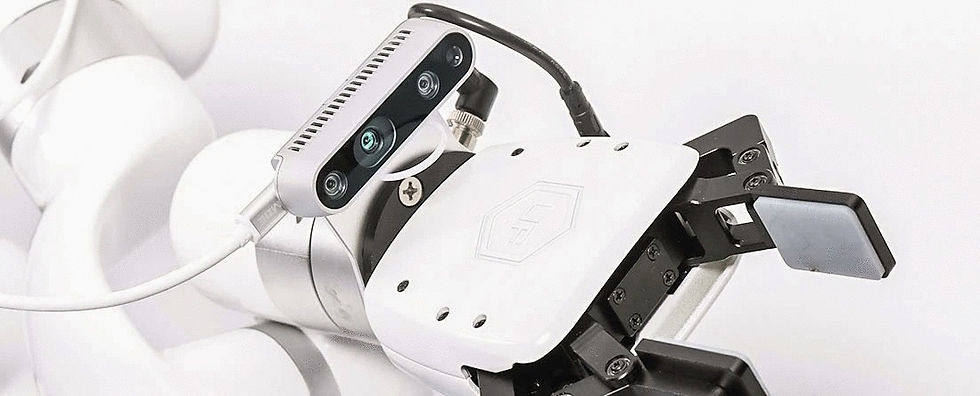
The AutoCoat System from Blue Sky Robotics is a finishing kit designed to add robotic paint, powder coating, and adhesive capability to your existing robotic arm setup. It's not a standalone machine, it's an add-on that transforms a cobot you already have (or are planning to purchase) into a purpose-built finishing cell.
The AutoCoat System starts at $9,999. Because every coating application is different, part geometry, coating material, batch size, and spray pattern all affect what the kit needs to include, final pricing is determined through a consultation process. Blue Sky Robotics works with each customer to specify the right configuration for their process before generating an accurate quote. There's no guessing and no surprise add-ons after the fact.
If you're also in the market for a robotic arm to pair with AutoCoat, Blue Sky Robotics recommends the Fairino line, specifically the explosion-proof configuration, which is required for any solvent-based coating environment. The Fairino FR3 through FR30 covers a wide range of reach and payload requirements, and Blue Sky Robotics can help spec the right model for your parts during the same consultation. Browse the Fairino robot lineup or use the Cobot Selector to narrow down the right arm for your application.
AutoCoat vs. Industrial Paint Robots: An Honest Comparison
It's worth being direct about where the AutoCoat System fits, and where it doesn't, relative to industrial paint robots from FANUC, ABB, and Dürr.
Those systems are engineered for one thing: painting complete vehicle bodies at OEM volume. The ABB IRB 5500 has a 2.5-meter reach designed to cover an entire car exterior. Dürr's EcoRP series extends five meters into vehicle bodies. These are impressive machines solving a specific, high-volume problem, and they're priced accordingly, typically $60,000 to $200,000+ before integration, booth construction, and paint delivery systems.
For a shop painting bumper covers, brackets, trim components, or sign panels in batches, that's not the right tool. You don't need 2.5 meters of reach to coat a housing. You need consistent coverage, efficient material usage, explosion-proof certification, and a system that doesn't require a dedicated robotics team to program and maintain.
Standard Bots' RO1 positions itself as the "affordable" option in this space at $37,000 for the arm alone , before any finishing-specific tooling. The AutoCoat kit starts at $9,999 and is configured specifically for your coating process, not retrofitted from a general-purpose platform.
The honest answer: if you're painting full car bodies on an OEM line, call ABB. If you're coating components, parts, and batches on a real shop budget, and especially if you already have a cobot or are shopping for one, the AutoCoat System is worth a serious conversation.
How to Choose the Right Paint Robot Setup for Your Operation
Before you buy anything, work through these four questions.
What are you painting?
Part geometry drives reach and axis requirements. A flat panel needs less articulation than a complex housing with interior surfaces. The Fairino line covers a wide range of reach and payload configurations, use the Cobot Selector to match the right arm to your specific part, then bring that information into your AutoCoat consultation.
What coating are you applying?
Solvent-based paints, lacquers, and primers require an explosion-proof robot, no exceptions. Water-based coatings are less demanding. Powder coating requires different applicator tooling. The AutoCoat kit is configured during consultation to match your specific coating material and process, so you're not paying for components your application doesn't need.
Do you already have a cobot?
The AutoCoat System is a kit that adds to your existing robotic arm, it doesn't include one. If you already have a compatible cobot, you may be closer to automated finishing than you think. If you're starting from scratch, Blue Sky Robotics can help you spec a Fairino arm alongside the AutoCoat kit so both are optimized for your application from day one.
What does your ROI timeline need to look like?
Use paint savings as your primary calculator. If you know your current monthly paint spend and your overspray rate, a 70% reduction in material consumption gives you a concrete first-year savings number to stack against your investment. The Automation Analysis Tool on the Blue Sky Robotics site can help you build this calculation for your specific operation.
If you want to discuss your process and get an accurate quote, book a 30-minute consultation with Blue Sky Robotics directly.
The Bottom Line
Paint robots in the automotive industry aren't a new idea, they've been on OEM lines since the 1980s. What's new is the accessibility. The finishing capability that used to require a $150,000 capital commitment is now available as a kit you add to a cobot you already own, starting at $9,999 and configured specifically to your process. That changes the math for component shops, parts manufacturers, and large-batch operations that have been absorbing the cost of manual painting because they assumed automation wasn't in their budget.
It is. And if a signage manufacturer can recover that investment in three months through paint savings alone, the question isn't whether to automate, it's how soon you can get the right kit on your floor. Explore the AutoCoat System, use the Automation Analysis Tool to model your own ROI, or book a consultation to get an accurate quote for your specific coating process.
Frequently Asked Questions
Do paint robots require explosion-proof certification?
Yes, for any application using solvent-based coatings, lacquers, or primers. If you're pairing the AutoCoat kit with a new arm, Blue Sky Robotics recommends the explosion-proof configuration of the Fairino line, which is available across all Fairino models.
Does the AutoCoat System include a robotic arm?
No. The AutoCoat System is a finishing kit that adds to your existing robotic arm setup. If you need an arm, Blue Sky Robotics can help you spec and source a compatible Fairino cobot alongside the AutoCoat kit.
How much does the AutoCoat System cost?
The AutoCoat System starts at $9,999. Because every coating process is different, coating material, part geometry, batch size, and spray pattern all affect the configuration, final pricing is determined through a consultation with the Blue Sky Robotics team to ensure you're quoted accurately for your specific application.
How quickly does automated painting pay for itself?
ROI depends on your current paint spend and overspray rate. Blue Sky Robotics customers have achieved full payback in as little as three months, primarily from a 70% reduction in paint usage through elimination of overspray and consistent film application.
Can the AutoCoat System handle multiple part types?
Yes. The robotic arm paired with AutoCoat can store multiple spray programs, allowing fast changeovers between different parts or coating sequences, well-suited for the high-mix production environments common in component shops and sign manufacturers.
Is AutoCoat only for automotive applications?
No. While it's well-suited for automotive component painting, the AutoCoat kit works across any application requiring consistent batch coating, including signage base coats, industrial parts finishing, powder coating, and adhesive application.