

Choosing the Right Robotic Arm Software for Industrial Efficiency
- Nov 19, 2025
- 5 min read
Industrial automation increasingly relies on software to translate mechanical capability into measurable productivity gains. Robotic arm software has become the connective tissue between hardware, sensors and enterprise systems, enabling manufacturers and warehouses to boost throughput, cut cycle times and reduce defects while maintaining consistent quality. For Blue Sky Robotics’ audience in manufacturing, warehousing and automation, understanding the software layer is essential to unlocking those benefits and aligning robotics investments with business goals.
Choosing the right control and orchestration platform directly improves flexibility, precision and scalability, allowing cells to adapt to product variation, execute tighter tolerances and grow without costly rework. As robotics and AI software converge, systems now offer smarter motion planning, adaptive vision and predictive maintenance that translate to faster ramp-up and lower total cost of ownership. The next sections outline the selection criteria, core features, integration and deployment considerations, and practical measures of ROI you should use when evaluating options; we begin by defining the key selection criteria manufacturers should apply.
Understanding Robotic Arm Software and Its Core Functions
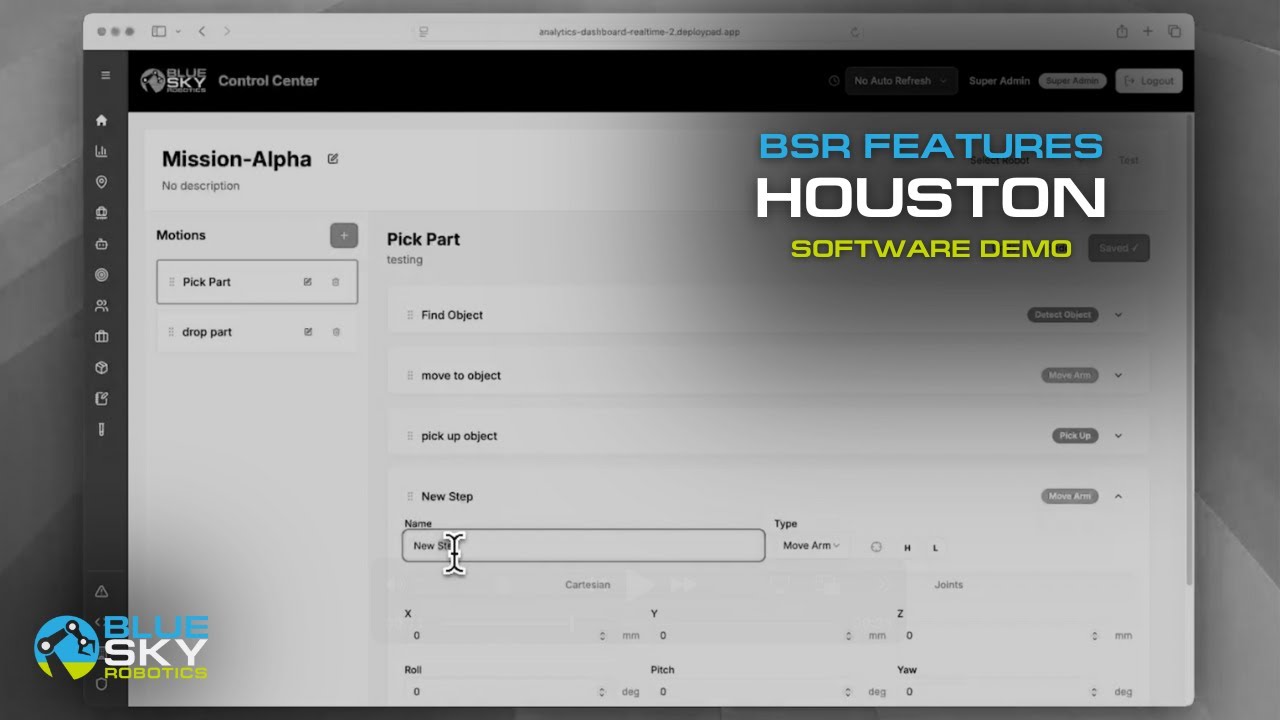
Robotic arm software is the middleware that turns high-level task descriptions into coordinated actuator commands, sensor-driven feedback loops, and safety interlocks; it is responsible for programming, motion control, and task automation while ensuring repeatable, precise motion across production cycles. Modern industrial deployments increasingly combine deterministic control with higher-level orchestration and AI-driven decision layers, which improves throughput and reduces downtime across mixed-production lines. For a concise industry overview of how control and orchestration connect on the factory floor, see programming, motion control, and task automation, which outlines these trends and practical implementations.
Choosing between proprietary and open-source robotic arm software affects access to vendor support, customization, and integration effort: proprietary suites often provide turnkey compatibility and certified drivers, while open-source frameworks offer flexibility and faster innovation but may require more integration work. Compatibility with existing PLCs, motor controllers, and safety systems is critical; robust software provides modules for path planning, machine vision integration, and real-time monitoring to ensure accuracy and traceability on the shop floor. By prioritizing interoperability and modular architectures, manufacturers can lift precision, scalability, and adaptability, especially as robotics and AI software converge to enable smarter, more autonomous production lines.
Key Criteria for Selecting Robotic Arm Software
When evaluating robotic arm software for industrial automation, prioritize core selection factors such as ease of integration, user interface design, scalability, and security so the platform can be rapidly deployed across existing PLCs, MES, and edge devices. Interoperability with Industrial IoT and AI systems is essential for feeding sensor data and analytics into motion planning and adaptive control loops, which in turn improves flexibility, precision, and scalability on the shop floor. A well-designed user interface reduces engineering time and error rates, while built-in security and scalable architectures protect IP and support growth from a single cell to enterprise-wide fleets.
Beyond technical fit, vendor support, transparent licensing models, and clear total cost of ownership are practical decision drivers when choosing robotic arm software, especially for long-term maintenance and upgrades. Evaluate software capability with real-world performance metrics such as cycle time, positional repeatability, task success rate, latency/throughput under load, and mean time between failures (MTBF) during pilot runs or benchmarks to validate cost-effectiveness and reliability. Combining these quantitative metrics with a vendor’s service commitments and integration roadmap yields a defensible choice that aligns robotics and AI investments with production goals.
Comparing Leading Robotic Arm Software Solutions
When selecting robotic arm software, engineers should weigh the differences between ROS, ABB RobotStudio, and FANUC ROBOGUIDE; the trade-offs between open, modular ecosystems and vendor-tuned suites directly affect development speed, integration effort, and long-term flexibility. ROS excels at customization, package sharing, and integrating AI-driven perception and motion planning, while RobotStudio and ROBOGUIDE provide polished offline programming, high-fidelity simulation, and manufacturer-specific toolchains that shorten commissioning. A survey of major software platforms highlights these distinctions, helping teams match tool capability to project requirements.
Cloud-based offerings simplify fleet management, remote monitoring, and over-the-air updates, enabling scalable deployments and data-driven optimization, whereas on-premises solutions preserve low-latency control and satisfy strict security or regulatory needs. In practice, hybrid architectures are increasingly common: manufacturers run real-time control locally while using cloud analytics to refine AI-driven motion profiles, producing measurable improvements in cycle time, precision, and overall equipment effectiveness across pick-and-place, welding, and assembly use cases. Compatibility also differs: vendor suites typically offer deep integration with their robot models and proprietary programming environments, while ROS and middleware prioritize broad hardware support and multi-vendor interoperability, so software choice should align with desired scalability, tooling, and future automation roadmaps.
Frequently Asked Questions
What is the difference between robotic arm hardware and software?
Hardware refers to the robotic arm’s physical components, actuators, joints, sensors, end-effectors and the mechanical frame, while software handles motion control, path planning, task sequencing, safety logic and higher‑level behaviors such as vision or AI-driven decision making. Together they form a closed‑loop system where sensor feedback and control algorithms translate software plans into precise, repeatable motion, delivering the speed, accuracy and uptime industrial automation demands. Choosing the right software therefore improves flexibility, precision and scalability by simplifying integration, enabling advanced analytics and AI capabilities, and making it easier to reconfigure production for new tasks.
Can robotic arm software be updated remotely?
Yes, modern robotic arm platforms commonly support secure over‑the‑air updates and model deployments so manufacturers can roll out performance improvements, security patches and AI-driven control upgrades without physical intervention, which helps maintain and enhance production efficiency while improving flexibility, precision and scalability. To ensure safe and reliable update processes, organizations should use authenticated, encrypted update channels, staged rollouts with rollback capability, pre-deployment testing in simulation or sandbox environments, scheduled maintenance windows and real‑time monitoring to detect issues rapidly. Choosing robotic arm software that includes built‑in secure update management, version control and compatibility checks aligns with smart automation strategies and lets factories continuously optimize operations with minimal disruption.
How does AI enhance robotic arm software performance?
AI enhances robotic arm software performance by enabling adaptive learning that refines motion planning and grasp strategies from real-time sensor feedback, predictive maintenance that analyzes operating data to forecast wear and schedule interventions before failures occur, and autonomous task optimization that streamlines sequencing and on-the-fly decision-making for higher precision. Together these capabilities cut downtime, improve production cycle accuracy, and, when paired with the right robotic arm software, deliver greater flexibility, scalability, and throughput for industrial automation projects pursuing smart, AI-driven efficiency.
The Horizon of Automated Systems
The rise of factory automation heralds a new era of increased efficiency and yield. Through the smart application of robotics, cobots, and software, industry leaders have significantly streamlined their operations, realizing unprecedented levels of productivity. Safety, often compromised in manually intensive settings, has seen substantial enhancements with the adoption of automated systems. The risk-prone, human element can be progressively replaced with diligently precise machines, safeguarding workers, and thereby strengthening the operational backbone.
As we look to the future, the horizon expands further. The coming years promise an exciting phase where Artificial Intelligence and Machine Learning become the cornerstones of automated systems. A world where machines not only perform tasks but learn, adapt, and optimize. Embrace the change, welcome the efficiency, and secure your future with Blue Sky Robotics' advanced automation solutions. Speak to our experts today and begin your journey towards the future of manufacturing. Because at Blue Sky Robotics, we're not just building machines, we're architecting tomorrow.