



3D Machine Vision Cameras, Software, and Measurement Tools: How the Full System Works
- 2 days ago
- 6 min read
A 3D machine vision system is not a single product. It is a stack of three components that have to work together: a camera that captures depth data, software that interprets that data and makes decisions, and measurement tools that translate point cloud information into actionable outputs like coordinates, dimensions, or pass/fail results.
Most buyers focus on the camera and underinvest in understanding the software. That is a mistake. The camera determines the quality of the raw data. The software determines what you can actually do with it.
This post covers how each layer of a 3D machine vision system works, what to look for when evaluating each one, and how Blue Sky Robotics approaches the full stack for its cobot deployments.
The 3D Machine Vision Camera
A 3D machine vision camera is an optical device that captures depth information alongside standard image data, producing a three-dimensional representation of the scene. Instead of a flat pixel grid, the output is a point cloud: a collection of points in X, Y, and Z space that maps the exact position of every surface in the camera's field of view.
There are two main acquisition formats.
Area Scan Cameras
Area scan cameras capture the entire field of view in a single frame. These are the most common type for robot guidance, bin picking, and stationary inspection. Structured light, time-of-flight, and stereo vision cameras are typically area scan.
Line Scan Cameras
Line scan cameras sweep a laser or light line across the object as it moves past on a conveyor, building up a 3D profile line by line. These are used in high-speed inline measurement and surface inspection on continuous production lines.
Key specifications to evaluate when selecting a 3D machine vision camera:
Working distance: The range at which the camera produces usable depth data. Bin picking cells typically need 0.5 m to 2 m. Wide-area applications may need 3 m or more.
Point cloud density and accuracy: How many points per unit area and how precisely each point's Z position is measured. VDI/VDE accuracy ratings are the standard benchmark.
Material handling: How the camera performs on shiny metals, transparent plastics, and dark rubber. Most failures in production come from material properties, not mechanical issues.
IP rating: Industrial deployments need at minimum IP54. IP65 is the standard for demanding environments.
Frame rate: How quickly the camera can produce a new point cloud. Relevant when parts are moving or cycle time is constrained.
3D Machine Vision Software
The camera captures the data. The software decides what it means and what the robot should do next.
3D machine vision software handles several distinct functions.
Pose Estimation
The process of determining the 3D position and orientation of an object within the camera's field of view. This is the core function for robot guidance: once the software knows where a part is and how it is oriented in all six degrees of freedom, it can calculate the optimal grasp point and approach vector for the robot arm.
Object Detection and Segmentation
Identifies which parts of the point cloud correspond to the target object versus the background, bin walls, or other objects. In a cluttered bin, this means isolating individual parts from a pile and selecting the best candidate to pick based on accessibility and grasp confidence.
Path Planning and Collision Avoidance
Translates the grasp point into a motion path the robot can execute without colliding with the bin, other parts, or surrounding fixtures. This is handled in software, not hardware.
Quality Inspection Logic
Compares measured dimensions or surface geometry against reference models or tolerance specifications and generates pass/fail outputs. This function is the core of 3D measurement software for inline quality control.
Integration and Communication
Handles how the vision software talks to the robot controller. In well-designed systems, this happens without custom middleware: the vision system outputs coordinates or commands that the robot controller receives directly over a standard interface.
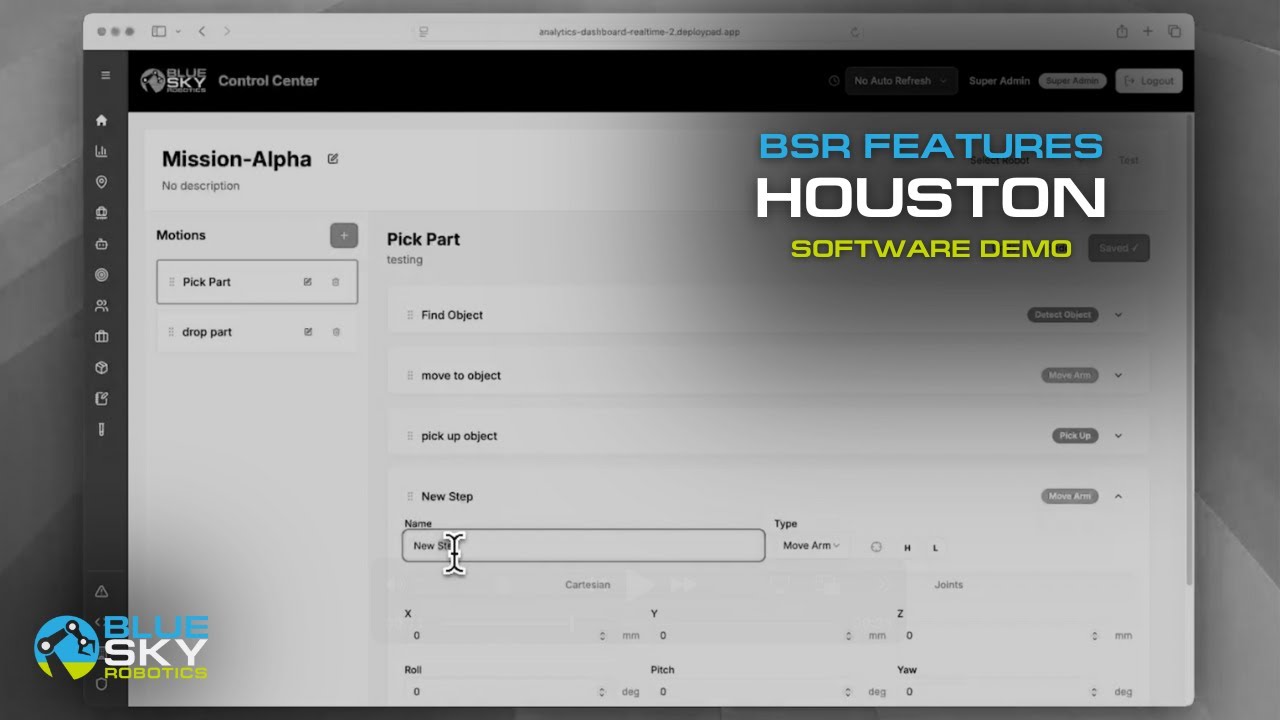
Blue Sky Robotics integrates all of these functions into a single platform via Blue Argus. Pose estimation, object detection, path planning, inspection logic, and robot communication are handled in one environment, trained on customer-specific parts and environments rather than generic datasets.
3D Measurement Software
3D measurement software is the specialized layer used when the output needed is not a grasp coordinate but a dimensional measurement: a length, a gap, a surface profile, a volume, or a tolerance check.
This matters in two distinct contexts for manufacturing.
Inline Dimensional Inspection
Uses a 3D camera mounted over a production line to measure each part as it passes, comparing geometry against a CAD model or statistical tolerance band. Parts outside specification are flagged automatically without stopping the line. This replaces manual sampling with 100% inspection at production speed.
Robot-Integrated Measurement
Combines the robot's positioning capability with the camera's dimensional accuracy to measure features that require multiple viewpoints. The robot moves the camera to the measurement position, the software captures the geometry, and the result feeds directly into a quality record or control chart.
Key capabilities to look for in 3D measurement software:
CAD comparison: the ability to register a point cloud against a reference model and calculate deviation across the full surface
GD&T tools for measuring flatness, roundness, parallelism, and other form tolerances
Statistical process control output for feeding measurement data into upstream quality systems
No-code or low-code setup for operators who do not have metrology engineering backgrounds
How the Three Layers Work Together
In a well-integrated 3D machine vision system, the camera, software, and measurement tools operate as a single pipeline with no manual hand-off between layers.
The camera captures a point cloud. The software processes it to identify the object, estimate its pose, and either guide the robot to pick it or measure its geometry. The measurement output feeds into a quality record or a robot motion command. The whole cycle repeats in seconds.
Where systems break down is usually at the integration points between layers: a camera that produces good point clouds but whose data format requires custom conversion before the software can process it, or a measurement tool that runs on a separate PC with no direct connection to the robot controller. The more these layers operate independently, the more integration overhead and failure modes the system carries.
Blue Sky Robotics uses RealSense depth cameras with its Blue Argus platform precisely because the integration is native. The camera, pose estimation software, and robot communication are designed to work together without a custom middleware layer.
The most commonly deployed arms for 3D machine vision applications are the Fairino FR5 ($6,999) for light to mid-range applications, and the Fairino FR10 ($10,199) for heavier parts or larger work envelopes. Use the Cobot Selector to find the right arm for your application, or book a live demo to see the full system running on a real use case.
Conclusion
A 3D machine vision system is only as strong as its weakest layer. The camera determines raw data quality. The software determines what decisions the system can make. The measurement tools determine the accuracy and utility of the output.
Blue Sky Robotics builds all three layers into a single integrated platform via Blue Argus, designed to work with Fairino and UFactory cobot arms without custom integration work. Explore the full robot lineup to find the right arm for your 3D vision application.
Frequently Asked Questions
What is a 3D machine vision camera?
A 3D machine vision camera is an industrial optical device that captures depth information alongside standard image data, producing a point cloud that maps the X, Y, and Z position of every surface in the field of view. It is the hardware foundation of a 3D vision-guided robotics system.
What does 3D machine vision software do?
3D machine vision software processes the point cloud from the camera to estimate object pose, detect and segment parts, plan robot motion paths, avoid collisions, and execute quality inspection logic. It is the layer that translates raw depth data into robot commands or measurement outputs.
What is 3D measurement software used for in manufacturing?
3D measurement software is used for inline dimensional inspection, CAD comparison, and GD&T analysis. It allows manufacturers to measure part geometry at production speed and compare measurements against tolerance specifications without manual sampling or offline coordinate measuring machines.
What 3D machine vision system does Blue Sky Robotics use?
Blue Sky Robotics uses RealSense depth cameras integrated into its Blue Argus computer vision platform. The system handles pose estimation, object detection, robot guidance, and quality inspection in a single integrated environment, trained on customer-specific parts and environments.


