



2D vs 3D Machine Vision Systems: Which One Does Your Automation Actually Need?
- May 18
- 6 min read
Not every robotic application needs the same vision system. Choosing 3D where 2D is sufficient adds cost and complexity with no meaningful benefit. Choosing 2D where 3D is required means building a system that will fail the moment parts arrive in a different orientation.
The machine vision market is growing fast, projected to reach $41 billion by 2030, and both 2D and 3D segments are expanding. But they are expanding into different applications, and understanding the distinction is the first step toward choosing a system that actually works in production.
This post covers how 2D and 3D machine vision systems work, where each performs best, how they compare in cost, and where Blue Sky Robotics' vision platform fits into the picture.
What Is a 2D Machine Vision System?
A 2D machine vision system captures a flat, pixel-based image of a scene and processes it using algorithms that analyze brightness, contrast, edges, patterns, and color within a single plane.
The system sees length and width. It does not see depth.
That is not a limitation for many applications. 2D vision is fast, cost-effective, and entirely sufficient when the information needed is on the surface of the object and the object itself is reasonably flat or always oriented the same way.
Strong applications for 2D vision include:
Barcode and QR code reading for traceability
Label verification and print inspection
Presence/absence checks: is the cap seated, is the label applied, is the connector populated
Surface defect detection on flat materials: scratches, stains, discoloration
OCR for part number and date code verification
High-speed sorting where all items pass through in a consistent orientation
2D systems currently hold 59.7% of the machine vision market in 2026. They dominate high-volume, high-speed inspection lines where the application is well-defined and parts are presented consistently.
What Is a 3D Machine Vision System?
A 3D machine vision system adds depth, the Z-axis, to the X and Y data captured by a 2D system. Instead of a flat image, it produces a point cloud: a three-dimensional map of where every surface in the scene actually is in space.
There are four primary technologies used to generate 3D depth data.
Structured Light
Projects a known pattern onto the scene and measures how it deforms across surfaces to calculate depth. Accurate and well-suited to stationary inspection.
Time-of-Flight (ToF)
Measures how long it takes for a light pulse to return from each surface. Fast and good for large work volumes, which is why it is common in bin picking applications.
Stereo Vision
Uses two cameras positioned at slightly different angles to calculate depth from the disparity between their images. Useful in passive sensing environments.
Laser Triangulation
Uses a laser line projected at an angle to measure depth as an object passes through the scan zone. High resolution along the scan axis, widely used on conveyor inspection lines.
Strong applications for 3D vision include:
Bin picking: parts in random orientations where position and tilt must be known in all three axes
Volumetric measurement: height, width, and depth of objects on a conveyor or in packaging
Complex surface inspection: solder joints, machined profiles, weld seams
Robot guidance for pick and place where part orientation is inconsistent
Assembly verification for components that must be seated at a specific depth or angle
Depalletizing where layer geometry varies
2D vs 3D Machine Vision: Head-to-Head Comparison
Depth perception: 2D has none. 3D captures full X, Y, and Z data as a point cloud.
Best for: 2D excels at surface inspection, code reading, and flat parts. 3D is required for bin picking, robot guidance with variable part positions, and volumetric measurement.
Cost: 2D systems have a lower entry point. 3D systems require higher initial investment but deliver stronger ROI for complex applications.
Speed: 2D is faster for simple tasks. 3D processing is slower but improving rapidly as hardware and software advance.
Lighting sensitivity: 2D systems are more affected by ambient light variation. Structured light and ToF-based 3D systems are more robust.
Robotics integration: 2D is limited to applications where parts arrive in consistent positions. 3D supports full 6-axis guidance with pose estimation across variable environments.
Where the Market Is Heading
The 2D machine vision market remains larger by volume, but 3D is growing faster. The adoption of collaborative robots for bin picking, flexible pick and place, and depalletizing is the primary driver. These applications cannot be reliably automated with 2D systems alone.
AI-based vision software is accelerating adoption of 3D in applications that were previously too variable or difficult to handle reliably. Systems that previously required extensive programming and controlled conditions now train on real production data and adapt to variation in lighting, part finish, and presentation.
The integration of 3D vision with cobot arms at accessible price points is bringing this technology into small and mid-size manufacturing operations that previously could not justify the investment.
How Blue Sky Robotics Approaches Machine Vision
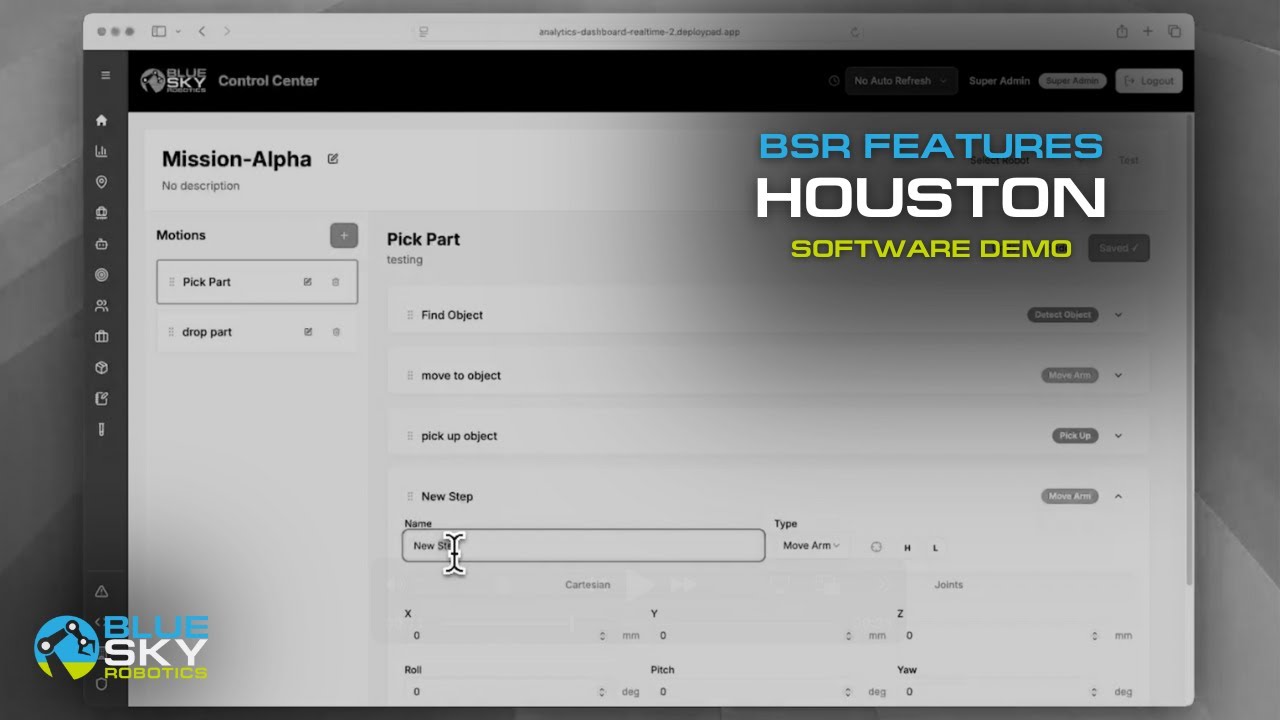
Blue Sky Robotics uses Intel RealSense depth cameras for 3D object detection, built into its automation software platform via Blue Argus. The system produces point cloud data for pose estimation and grasp planning, supporting bin picking, flexible pick and place, and inspection applications.
The platform is designed to be trained on customer-specific parts in the actual deployment environment. A model trained on your specific parts under your specific lighting conditions will outperform a generic system applied to the same application.
Key capabilities include:
3D pose estimation for bin picking and unstructured pick and place
Vision-based quality inspection integrated directly into the robot mission workflow
Real-time adaptive guidance that adjusts robot motion based on actual part position
No custom middleware required: vision and robot control operate in a single integrated platform
Which System Do You Need?
Start with the application, not the technology.
If your parts always arrive in the same position and orientation, and you need to verify surface quality, read a code, or confirm presence, 2D is likely sufficient and will cost less to deploy.
If your parts arrive in variable positions, are stacked or piled, require depth measurement, or need to be picked from a bin without pre-sorting, you need 3D.
Many production deployments use both: a 2D camera for fast barcode reading and cosmetic inspection, and a 3D sensor for robot guidance and volumetric measurement. The Blue Sky Robotics platform supports this architecture in a single integrated system.
Use the Cobot Selector to find the right arm for your vision-guided application, or the Automation Analysis Tool to estimate ROI for your specific use case. The Fairino FR5 ($6,999) is the most commonly deployed arm for 3D vision-guided applications in the Blue Sky lineup. For heavier parts, the Fairino FR10 ($10,199) covers payloads up to 10 kg with a 1,300 mm reach. Book a live demo to see 3D vision-guided automation running on a real application.
Conclusion
2D and 3D machine vision systems are not competing technologies. They solve different problems. The machine vision market is growing in both segments because manufacturers need both, often in the same facility or even the same cell.
The decision comes down to what your application actually requires. For anything involving variable part positions, depth measurement, or bin picking, 3D is the right foundation. For high-speed surface inspection and code reading with consistent part presentation, 2D handles the job at lower cost.
Blue Sky Robotics builds 3D vision into its automation platform via Blue Argus, integrated directly with Fairino and UFactory cobot arms. Explore the full robot lineup to find the right arm for your vision-guided application.
Frequently Asked Questions
What is the difference between 2D and 3D machine vision?
2D vision captures flat images and analyzes surface features like color, edges, and patterns. 3D vision adds depth data, creating a point cloud that allows measurement of height, volume, and orientation in all three axes.
Which is better: 2D or 3D machine vision?
Neither is universally better. 2D is faster and lower cost for surface inspection and code reading. 3D is essential for bin picking, robot guidance with variable part positions, and volumetric measurement. Many production lines use both.
What is the machine vision system market size?
The global machine vision market is projected to reach $41 billion by 2030, growing at around 12% annually. 2D systems hold approximately 59.7% of the market in 2026, with 3D growing faster driven by robotics adoption.
What 3D vision system does Blue Sky Robotics use?
Blue Sky Robotics uses Intel RealSense depth cameras integrated into its Blue Argus computer vision platform. The system supports pose estimation, bin picking, flexible pick and place, and quality inspection, working directly with Fairino and UFactory cobot arms.