



What Is Happening in 3D Vision AI Right Now and What It Means for Your Operation
- Apr 8
- 5 min read
Updated: Apr 13
The 3D vision AI space is moving faster in 2026 than it has at any point in the past decade. Research that was confined to academic papers two years ago is showing up in production-ready hardware and software today. What was true about the limits of vision-guided robotics twelve months ago may no longer be true now.
For manufacturers and distributors evaluating automation, that pace of change cuts both ways. It means more capable systems are available than ever before. It also means it is easy to base a buying decision on outdated assumptions about what the technology can and cannot do.
This post covers what is actually happening in 3D vision AI right now, what the developments mean in practical terms for real automation cells, and how to think about timing an investment in a space that is still actively evolving.
What Is Changing in 3D Vision AI in 2026
AI is filling the gaps that cameras leave behind - One of the most significant shifts in 3D vision AI is the growing role of machine learning in compensating for incomplete or noisy sensor data. When a 3D camera returns a sparse point cloud because a surface is reflective or partially occluded, AI models trained on large datasets can now predict and reconstruct the missing geometry rather than simply flagging the scan as a failure. MIT researchers demonstrated this approach using generative AI models to reconstruct the 3D shape of objects that are partially hidden or blocked from the sensor entirely. The practical implication for industrial automation is that the range of parts and surface types a vision-guided system can handle reliably is expanding, driven not by better cameras alone but by smarter software working on top of existing sensor data.
Edge computing is making real-time 3D perception practical - Processing a dense point cloud fast enough to direct robot motion in real time requires significant computing power. Until recently, that meant either a high-end workstation in the control cabinet or latency that limited cycle time. At NVIDIA GTC 2026, Aetina demonstrated high-precision 3D vision systems running on NVIDIA's Blackwell architecture at the edge, enabling sub-millisecond 3D perception processing without dependence on cloud connectivity or centralized compute. For production environments where network reliability cannot be guaranteed and cycle time matters, edge-based 3D vision processing is a meaningful step forward.
Humanoid robots are driving rapid investment in 3D vision - The race to build capable humanoid robots is accelerating development of 3D vision technology across the entire industry. RealSense demonstrated autonomous navigation using 3D vision and Visual SLAM at NVIDIA GTC 2026, enabling humanoid robots to build spatial maps of their environment and move safely through complex real-world spaces. The investment flowing into humanoid perception systems is producing better cameras, better software, and better integration platforms that are also available to conventional industrial robot arms. What gets developed for humanoids tends to find its way into standard cobot deployments within a product cycle or two.
Vision-language models are changing how robots understand tasks - Researchers at the Technical University of Munich developed a system that combines 3D vision with language-based AI to locate objects by understanding contextual relationships, not just visual features. The robot builds a spatial map of the environment and predicts where a target item is most likely to be based on semantic understanding of how objects relate to human activity. In industrial terms, this points toward systems that can be instructed in plain language rather than programmed in robot-specific code, which has direct implications for how quickly new applications can be deployed and how much integration expertise a facility needs in-house.
What This Means for Operations Evaluating Automation Now
The developments above are not all production-ready today. Some are research demonstrations. Some are early-stage products. But the direction is consistent, and it matters for how you think about an automation investment right now.
The capability floor is rising - Systems available today are more capable than what was available eighteen months ago, and the systems available in eighteen months will be more capable still. If you have evaluated vision-guided automation previously and found it could not handle your specific parts or environment, that evaluation may be worth revisiting. The gap between what the technology could do and what your application requires may have closed.
AI compensation for sensor limitations is reducing the barrier to entry - Historically, operations with reflective parts, mixed-material environments, or variable lighting conditions were told vision-guided automation was not viable for them. AI-assisted point cloud reconstruction and deep learning-based recognition are changing that. More surface types and more challenging environments are becoming automatable without specialized sensing hardware.
Timing an investment in a fast-moving space - The pace of improvement in 3D vision AI creates a genuine tension for operations ready to automate now. Waiting always means potentially better technology, but it also means continued labor costs, ergonomic risk, and production variability in the interim. The right framework is to evaluate based on what is available and proven today, design the cell with flexibility for future software updates, and avoid over-indexing on hardware that cannot be upgraded as the software layer improves.
Which Robots Work Best with Today's 3D Vision AI Systems
The vision AI layer is evolving rapidly. The robot arm is a longer-lived asset that needs to match the physical requirements of the application regardless of which software generation it is running.
For lightweight piece picking, inspection, and collaborative applications, the UFactory Lite 6 ($3,500) and Fairino FR5 ($6,999) provide the repeatability needed to act on vision system outputs accurately in a compact footprint.
For general-purpose pick and place, palletizing, and material handling, the Fairino FR10 ($10,199) handles the majority of case weights and reaches a standard pallet footprint from a fixed mount. For heavier payloads or extended reach, the Fairino FR16 ($11,699) and Fairino FR20 ($15,499) provide the capacity without a full industrial footprint.
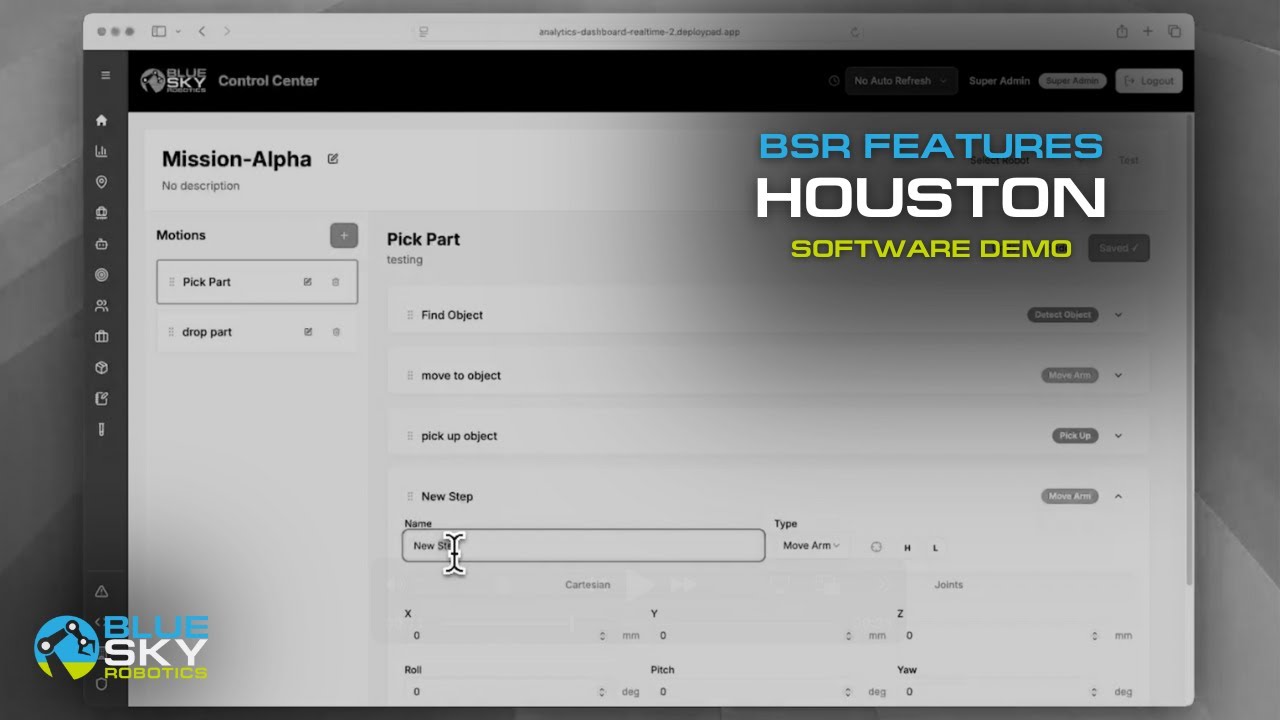
Blue Sky Robotics' automation software connects the latest 3D vision AI systems to robot motion in a unified platform, and the team stays current with the developments happening in the space so you do not have to.
Where to Start
If the pace of development in 3D vision AI has you watching and waiting, the Automation Analysis Tool is a practical way to evaluate what is viable for your specific application right now. The Cobot Selector matches the right arm to your payload and workspace. And if you want to see how current 3D vision AI systems perform on your specific parts and environment, book a live demo with the Blue Sky Robotics team. To learn more about computer vision software visit Blue Argus.
The technology is moving fast. The operations that engage with it now will be further ahead when the next generation arrives.
FAQ
How quickly is 3D vision AI improving?
The field is advancing rapidly. Developments that were research demonstrations in 2024 are showing up in production-ready software in 2026. The combination of better AI models, faster edge computing hardware, and larger training datasets is compressing the timeline between research and deployment significantly.
Will waiting for better technology mean a better automation system? Possibly, but waiting has its own costs. Labor expenses, ergonomic risk, and production variability continue while you wait. The more practical approach is to deploy a system matched to current proven technology, designed with software flexibility so it can benefit from improvements without a full hardware replacement.
Are developments in humanoid robots relevant to standard cobot applications?
Yes. The investment in perception systems for humanoid robots is producing better cameras, better point cloud processing software, and better integration tools that flow into standard cobot deployments. Improvements developed for humanoid navigation and manipulation make their way into industrial automation platforms within a relatively short product cycle.
How do I know if a 3D vision AI system is production-ready versus research-stage?
The practical test is whether it is available as a commercial product with a support structure behind it, not just a research paper or a conference demonstration. Blue Sky Robotics works with vision systems that are production-tested across real industrial deployments, which is a different standard than what gets presented at a research conference.


