



Vision Robotics: How Sight Is Transforming What Robot Arms Can Do
- Apr 8
- 4 min read
There is a moment in most automation conversations when a prospective customer says something like: "We could automate that, but the parts come in all different positions and we would need the robot to actually see what it is doing."
That moment used to be the end of the conversation. Today it is the beginning of one about vision robotics.
Vision robotics is the field that combines robot arms with camera systems and vision software to create machines that perceive their environment and act on what they see. It is not a single product or a fixed technology. It is a discipline that draws on computer vision, machine learning, mechanical engineering, and control systems to give robots the ability to handle tasks that require sight, spatial awareness, and the ability to adapt.
This post explains what vision robotics is, how the discipline has evolved, what it makes possible in practice, and how Blue Sky Robotics approaches it for manufacturers and distributors looking to automate today.
What Vision Robotics Actually Means
The simplest definition: vision robotics is the use of cameras and vision software to guide robot arm movements in real time.
In practice it covers a spectrum. At one end, a basic 2D camera mounted above a conveyor reads barcodes and tells the robot which bin to route a package into. At the other end, a 3D structured light camera produces a dense point cloud of a bin filled with metal parts, AI-powered vision software identifies pickable pieces and calculates grasp orientations, and the robot executes precise picks continuously without human intervention. Both are vision robotics. The complexity, cost, and capability differ by orders of magnitude.
What they share is the core feedback loop: the camera captures the scene, the vision software interprets it and produces actionable data, and the robot controller converts that data into physical movement. This loop is what separates vision robotics from traditional fixed-program automation, where the robot follows a preset path regardless of what it encounters.
How the Field Has Evolved
Industrial robots have existed since the 1960s. For most of that history, they operated without any visual perception. They were taught specific positions by a programmer, and they repeated those positions precisely. This worked well in highly controlled environments, automotive assembly lines, for instance, where nothing ever changed and every part arrived in exactly the right position.
The problem was that most manufacturing and logistics environments are not that controlled. SKUs change. Suppliers change. Parts arrive in different orientations. Products come in multiple sizes. Fixed-program robots required significant manual effort every time anything changed, which limited adoption outside of large-volume, single-product operations.
Vision robotics changed this by giving robots the ability to perceive variability and respond to it. The early systems used 2D cameras for simple presence detection and barcode reading. As 3D camera technology matured and became affordable, the scope of what vision robotics could handle expanded dramatically. Today, vision-guided robots pick randomly oriented parts from bins, palletize mixed-SKU loads, inspect parts for dimensional accuracy, and perform assembly tasks that would have required manual handling just a decade ago.
Machine learning has accelerated the trajectory further. Where early vision systems required painstaking manual programming of what each part looked like from every angle, modern systems train on image data and learn to recognize objects across variations in lighting, orientation, and occlusion without explicit programming for every case.
Vision Robotics Applications in Manufacturing and Logistics
The applications where vision robotics delivers the clearest ROI share a common trait: they involve variability that makes fixed-program automation impractical.
Bin picking is the canonical vision robotics application. Randomly oriented parts in an unstructured bin require 3D spatial awareness to locate and grasp reliably. No fixed program can handle a bin that looks different every time.
Flexible pick and place handles multiple SKUs in the same cell, identifying each item as it arrives and routing or placing it correctly. This is what makes automation viable for manufacturers who cannot dedicate a separate robot to every product.
Vision-guided palletizing and depalletizing manages mixed case sizes, variable pallet patterns, and non-uniform loads without reprogramming at each change.
Inline inspection pairs the robot's handling motion with camera-based quality checks, measuring dimensions, detecting defects, verifying assembly, combining two functions in a single cell.
Precision assembly uses vision feedback to correct for small positional errors before they affect product quality, enabling tighter tolerances than fixed-program placement can achieve.
Blue Sky Robotics' Approach to Vision Robotics
Blue Sky Robotics builds automation cells around cobots that support open vision integration. That means Python SDKs, ROS compatibility, and open APIs that connect the robot controller to any vision platform without proprietary lock-in.
For teams getting started with vision robotics, the UFactory Lite 6 ($3,500) paired with a stereo depth camera is the most accessible entry point. UFactory's open-source vision SDK includes camera integration examples for the Intel RealSense and Luxonis OAK-D cameras, reducing commissioning time significantly.
For production-grade vision robotics deployments, the Fairino FR5 ($6,999) covers the widest range of applications with a 5 kg payload, 924 mm reach, and full ROS support. For heavier vision-guided work including palletizing and bin picking of larger parts, the Fairino FR10 ($10,199) and Fairino FR16 ($11,699) provide the payload needed for production throughput.
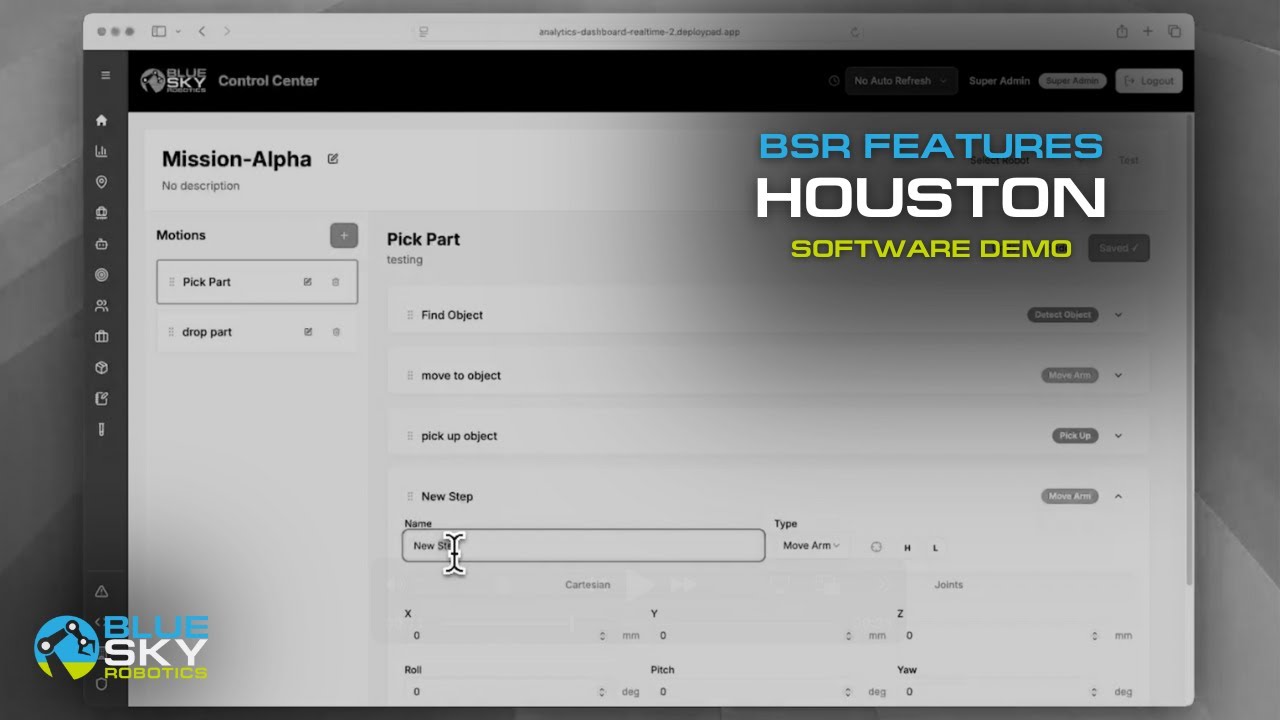
Our automation software handles the computer vision and mission-building layer, connecting camera input to robot output without requiring deep vision expertise to deploy.
Getting Started
Use our Cobot Selector to match an arm to your vision application, or the Automation Analysis Tool to model the ROI of a specific vision robotics deployment. When you are ready to see a working system, book a live demo.
Browse our full UFactory lineup and Fairino cobots with current pricing.
FAQ
What is vision robotics?
Vision robotics is the field that combines robot arms with cameras and vision software to create systems that perceive their environment and guide movements based on what they see. It enables robots to handle variable part positions, orientations, and types without fixed-program reprogramming.
How is vision robotics different from traditional industrial robotics?
Traditional industrial robots follow fixed, pre-programmed paths and require parts to be in consistent, predetermined positions. Vision robotics systems perceive the scene before each action and adapt their movements based on real-time visual data, allowing them to handle variability that would stop a fixed-program robot.
What industries use vision robotics most?
Manufacturing, logistics and warehousing, food and beverage, electronics, and automotive are the heaviest users. Any industry where parts, products, or loads arrive with variability in position, orientation, or type is a strong candidate for vision robotics.


