



Vision Guided Robot: How It Works and Where It Makes the Biggest Impact
- Apr 8
- 6 min read
Updated: Apr 13
Mention vision guided robots to a plant manager dealing with inconsistent product placement or frequent SKU changeovers and the reaction is usually the same: interest followed immediately by skepticism. The technology sounds compelling in theory, but the assumption has long been that vision-guided automation is expensive, fragile, and built for high-volume operations with dedicated integration teams.
That assumption is changing. The cameras, software, and robot arms that make up a vision guided robot system have become significantly more capable and more affordable. A small to mid-size manufacturer or distributor can now deploy a vision-guided cell for pick and place, palletizing, inspection, or finishing at a cost that makes the business case straightforward. Fairino cobots start at $6,999. A complete vision-guided cell is well within reach for operations that previously assumed automation was out of their budget.
This post covers how a vision guided robot works, what makes vision guidance different from fixed automation, and which arms Blue Sky Robotics recommends for the job.
What Vision Guided Robots Actually Are
A vision guided robot is a robotic arm paired with one or more cameras and software that interprets visual input and uses it to direct the robot's motion. Rather than following pre-programmed coordinates, the robot reads the scene in real time, identifies what it is looking at, determines the position and orientation of the target, and calculates the correct path of movement.
This is a significant departure from traditional fixed automation. Legacy systems require parts and products to arrive in precisely the same location and orientation every time. Change a box size, swap a SKU, or introduce any variability in how items are presented, and the system needs to be reprogrammed. A vision guided robot, by contrast, can locate an object wherever it lands on a conveyor, identify a case regardless of how it is rotated, or detect a surface defect without being told exactly where to look.
The vision system itself typically consists of a 2D or 3D camera, a lighting setup suited to the environment, and software that processes the image feed and translates it into positional data the robot controller can act on. In 3D applications, the camera produces a point cloud of the scene that gives the robot precise spatial information about depth and shape, not just a flat image.
Why Vision Guidance Changes the Equation
The practical value of a vision guided robot comes down to flexibility. Fixed automation makes sense when you are running one product, one packaging format, and one pallet pattern at high volume indefinitely. Most operations are not that simple.
Mixed SKUs, frequent changeovers, variable case sizes, and inconsistent product presentation are the norm for small and mid-size manufacturers and distributors. Vision guidance is what allows a single robot to handle all of it without requiring an integrator every time something changes.
A few specific advantages stand out.
No reprogramming for product changes - When a new SKU comes down the line, the vision software adapts. Operators interact with a graphical interface rather than rewriting robot paths. The system identifies the new item and adjusts its behavior accordingly.
Reliable recognition of difficult objects - 3D cameras produce detailed point clouds that allow the robot to distinguish between tightly packed cases, identify the top layer of a mixed load, pick from a disorganized bin, or detect surface anomalies that would be invisible to a fixed sensor.
Consistent performance across shifts - A vision guided robot does not get fatigued, distracted, or injured. It applies the same standard of precision at hour one and hour ten. For inspection tasks especially, that consistency translates directly into better quality output.
Where Vision Guided Robots Deliver the Most Value
Vision guidance is not a single use case. It is a capability that improves performance across a wide range of applications.
Pick and place - This is the most common starting point. Vision allows the robot to locate and pick items from unstructured environments: a moving conveyor, a bin of mixed parts, or a tote with no defined product placement. Blue Sky Robotics works with operations across logistics, food production, and manufacturing on pick and place cells that handle exactly this kind of variability.
Palletizing and depalletizing - Vision-guided palletizing uses a 3D camera mounted above the work area to give the robot real-time information about case position and orientation. The robot reads the scene, plans a collision-free pick path, and stacks without requiring every case to arrive in an identical position.
Mixed pallet patterns, variable case sizes, and angled items are all manageable.
Quality inspection - Cameras allow the robot to examine products for defects, dimensional inconsistencies, incorrect labeling, or surface flaws. Vision-guided inspection runs faster and more consistently than manual checking and produces a data trail that fixed sensors cannot.
Painting and surface finishing - In finishing applications, vision helps the robot map the surface of a part before applying paint, powder coat, or adhesive. Blue Sky Robotics' AutoCoat system uses this approach to deliver even coverage regardless of part variation, reducing waste and rework on each run.
Material handling and AS/RS - Vision-guided robots can identify products by label, shape, or barcode and route them correctly through automated storage and retrieval systems without manual intervention.
Which Robots Work Best for Vision Guided Applications
The right arm depends on the application, the payload requirements, and the workspace. Here is how the Blue Sky Robotics lineup maps to common vision-guided use cases.
Fairino FR5 ($6,999) is the most accessible entry point for vision-guided automation. At 5 kg payload, it suits lightweight pick and place, inspection, and small-part assembly. It is a practical starting point for proof-of-concept deployments before scaling up.
Fairino FR10 ($10,199) handles the majority of consumer goods and food and beverage applications. Its 10 kg payload and 1,450 mm reach cover a standard pallet footprint from a fixed mount and make it a strong general-purpose arm for palletizing and material handling cells.
Fairino FR16 ($11,699) steps up to 16 kg for heavier cases, bags of product, or applications that require picking multiple items in a single grasp. The additional payload headroom also accommodates heavier end-of-arm tooling without limiting lift capacity.
Fairino FR20 ($15,499) is the right choice for operations with heavier unit loads or applications that require the arm to reach the outer edges of a large work envelope. The 20 kg payload and extended reach mean fewer compromises on layout and case weight.
For operations that need collaborative robot performance in a compact footprint, the UFactory Lite 6 ($3,500) is a strong option for benchtop inspection or lightweight pick and place alongside human workers.
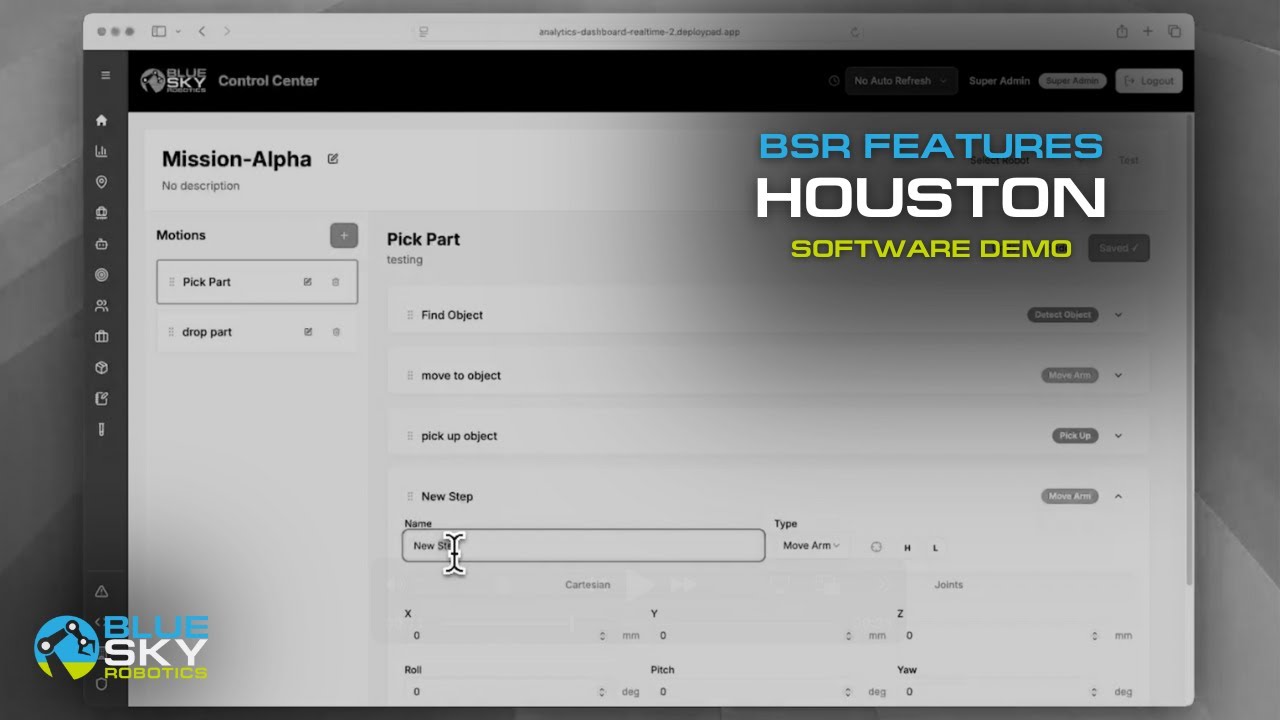
Blue Sky Robotics' automation software handles the vision integration and mission logic that connects the camera's output to robot motion in a single platform, reducing the integration complexity that vision-guided applications can add.
Where to Start
If your operation has been managing variability manually and has assumed vision-guided automation is not within reach, that assumption is worth revisiting. The Automation Analysis Tool evaluates your specific application for feasibility. The Cobot Selector matches the right arm to your payload and task. And if you want to see how a vision guided robot handles your specific application before committing to hardware, book a live demo with the Blue Sky Robotics team.
Fixed automation used to be the only realistic option for most facilities.
Increasingly it is not. To learn more about computer vision software visit Blue Argus.
FAQ
What is the difference between a vision guided robot and a traditional robot? A traditional robot follows pre-programmed coordinates and requires parts to be presented in a fixed, consistent position. A vision guided robot uses cameras and image-processing software to locate objects in real time and adjust its movements accordingly. This allows it to handle variable product placement, mixed SKUs, and changeovers without reprogramming.
What industries use vision guided robots?
Vision guided robots are used across manufacturing, logistics, food and beverage, healthcare, electronics, and automotive. Any application that involves variable product presentation, quality inspection, or mixed-SKU handling is a strong candidate.
Do I need a systems integrator to deploy a vision guided robot?
Not necessarily. Modern vision-guided automation platforms with graphical interfaces and code-free programming have lowered the barrier significantly. Blue Sky Robotics can help scope the right cell and support the setup without requiring a full integration engagement.
How accurate is a vision guided robot?
Accuracy depends on the camera resolution, lighting conditions, software calibration, and the robot arm's repeatability spec. Well-configured vision-guided systems routinely achieve sub-millimeter precision on structured applications and reliable performance on less controlled environments like bin picking.


