



Robots for Warehouse Operations: What to Buy and Where to Start
- Mar 30
- 4 min read
The category "robots for warehouse" covers a wider range of technology than most people realize when they start looking. AMRs that navigate warehouse floors. Robotic arms that pick and pack at fixed workstations. Vision-guided systems that inspect and sort. The right choice depends entirely on which problem you're trying to solve, and those problems are rarely the same from one operation to the next.
This guide breaks down the main types of warehouse robots, what each is suited for, and how to figure out where to start.
The main types of warehouse robots
Autonomous Mobile Robots move goods through a facility. They navigate using onboard sensors and pre-mapped floor plans, transporting totes, shelves, or pallets between locations without a fixed track or guide tape. AMRs are the right tool for solving travel time, they eliminate the walking that accounts for up to 60% of a picker's shift in conventional warehouses. They don't pick; they move.
Robotic arms handle the physical manipulation of items, picking from bins, placing into containers, packing cases, tending machines, and inspecting parts. A six-axis cobot mounted at a fixed workstation can sustain consistent pick rates around the clock without fatigue or variation. When paired with a vision system, it can handle the kind of item variation that previously required a human hand.
Goods-to-person systems combine storage infrastructure with AMRs to bring inventory directly to a stationary workstation, eliminating travel time entirely. These require more upfront design and capital than a standalone robot arm, but deliver the highest throughput for pure order fulfillment operations.
For most manufacturers and smaller distributors, a robotic arm at a key workstation is the right starting point, lower capital cost, faster deployment, and no facility redesign required.
Where vision systems fit in
A robot arm without vision is useful only when parts arrive in a predictable, consistent position. That's fine for some applications, a conveyor delivering parts in a fixed orientation, for example, but it rules out most real warehouse picking scenarios where items vary in position, orientation, or presentation.
Computer vision gives the robot the ability to adapt. A camera above the pick station captures the scene; AI software identifies the item, determines its position and orientation, and calculates the best grip point before the robot moves. The result is a picking system that handles real-world variation rather than requiring the world to be perfectly organized around it.
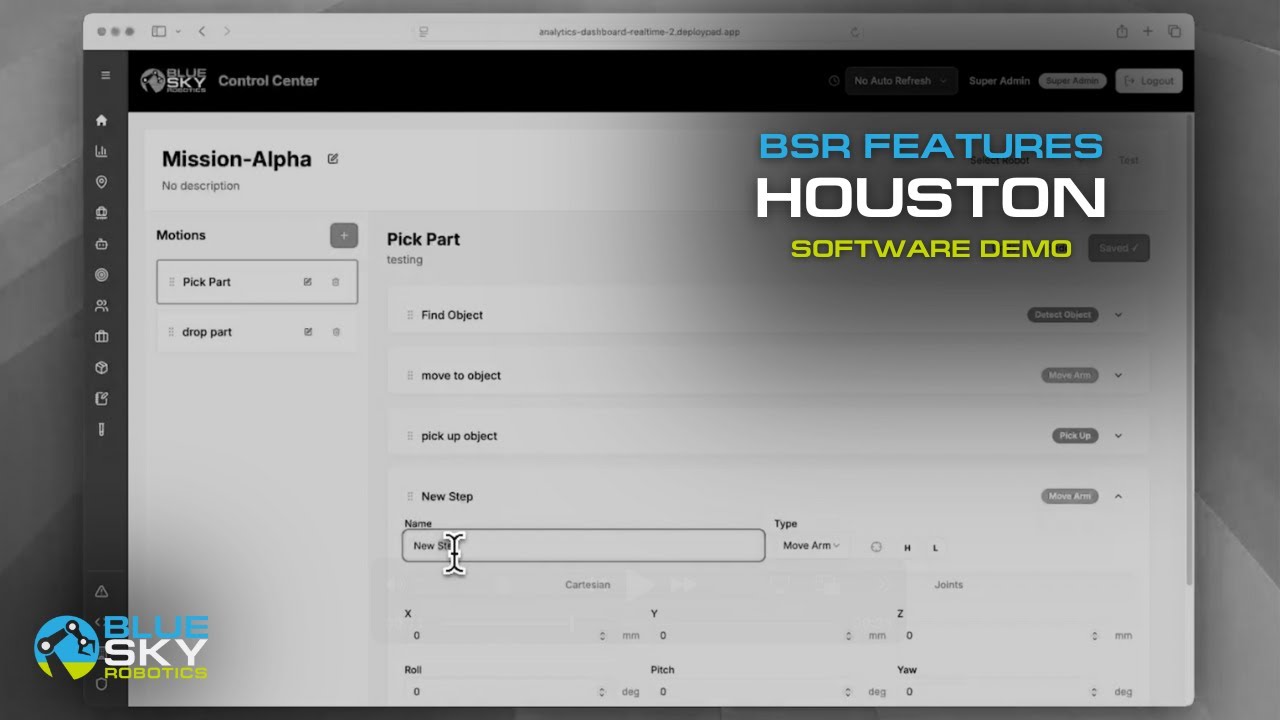
Blue Sky Robotics builds computer vision into their automation software platform, which works directly with UFactory and Fairino robot arms. Vision-guided picking, inspection, and placement are handled in a single integrated system, no separate vendor, no custom middleware.
Matching the robot to the job
The most important specs when selecting a warehouse robot arm are payload, reach, and repeatability. Payload needs to cover the combined weight of the end effector and the heaviest item you'll pick. Reach needs to cover the full extent of your pick area, a robot that can't reach the far end of a bin or the back of a conveyor is a problem regardless of how capable it is at the center.
For light picking and kitting under 5 kg, the UFactory xArm 6 ($9,500) and Fairino FR5 ($6,999) are both strong options with 700 mm and 922 mm reach respectively. For heavier parts or wider workstations, the Fairino FR10 ($10,199) brings 10 kg payload and 1,400 mm reach. For operations requiring precision assembly or surface finishing alongside picking, the UFactory xArm 850 ($10,500) adds ±0.02 mm repeatability and 850 mm reach.
Not sure which combination of payload and reach fits your application? The Cobot Selector walks through the decision based on your specific requirements.
What warehouse robots cost
Robot arms for warehouse applications from Blue Sky Robotics start at $3,500 for the UFactory Lite 6, a compact tabletop arm suited for light tasks and prototyping, and scale up to $11,000 for the xArm 7, which adds a seventh axis for applications requiring greater dexterity.
A complete warehouse robot cell, arm, end effector, vision, and basic integration, typically runs $15,000–$45,000 for a first deployment. That compares favorably to enterprise-grade warehouse automation systems, which start at $75,000 and frequently exceed $200,000 for full installations.
At a fully loaded labor cost of $30–$40 per hour, a single robot arm running one shift typically pays back in 12–18 months. Run it two shifts and that timeline shortens considerably.
Getting started
The most effective first deployment focuses on a single, well-defined problem: a high-volume pick task, a material handling bottleneck, or a packing line that's capping throughput. Solve that completely with one robot before expanding. The Automation Analysis Tool can help you identify where automation delivers the strongest return in your specific operation. Or book a live demo to see the hardware running on a task similar to yours.
FAQs
Q: What is the difference between an AMR and a robotic arm for warehouse use?
A: AMRs move goods through a facility, they solve the travel time problem. Robotic arms manipulate items at a fixed station, they solve the picking, packing, or handling problem. Most fully automated warehouses use both, but a robotic arm at a key workstation is usually the faster and lower-cost starting point for smaller operations.
Q: Do warehouse robots require a dedicated technician to operate?
A: Modern cobots are designed to be operated by existing staff with minimal training. UFactory Studio and Fairino's WebApp both use visual, no-code programming interfaces. Blue Sky Robotics' automation software adds a mission builder that lets operators build and adjust workflows without engineering support.


