



Robotic Vision: Why It Fails in Production and How to Make It Work
- Apr 6
- 5 min read
Updated: Apr 13
Robotic vision looks reliable in a demonstration. The lighting is controlled. The parts are clean. The camera is perfectly positioned. The robot picks cleanly every time.
Six weeks into production, the same system misses picks on parts that have a slightly different surface finish from the new supplier. It slows down when a shift change moves a floor light that was not in the original setup. It stops entirely when a box is placed near the camera's field of view and the detection algorithm loses confidence.
None of this is a reason not to use robotic vision. Virtually every modern industrial automation application that handles variable parts requires it. But there is a significant gap between a robotic vision system that works in a controlled test and one that runs reliably across multiple shifts, multiple product batches, and the daily unpredictability of a real production floor. Closing that gap is what this post is about.
What Robotic Vision Actually Has to Do
A robotic vision system is not a camera. It is the complete chain of hardware and software that transforms a raw image or point cloud into a motion command the robot arm can execute. That chain involves more decision points than most first-time deployers realize.
The camera captures the scene. The image processing layer filters noise and corrects for optical distortion. The detection algorithm identifies objects in the frame. The pose estimation system determines each object's exact position and orientation in three dimensions. The grasp planner selects the best contact point given the object's geometry and the surrounding environment. The robot controller receives the motion target and executes the pick. If any of these steps produces an unreliable output, the error propagates forward and the cycle fails.
In a laboratory setup, each step is tuned to the exact conditions of that environment. The challenge in production is that real environments vary in ways that degrade each step's reliability. Understanding where robotic vision fails in practice is the starting point for building a system that does not.
The Four Most Common Robotic Vision Failures in Production
Lighting variation. This is responsible for more robotic vision failures than any other single factor. Detection algorithms trained on images captured under specific lighting conditions degrade when ambient light levels change, when a nearby light source burns out or is repositioned, or when seasonal changes shift the natural light entering a facility. Systems that rely on ambient lighting for image quality are inherently fragile. The fix is active, controlled illumination: dedicated lighting integrated into the camera housing or cell structure that provides consistent light regardless of the facility environment. ToF cameras with built-in near-infrared illumination handle this more robustly than passive stereo systems that depend on ambient light.
Surface variation in parts. A detection model trained on one batch of parts may degrade when a new supplier delivers the same part with a different surface finish, a different sheen, or slightly different dimensional tolerances. Shiny, transparent, or very dark materials cause depth sensing errors in both structured light and ToF cameras because they reflect or absorb the projected illumination unpredictably. Identifying these surface-sensitive conditions before deployment and testing against the full range of expected material variants prevents production surprises.
Calibration drift. Hand-eye calibration, the process that aligns the camera's coordinate system with the robot's, is performed once at setup and then assumed to be static. In practice, vibration, thermal expansion of the mounting structure, and minor mechanical wear shift the physical relationship between camera and robot over time. A cell that was accurate at commissioning produces increasing pick errors weeks or months later without any obvious cause. Regular calibration checks, and a calibration workflow that is fast enough to run without significant production disruption, are the operational discipline that keeps a robotic vision system accurate over its lifespan.
Exception handling gaps. A robotic vision system that halts and waits for an operator every time it encounters a low-confidence detection is not a lights-out system. It is a system that trades one form of labor dependency for another. Robust exception handling defines the robot's behavior when confidence thresholds are not met: does it attempt a secondary scan at a different angle, request a human review of the flagged cycle, skip and log, or alert via a notification system? The difference between a cell that runs unattended and one that needs a watchful eye is almost always in how exceptions are handled, not in the average-case pick accuracy.
Building Robotic Vision for Production Reliability
The practices that separate reliable production deployments from fragile ones are consistent across industries and robot platforms.
Test against worst-case conditions, not average conditions. Shiny parts, damaged packaging, poorly lit scenarios, and the end of a full bin are the conditions where robotic vision systems fail. Test against all of them before commissioning, not after.
Control the light. Integrate lighting into the cell design rather than relying on facility illumination. The cost of a dedicated LED ring or structured light source is trivial relative to the cost of vision failures in production.
Define exception handling before go-live. Document exactly what the system should do when object detection confidence falls below threshold, when a pick attempt fails, and when the bin is too empty for reliable scanning. Build those behaviors into the mission logic before the cell is handed over to production.
Schedule calibration checks. Monthly calibration verification on active cells catches drift before it becomes a production problem. A 15-minute calibration check is significantly cheaper than the downstream cost of systematically bad picks.
Robotic Vision Paired with the Right Hardware
A robotic vision system is only as reliable as the robot arm it guides. Every robot in the Blue Sky Robotics lineup is built for the 24/7 production duty cycles where robotic vision earns its keep.
The UFactory Lite 6 ($3,500) is the entry point for robotic vision-guided tabletop applications, with native support for Intel RealSense cameras and an active open-source vision integration community. The Fairino FR5 ($6,999) and Fairino FR10 ($10,199) handle production-level vision-guided picking and machine tending with the repeatability and duty cycle ratings that multi-shift operation requires. The Fairino FR16 ($11,699) and Fairino FR20 ($15,499) cover the high-payload applications where robotic vision manages real-world pallet variation, mixed-SKU bin contents, and material handling at production speed.
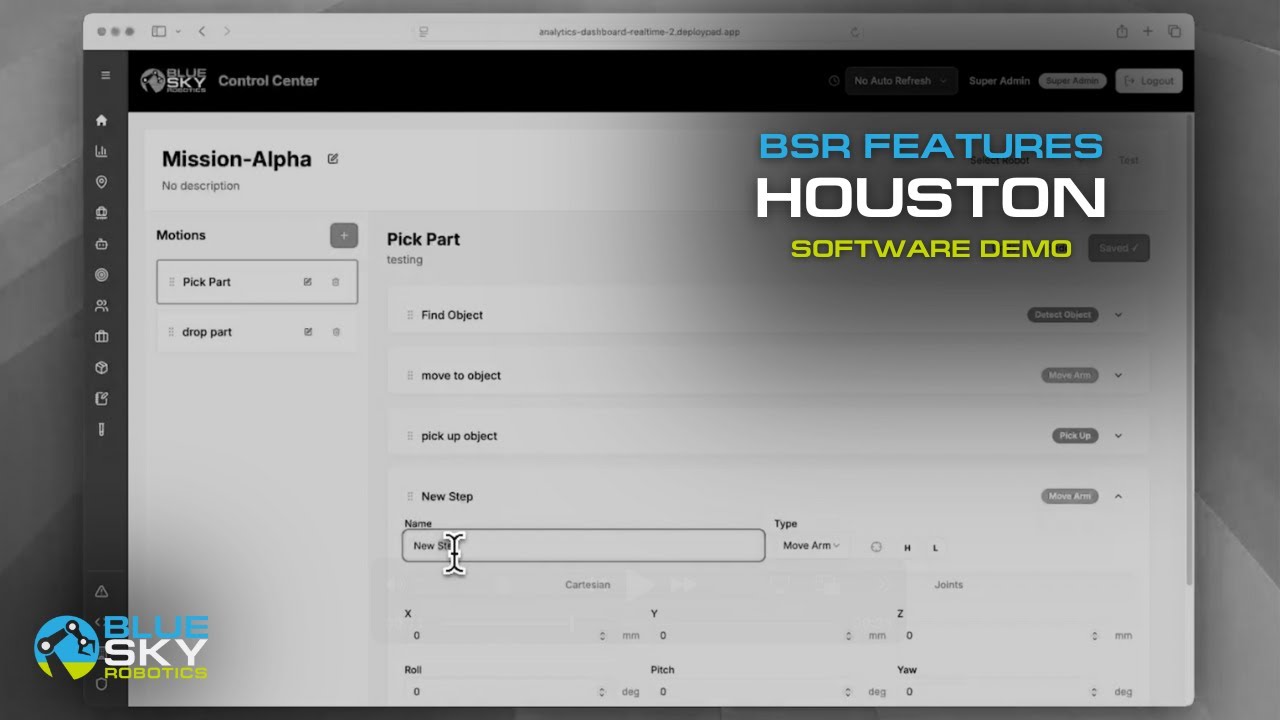
Blue Sky Robotics' automation software includes the vision integration and mission logic layer that coordinates camera input, grasp planning, and exception handling in a single platform, reducing the integration surface area where production failures typically originate.
Starting With the Right Foundation
The Automation Analysis Tool evaluates your specific application for robotic vision feasibility. The Cobot Selector matches the right arm to your payload and task. And if you want to see a robotic vision cell running under real production conditions before committing, book a live demo with the Blue Sky Robotics team.
Robotic vision works. The question is whether it works reliably enough to run on its own. That is an engineering question, not a technology question. To learn more about computer vision software, visit Blue Argus.


