



Robotic Vision: What It Is, How It Works, and Why It Makes Your Cobot Smarter
- Apr 6
- 5 min read
Updated: Apr 13
A robot without vision is essentially a very precise, very fast machine that does exactly what it is told, every time, as long as nothing changes. Move a part two inches to the left and the arm misses it. Change a box size and the whole program breaks. That rigidity is fine in tightly controlled environments, but it is a serious limitation for any operation where variability is part of the daily reality.
Robotic vision solves that. It gives a robot arm the ability to perceive its environment, identify objects, adapt to changes, and make decisions in real time rather than just replaying a fixed set of movements. The result is a robot that can handle the kind of variability that used to require a human worker.
This post explains what robotic vision is, how the technology stack works, what it enables, and how Blue Sky Robotics' cobot lineup integrates with it.
What Robotic Vision Actually Is
Robotic vision is the combination of cameras, 3D sensors, and software that allows a robot to interpret visual data and use it to guide movement. It is sometimes called machine vision or computer vision, though those terms have slightly different technical meanings depending on context. For practical purposes, robotic vision refers to any system where a camera feeds image data to software, which then sends instructions to a robot controller.
The difference between 2D and 3D vision is worth understanding. A standard 2D camera captures a flat image, useful for reading barcodes, detecting labels, or identifying whether an object is present. A 3D vision system captures depth information as well, producing a point cloud that tells the robot not just where something is in the image frame, but how far away it is, what shape it has, and how it is oriented in space. For most robotic manipulation tasks, such as bin picking, palletizing, or assembly, 3D vision is what makes reliable automation possible.
Mech-Mind's hardware and software ecosystem is built around this 3D vision capability. Their Mech-Eye industrial cameras produce high-resolution, detail-rich 3D images across a wide range of object types, including reflective metal parts, transparent materials, and dark or low-contrast surfaces that defeat most standard vision systems. Their Mech-Vision software processes that data and feeds it to robot controllers without requiring the operator to write code.
The Three Layers of a Robotic Vision System
Every robotic vision system has the same basic structure, regardless of the hardware brand or application.
The sensor layer captures the scene. This is typically a 3D camera mounted above the workspace, on the robot arm, or at a fixed inspection point. The camera produces raw image data: color, depth, or both, depending on the sensor type.
The processing layer interprets the data. Vision software identifies objects in the scene, calculates their position and orientation in 3D space, and determines the coordinates the robot needs to interact with them. This is where machine learning models come in. Trained on thousands of images, these models can recognize objects even when they are partially occluded, differently lit, or rotated in ways the programmer did not explicitly anticipate.
The control layer executes the action. The robot controller receives the processed coordinates and converts them into arm movements. Precision at this stage depends on both the quality of the vision data and the mechanical repeatability of the arm. UFactory xArm models achieve ±0.1 mm repeatability, which is tight enough that when the vision system says "pick here," the arm consistently arrives at the right spot.
What Robotic Vision Enables
The practical difference robotic vision makes shows up clearly across a handful of core applications.
Bin picking. Without vision, parts must be presented in a consistent position every time. With 3D vision, a robot can look into a bin of randomly oriented parts, identify a viable pick, and grasp it cleanly without any upstream sorting or fixturing. This eliminates significant manual labor and infrastructure.
Flexible pick and place. Vision-guided pick and place can handle multiple SKUs in the same cell without reprogramming. The vision system identifies the object, and the arm adapts its approach accordingly.
Inline quality inspection. A robot arm equipped with a camera can inspect parts as it handles them, flagging defects, verifying dimensions, and checking for missing components at line speed. This replaces dedicated inspection stations and reduces the cost of catching defects downstream.
Palletizing and depalletizing. Vision allows a palletizing robot to handle mixed pallet patterns, deformed packaging, and varying case sizes without stopping for reprogramming each time the load changes.
Assembly and alignment. For tasks requiring precise placement, vision gives the robot real-time feedback to correct for small positional errors that a fixed-program arm would compound into rejects.
Which Blue Sky Robotics Arms Support Vision Integration
The short answer is all of them. Every arm in the UFactory and Fairino lineups supports integration with 3D vision systems through open APIs, ROS compatibility, and Python-based SDKs.
For most vision applications, the UFactory xArm 6 ($7,499) is the strongest starting point. Six axes give it the wrist flexibility to approach objects from multiple angles, and UFactory's open-source vision SDK includes ready-to-run examples for Intel RealSense and Luxonis OAK-D cameras.
The UFactory Lite 6 ($3,500) is the most affordable entry point for teams that want to test a vision-guided application before committing to a larger deployment. It supports the same camera integrations as the full xArm lineup.
For applications that require heavier payloads alongside vision, such as vision-guided palletizing or bin picking of larger parts, the Fairino FR5 ($6,999) through FR10 ($10,999) cover the range.
Getting Started
Robotic vision is not as complex to deploy as it once was. The hardware has come down in price significantly, the software has become far more accessible, and the cobot arms that support it no longer cost six figures.
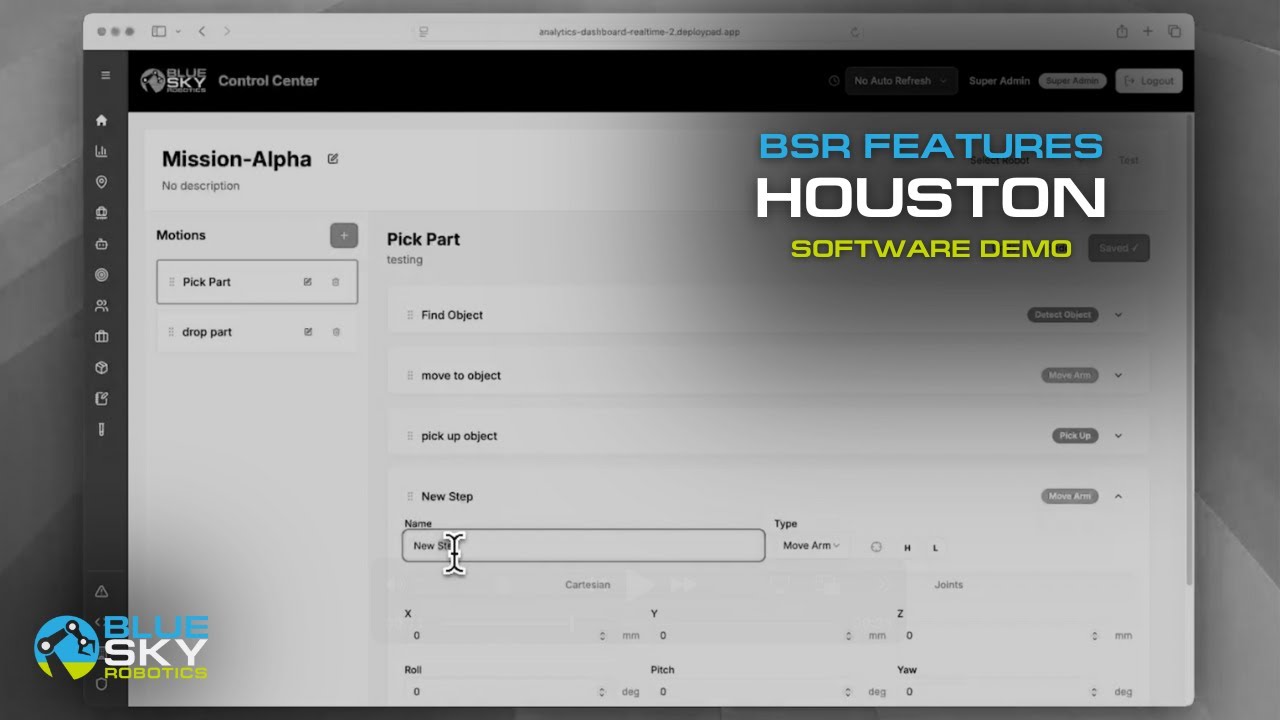
Use our Cobot Selector to match an arm to your application, or explore our automation software to see how Blue Sky Robotics' computer vision and mission-building tools fit into a complete vision cell. When you are ready to see it working, book a live demo. To learn more about computer vision software visit Blue Argus.
Browse the full UFactory lineup and Fairino cobots with current pricing.
FAQ
What is the difference between robotic vision and machine vision?
Machine vision typically refers to industrial inspection systems where cameras check parts for defects or verify dimensions, often without a robot arm involved. Robotic vision is broader: it refers to any vision system that guides a robot's movements. In practice the terms are often used interchangeably.
Do I need a 3D camera or will a standard camera work?
For most robotic manipulation tasks, including bin picking, palletizing, and assembly, 3D vision is required. A 2D camera can handle simpler tasks like barcode reading, label verification, or presence detection but does not provide the depth information needed to guide a robot arm reliably in three-dimensional space.
How hard is it to set up a vision-guided robot cell?
It depends on the application and the tools you use. With modern vision software that uses graphical interfaces and pre-trained models, straightforward applications can be deployed without writing code. More complex applications may require custom model training or integration work. Blue Sky Robotics can help scope what your specific application needs.


