

Machine Vision Programming: What It Is, How It Works, and Why It's Getting Easier
- Apr 13
- 6 min read
Five years ago, deploying a machine vision system meant hiring a specialist. You needed someone who understood image processing algorithms, could write in C++ or Python against a proprietary SDK, and knew how to tune lighting, thresholds, and feature detectors for your specific part. That person was expensive, hard to find, and often not available when something needed to change on the line.
That picture has shifted significantly. Modern machine vision programming tools range from fully graphical, no-code environments to deep learning platforms that train themselves from images rather than hand-written rules. The barrier to deploying a functional vision system on a robot or inspection line has dropped considerably, and the applications that were previously out of reach for a small or mid-size manufacturer are now practical.
This post covers how machine vision programming works, which approaches fit which applications, and what to look for when evaluating a vision platform for a robot-guided automation project.
What Machine Vision Programming Actually Does
Machine vision programming is the process of instructing a software system to extract useful information from camera images. That information might be a pass/fail decision on a part, a set of coordinates telling a robot where to grasp an object, a measurement of a dimension, or an identification of which product type is present.
The programming task is to define what the system should look for, how it should evaluate what it finds, and what it should do with the result. In a robot guidance application, the output is pick coordinates fed to the robot controller in real time. In an inspection application, the output is a signal to accept or reject a part, or a data record for traceability.
Traditional machine vision programming built these systems from explicit rules: find an edge at this contrast threshold, measure this distance, compare to tolerance. Modern AI-based systems learn from labeled images instead of rules, which makes them far more robust to natural variation in lighting, part finish, and presentation.
The Main Approaches to Machine Vision Programming
Rule-based vision - The traditional approach. A developer defines the visual features to look for: edges, blobs, color regions, geometric shapes, pattern matches. The system applies those definitions to each image and returns a result. Rule-based vision is fast, deterministic, and well suited to controlled environments where the part presentation is consistent and the features to detect are clear. It struggles when variation is high or when the "defect" is difficult to describe in explicit geometric terms.
Deep learning vision - Instead of defining rules, you train a neural network on a set of labeled images showing good and bad examples, or showing object positions and orientations. The network learns to recognize patterns that rules would miss and generalizes to variation it has not seen before. Deep learning is now the standard approach for complex inspection tasks (surface texture defects, subtle anomalies) and for flexible object detection where parts arrive in varying orientations. Training requires a sufficient dataset of labeled images, which is the primary upfront investment.
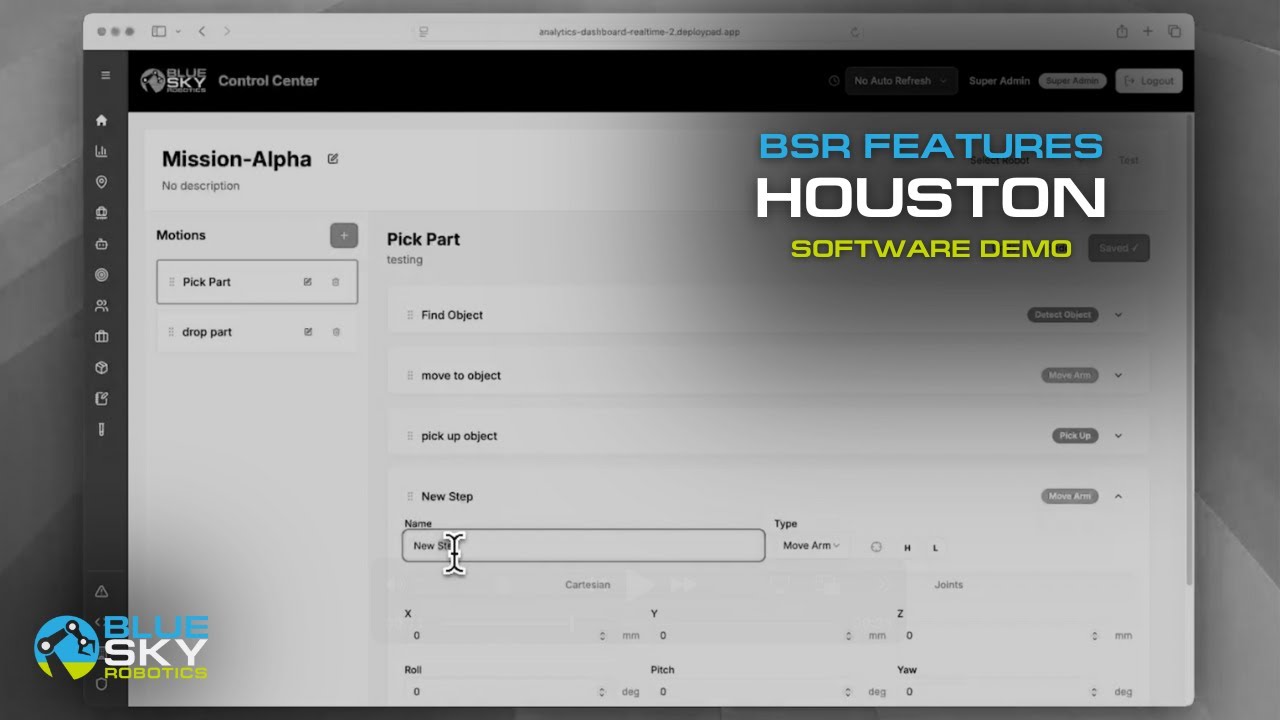
No-code and low-code vision platforms - These tools abstract the programming layer into a graphical interface. An operator configures an inspection or guidance task by selecting tools from a menu, drawing regions of interest, and setting thresholds through a visual interface rather than writing code. The best no-code platforms combine rule-based and deep learning tools in the same environment, letting users deploy basic tasks quickly and add AI capabilities as needed. This is where the accessibility shift has been most dramatic for small to mid-size manufacturers.
Vision language models (VLMs) - An emerging approach where the vision system is trained on both image data and natural language descriptions, allowing it to reason about what it sees in context rather than matching fixed patterns. VLMs are beginning to appear in inspection applications where the definition of a defect requires judgment rather than a fixed threshold. For most industrial automation in 2026, deep learning and no-code platforms are the practical deployment tier, with VLMs arriving as a next-generation option for the most complex tasks.
Key Components of a Machine Vision Program
Regardless of the programming approach, every machine vision system works through the same sequence of steps.
Image acquisition - The camera captures a frame triggered by a sensor, a robot signal, or a time interval. Lighting, exposure, and focus must be consistent for the vision algorithm to produce reliable results. A well-designed image acquisition setup makes every subsequent step easier.
Preprocessing - The raw image is filtered, enhanced, or transformed to make the features of interest more distinguishable. This might involve converting to grayscale, applying a sharpening filter, correcting for lens distortion, or normalizing brightness.
Feature extraction - The algorithm finds the relevant features in the image: edges, blobs, keypoints, object boundaries, or learned feature maps from a neural network. This is where the core "programming" lives, whether it is explicit rules or a trained model.
Decision or measurement - The extracted features are evaluated against a standard. Is this part within tolerance? Is this object in the expected position? Is this a defect or natural variation? The result is a pass/fail signal, a measurement value, or a set of coordinates.
Output to the robot or line - The result is transmitted to the robot controller, PLC, or MES via a standard protocol. For robot guidance, this is a coordinate set telling the arm where to pick. For inspection, it is a signal triggering accept/reject sorting or a data write for traceability.
Machine Vision Programming for Robot Guidance
The most impactful use of machine vision programming in a cobot deployment is enabling the robot to locate parts in real time rather than relying on fixed-position fixtures. This is what separates a flexible automation cell from a rigid one.
In a vision-guided pick and place setup, a camera captures an image of the work area, the vision software identifies the target object and calculates its position and orientation, and that information is passed to the robot arm as a pick coordinate. The robot picks from that coordinate rather than a fixed point. This allows the system to handle parts that vary in position, to pick from bins without precise fixturing, and to adapt across product changeovers without reprogramming the arm's path.
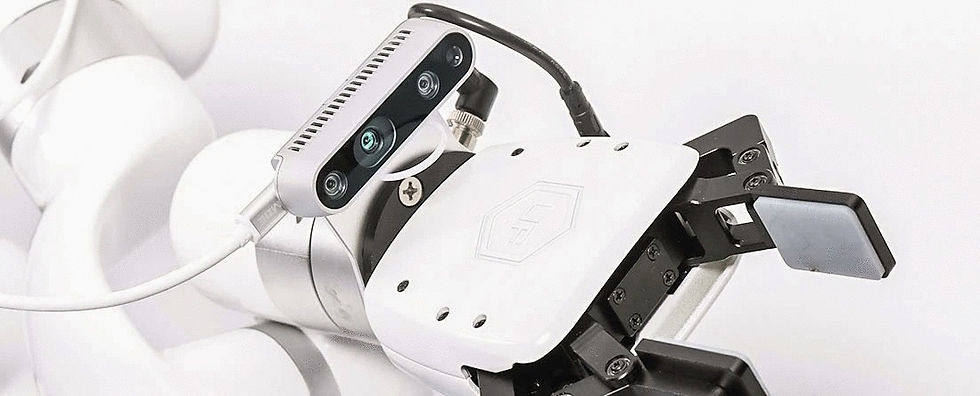
Blue Sky Robotics' automation software includes computer vision capabilities built for exactly this workflow. Object detection, pose estimation, and coordinate output to the robot are handled within the platform, without requiring custom code for standard pick and place, bin picking, and inspection applications. The Blue Argus computer vision system is designed to deploy with the full Blue Sky Robotics robot lineup, from the UFactory Lite 6 ($3,500) through the Fairino FR10 ($10,199) and beyond.
What to Look for When Evaluating a Vision Platform
Integration with your robot arm - The vision software needs to communicate with the robot controller. Verify that the platform supports your arm's interface protocol before committing to a camera or software stack.
No-code or low-code capability - Unless you have a dedicated vision engineer on staff, a graphical configuration interface is essential for initial deployment and for ongoing adjustments when parts or processes change.
2D and 3D support - If your application involves bin picking or any scenario where depth matters, confirm the platform handles 3D point cloud data and not just 2D images.
Training data requirements - Deep learning platforms require labeled image datasets to train. Understand how many images are needed for your specific task and whether the platform provides tools to collect and label them efficiently.
Retraining and adaptation - Parts change, products change, and lighting shifts over time. A vision platform that requires a specialist to retrain the model every time something changes adds ongoing cost and dependency.
Getting Started
If you are evaluating vision-guided automation for a pick and place, bin picking, or inspection application, the starting point is the robot arm, not the camera. The Cobot Selector matches robot arms to your payload and use case. The Automation Analysis Tool models ROI before you commit to anything.
Browse the full UFactory and Fairino lineups with live pricing, or book a live demo to see a vision-guided system running in real time. To learn more about machine vision programming and computer vision for robotics, visit Blue Argus.
FAQ
Do I need to know how to code to program a machine vision system?
Not necessarily. Modern no-code and low-code vision platforms let operators configure inspection and guidance tasks through graphical interfaces without writing code. For more complex applications involving custom deep learning models or integration with multiple systems, programming skills help. Blue Sky Robotics' automation software is designed to handle standard pick and place and inspection vision tasks without requiring custom code.
What programming language is used for machine vision?
Traditional machine vision systems are often programmed in C++ or Python against vendor SDKs like Cognex VisionPro or Halcon. Modern platforms are shifting toward graphical configuration tools and Python-based deep learning frameworks like PyTorch and TensorFlow for custom model training. No-code platforms abstract all of this behind a visual interface.
How long does it take to program a machine vision system?
A simple fixed-position pick and place application using a no-code platform can be configured in hours. A complex bin picking or inspection application requiring deep learning model training typically takes days to weeks, depending on dataset size and the variability of the application. Retraining an existing model for a new part or product is generally faster than the initial training cycle.