

Logistics Robots Explained: Types, Use Cases, and What They Actually Cost in 2026
- Feb 26
- 5 min read
Updated: 6 days ago
When someone searches "logistics robot," they're usually looking for one of two things: a broad understanding of what's out there, or a specific solution to a specific problem. Most articles on this topic give you the former and make you work for the latter.
This post does both. We'll map the logistics robot landscape clearly, including the types that Blue Sky Robotics doesn't sell, and then go deep on where robot arms specifically fit in logistics workflows, which applications they handle best, and what they actually cost. No "request a quote" required.
What "Logistics Robot" Actually Means
The term covers a wide category. A logistics robot is any automated system designed to move, handle, or process goods within a supply chain, warehouse, or distribution center. That's a broad definition, and it covers several distinct technologies that work very differently from each other.
Understanding the landscape starts with knowing which problems each type is built to solve.
The Main Types of Logistics Robots
Autonomous Mobile Robots (AMRs) and Automated Guided Vehicles (AGVs)
These are the robots most people picture when they think "warehouse robot", the ones gliding across facility floors moving shelves, totes, or carts. AMRs use sensors and real-time mapping to navigate dynamically. AGVs follow fixed paths using magnetic tape or floor markers.
Both are primarily transport solutions. They move goods from one point to another but don't pick, pack, or manipulate items. They're strong in facilities with high intralogistics volume, constant internal movement of goods across long distances. The cost for AMR systems typically runs $30,000 to $150,000 per unit, and total project costs for a meaningful fleet deployment scale quickly from there.
Autonomous Forklifts
Pallet-level transport handled without a human driver. Most practical in high-throughput distribution centers with consistent pallet flows and adequate floor space. Capital cost is significant, and these systems generally require facility modifications to operate safely.
Robot Arms (Cobots and Industrial Arms)
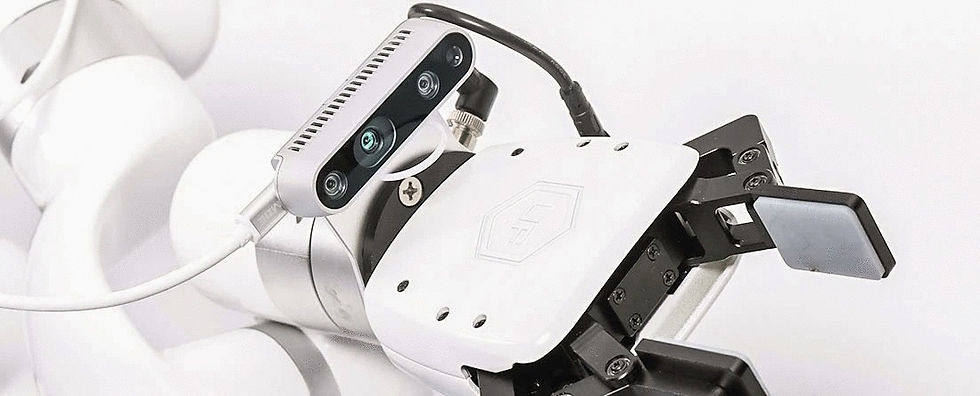
This is where Blue Sky Robotics operates. Robot arms don't move goods across a facility, they manipulate goods at a workstation. Picking items from bins, packing products into cases, building pallets, loading and unloading conveyors. The task is precise, repetitive manipulation rather than transport.
In logistics, robot arms handle the work that happens before and after goods move, the picking, packing, and palletizing that bookend every order.
Where Robot Arms Fit in Logistics Workflows
The distinction matters because logistics operations typically need both types of automation, and they're usually deployed in sequence. AMRs bring goods to a workstation. A robot arm handles the manipulation task at that workstation. The two technologies are complementary, not competing.
For operations evaluating their first automation cell, robot arms typically offer a faster, lower-cost entry point than full AMR fleet deployments, and they target the specific tasks generating the most labor hours.
Each Picking and Order Fulfillment
In e-commerce and 3PL environments, each picking, pulling individual units to fill orders, is one of the most labor-intensive tasks in the facility. A six-axis cobot with a vision system and appropriate end-of-arm tooling can handle this application at throughput rates that meaningfully reduce headcount requirements at that station.
The Fairino FR5, available through Blue Sky Robotics at $6,999, is a six-axis collaborative robot well-matched to each picking applications where payload requirements are modest and dexterity matters. It can reach into bins, handle variable orientations, and reorient items for placement, the core demands of a picking task.
Case Packing
Loading products into cases or cartons is one of the most automatable tasks in logistics. The motion is repetitive, the product presentation is relatively consistent, and the labor savings are immediate. A cobot cell handles this task reliably across shifts without fatigue-related inconsistency. Blue Sky Robotics' case packing solutions are built around Fairino hardware with integrated EOAT selection for a range of product types and packaging formats.
Palletizing
End-of-line palletizing is physically demanding, injury-prone, and consistent enough in motion pattern that a cobot handles it well. This is one of the highest-ROI entry points for logistics automation because the task is clearly defined, the labor cost is measurable, and the robot doesn't need a complex vision system to do it reliably.
For lighter palletizing loads, the Fairino FR10 ($10,199) handles the application with the reach and repeatability the task requires. Higher-volume general palletizing calls for the Fairino FR16 ($11,699), the workhorse of the Fairino line for this application. An explosion-proof variant of the FR16 is also available, contact Blue Sky Robotics for pricing on that configuration.
What Logistics Robots Actually Cost in 2026
Pricing in this space is notoriously opaque. Most vendors require a form submission before sharing any numbers. Here's a straight read on what you're actually looking at.
For AMR systems, fleet deployments from established vendors typically run $30,000 to $150,000 per unit, with total project costs for a meaningful deployment running well into six figures before integration is factored in.
For robot arms in logistics applications, the range is considerably wider, and considerably more accessible:
Fairino FR5 — each picking, bin picking: $6,999
Fairino FR10 — light palletizing, heavier case packing: $10,199
Fairino FR16 — general palletizing workhorse: $11,699
Explosion-proof variants are available upon request: contact for pricing.
These are hardware prices. A complete cell, including end-of-arm tooling, mounting, vision system if required, and integration, will carry additional cost. The total project cost varies based on application complexity, and it's worth scoping carefully before any hardware is specified.
How to Decide What You Need
The starting point is always the task, not the technology. Ask: what is the specific bottleneck costing the most in labor hours per shift? Is it moving goods across the facility, an AMR use case, or handling goods at a workstation, a robot arm use case?
Most first-time automation buyers in logistics discover that their highest-cost, most repetitive task is at a workstation, picking, packing, or palletizing, rather than in transit. That's where a robot arm delivers the clearest value with the fastest implementation and the lowest entry cost.
If you're not sure which category your problem falls into, the Cobot Selector is a useful first step. For a direct conversation about your specific operation, book a free 30-minute consultation with one of our automation specialists, no commitment required.
Frequently Asked Questions
What is the difference between an AMR and a robot arm in logistics?
AMRs and AGVs are transport robots, they move goods across a facility. Robot arms are manipulation robots, they handle goods at a workstation. Most logistics automation strategies eventually use both, but they solve different problems. AMRs address intralogistics transport; robot arms address picking, packing, and palletizing.
How much does a logistics robot cost?
It depends on the type. AMR systems typically run $30,000 to $150,000 per unit. Collaborative robot arms for logistics applications start at $6,999 for the Fairino FR5 through Blue Sky Robotics. Total cell cost, including end-of-arm tooling, vision, and integration, varies by application complexity.
What logistics tasks are robot arms best suited for?
Each picking and bin picking, case packing, and palletizing are the three most common robot arm applications in logistics. All three are characterized by repetitive motion, measurable throughput requirements, and direct labor cost offset, making ROI straightforward to calculate.
Do I need a vision system for logistics robot automation?
Not always. Palletizing and case packing with consistent product presentation often don't require a vision system. Bin picking and each picking for high-SKU environments typically do. Vision requirements should be scoped before hardware is specified, the wrong sequence here is one of the most common mistakes in logistics automation projects.