



Is Vision a Robot? What Vision Actually Does for a Robot Arm
- Apr 6
- 5 min read
Updated: Apr 13
Vision is not a robot. But a robot without vision is only half the automation system most manufacturers actually need.
This is one of the most practically important distinctions in industrial automation, and it is one that buyers frequently miss until they are already committed to a deployment. A robot arm is a mechanical system that moves with precision and repeatability. Vision is the sensory system that tells it where things actually are. Neither one alone does what both together accomplish.
Understanding the relationship between vision and a robot arm, what vision adds, what a robot can and cannot do without it, and when vision becomes non-negotiable, is the foundation of making good automation decisions. This post covers all of it.
What a Robot Is Without Vision
A robot arm without any vision system is a highly precise, highly repeatable machine that executes programmed motion sequences. It moves to coordinates. It picks from known positions. It places into defined locations. Within those parameters, it does this with extraordinary consistency: the same motion, to the same position, with the same timing, cycle after cycle.
This is genuinely useful for a specific class of application. If parts arrive in exactly the same position every time, fed by a vibratory bowl or a precision fixture, and the robot only needs to execute a fixed pick-and-place sequence, a vision-free setup works. High-volume, single-product lines with tightly controlled upstream processes have run this way for decades.
The limitation is the word "exactly." Real production environments are not exactly controlled. Parts shift. Bins empty unevenly. Batches vary slightly between suppliers. A new operator loads the feeder slightly differently. Any of these variations, invisible to a blind robot, causes a missed pick, a jammed gripper, or a fault condition that stops the line and calls for human intervention.
A robot without vision can only handle the world as it was programmed to expect it. Vision is what lets it handle the world as it actually is.
What Vision Adds to a Robot
When a vision system is integrated with a robot arm, the combination gains capabilities that neither component has alone.
Spatial awareness. A camera generates a map of the workspace: where objects are, how they are oriented, and how they relate to each other. For a 3D vision system, that map includes depth, meaning the robot knows not just where something is in a flat plane but exactly where it sits in three-dimensional space. This is what makes bin picking possible. Without depth data, a robot cannot reliably grasp parts that are stacked, tilted, or partially obscured by other parts in a container.
Adaptive picking. Rather than moving to a fixed coordinate, a vision-guided robot calculates a new grasp point on every cycle based on where the part actually is right now. If the part has shifted three millimeters to the left since the last cycle, the robot adjusts. If it is rotated 45 degrees from the expected orientation, the robot calculates the correct approach angle and picks it anyway.
This adaptability is the difference between a robot that needs babysitting and one that runs a full shift without intervention.
In-line inspection. A robot equipped with a vision system can verify part quality as part of the pick-and-place cycle, without routing parts to a separate inspection station. Surface defects, dimensional variance, missing features, and incorrect assembly can all be detected and flagged in the same motion sequence that handles the part. This turns a single robot into both a handling system and a quality control system simultaneously.
Human-robot safety monitoring. Vision systems mounted in a shared workspace can monitor the positions of human workers in real time, slowing or stopping the robot dynamically as people approach rather than relying solely on physical barriers or fixed safety zones. This is one of the core capabilities that makes collaborative robot deployments genuinely safe in practice rather than just in specification.
When Vision Is Non-Negotiable
There are specific application types where attempting to run a robot without vision is not a cost-saving decision. It is a decision to accept a system that will not work reliably.
Bin picking. Parts in a bin are in random positions and orientations. There is no fixed coordinate to program. Without a 3D vision system mapping the bin contents on every cycle, the robot has no basis for determining where to pick. This is the clearest case where vision is not optional equipment.
High-mix production. A shop running dozens of different part numbers per week cannot afford to maintain a separate set of fixed position programs for every part, recalibrated every time a new batch arrives with slight dimensional variation. A vision-guided robot identifies the part, calculates the grasp, and adapts automatically. Without vision, high-mix automation requires human intervention at every changeover.
Depalletizing with real-world variation. Incoming pallets are never perfectly uniform. Layer heights shift in transit, cases lean, and stacking patterns vary by supplier. Vision maps each layer as it is exposed and gives the robot accurate position data for every pick. Without it, the robot is guessing at positions that change with every pallet.
Unstructured environments. Any application where the robot needs to interact with objects that arrive without controlled positioning needs vision. The more variable the incoming conditions, the more critical vision becomes.
Vision as Part of a Complete Robot System
The right way to think about vision is not as an accessory added to a robot, but as a core component of the complete automation system alongside the arm, the gripper, and the control software.
Blue Sky Robotics builds this complete picture. The UFactory Lite 6 ($3,500) supports vision integration for tabletop inspection and light pick-and-place through standard camera interfaces and ROS2. The Fairino FR5 ($6,999) and Fairino FR10 ($10,199) handle production-level vision-guided picking and machine tending across multiple shifts. The Fairino FR16 ($11,699) and Fairino FR20 ($15,499) cover high-payload depalletizing and material handling where overhead vision systems manage real-world pallet variation.
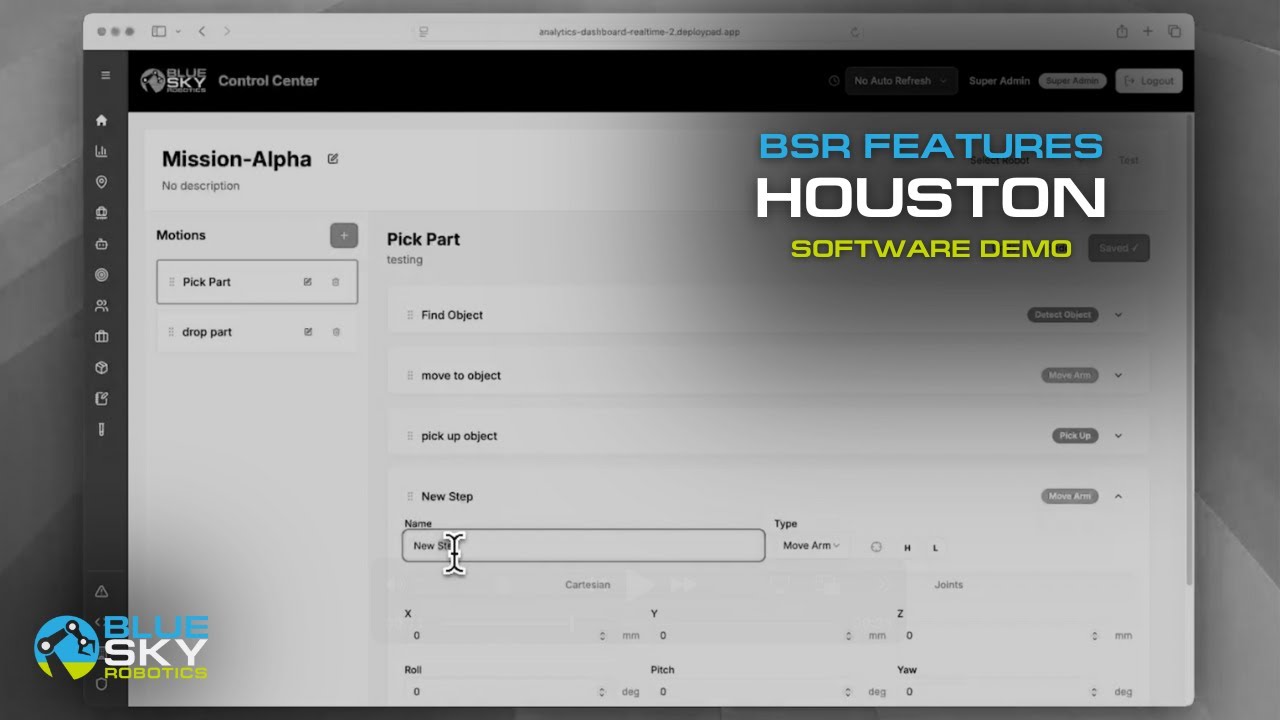
Blue Sky Robotics' automation software connects the vision layer to the robot motion layer in a single platform, handling the mission logic that turns camera data into robot action without requiring custom integration work between separate systems.
The Answer
Is vision a robot? No. Vision is the sensory system that makes a robot arm genuinely adaptive rather than merely precise.
A robot without vision is a capable machine for a narrow class of controlled applications. A robot with vision is an automation system that handles the real world as it arrives, not as it was optimized to be. For most manufacturers dealing with variable parts, mixed SKUs, and production environments that do not stay perfectly consistent shift to shift, vision is not optional equipment. It is what makes the automation work.
Use the Cobot Selector to match the right arm to your application, or run your specific process through the Automation Analysis Tool. When you are ready to see a vision-guided robot arm running on a real task, book a live demo with the Blue Sky Robotics team. To learn more about computer vision software visit Blue Argus.


