

Industrial Cobots: What They Are and How They Fit Into a Modern Factory
- Apr 6
- 5 min read
Updated: Apr 13
The word "cobot" is short for collaborative robot, a robot arm designed to work alongside people rather than behind a safety cage. Industrial cobots take that core idea and apply it to the demanding requirements of production environments: consistent cycle times, reliable repeatability, integration with PLCs and vision systems, and the durability to run 24 hours a day across multiple shifts.
The distinction between a cobot and a traditional industrial robot matters more than most buyers initially realize. Traditional industrial robots are fast, powerful, and designed to operate in fully enclosed cells where human access is restricted during operation. They excel at high-speed, high-volume, single-task applications where nothing ever changes. Cobots trade some of that raw speed for flexibility, safety in shared workspaces, and ease of reprogramming. For small and mid-size manufacturers running multiple product lines, handling variable tasks, or deploying automation without major facility modifications, cobots are almost always the more practical choice.
This post explains what industrial cobots actually do, which applications they handle best, how they pair with vision systems to handle real-world variability, and which models Blue Sky Robotics recommends for production use.
What Makes a Cobot Industrial-Grade
Not all cobots are built for production environments. Research-grade and hobby cobots exist for education, prototyping, and demonstration. Industrial cobots are a different category, defined by several specific characteristics.
Repeatability- An industrial cobot needs to return to the same position, cycle after cycle, within a tolerance that matches the application. For assembly and inspection tasks, that typically means sub-millimeter repeatability. UFactory xArm models achieve ±0.1 mm repeatability, which is tight enough for precision pick and place, machine tending, and vision-guided inspection.
Duty cycle- Industrial cobots are designed for continuous operation. They are engineered with thermal management, joint lubrication, and drive systems that sustain performance across extended shifts rather than the light-duty cycles that research arms are designed for.
Integration standards- Industrial cobots communicate with PLCs, vision systems, conveyors, and safety systems through standard industrial protocols. Open APIs, ROS compatibility, and support for communication standards like EtherNet/IP and Modbus TCP are what allow a cobot to function as part of a broader factory automation system rather than an isolated standalone unit.
Safety architecture- Industrial cobots include force and torque sensing that detects contact with a person or obstacle and stops or reduces speed accordingly. This is what enables them to operate without full safety caging in risk-assessed applications, which is the defining practical advantage over traditional industrial robots in shared workspaces.
What Industrial Cobots Do Best
Industrial cobots handle a consistent set of applications particularly well. These are tasks where their combination of flexibility, precision, and collaborative operation provides a clear advantage over both manual labor and traditional fixed automation.
Pick and place- Moving parts from one location to another at consistent speed and without handling damage. Vision-guided pick and place handles variable part positions and orientations without upstream fixturing, which is where cobots outperform fixed-program systems decisively.
Machine tending- Loading and unloading CNC machines, injection molding presses, and other equipment. Machine tending is physically repetitive, often ergonomically stressful, and runs across multiple shifts. A cobot handles it without fatigue, without shift changeover gaps, and without the injury risk that accumulates with manual tending over time.
Inspection- A cobot arm paired with a 3D vision system or a laser profiler can inspect parts for dimensional accuracy, surface defects, and assembly completeness at line speed. For applications requiring sub-millimeter measurement accuracy, pairing a cobot with a high-precision sensor like a 3D laser profiler provides the combination of precise part presentation and accurate measurement that inline inspection requires.
Palletizing and case packing- Stacking outbound cases onto pallets or placing products into shipping cases at consistent speed. Vision guidance allows cobots to handle mixed case sizes and variable pallet patterns without reprogramming for each SKU change.
Assembly- Placing components, driving fasteners, applying adhesives, and verifying assembly completeness. Force sensing allows cobots to handle delicate assembly tasks that require controlled contact force rather than just position control.
Pairing Industrial Cobots with Vision
The applications where industrial cobots deliver the most value are almost always vision-guided. A cobot without a vision system is still limited by the need for upstream fixturing and consistent part presentation. A cobot paired with a 3D sensor adapts to the real world as it finds it.
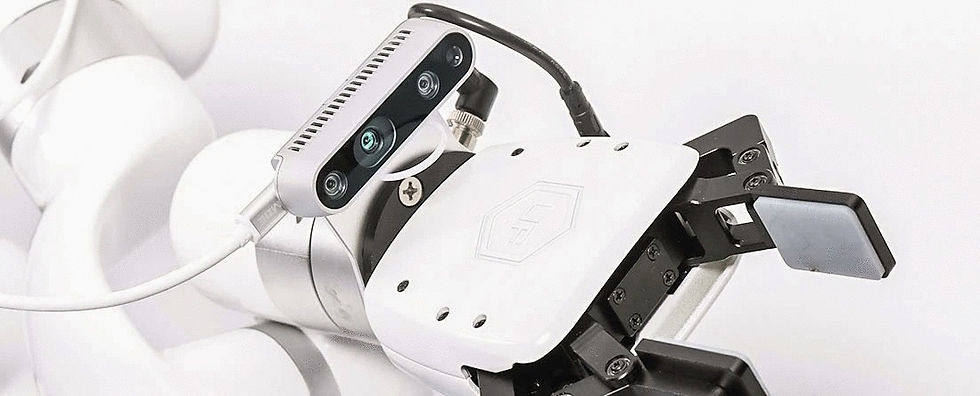
For standard pick and place and machine tending, depth cameras like the Intel RealSense D435 or Luxonis OAK-D-Pro-PoE provide sufficient accuracy at low cost. UFactory's open-source vision SDK supports both cameras natively across the full xArm and Lite 6 lineup.
For high-accuracy inspection tasks where part features are measured in microns, structured light 3D cameras and laser profilers provide the point cloud density and repeatability that standard depth cameras cannot match. Mech-Mind's LNX series 3D laser profilers, for example, achieve X resolution down to 9 micrometers and Z repeatability down to 0.2 micrometers, making them the appropriate sensor for connector pin inspection, battery module measurement, and surface flatness verification on precision parts.
Which Industrial Cobots Blue Sky Robotics Recommends
The right cobot for a production application depends on payload, reach, and the nature of the task.
For light inspection, assembly, and small-part pick and place, the UFactory Lite 6 ($3,500) and Fairino FR3 ($6,099) cover compact, low-payload applications efficiently. Both support standard depth camera integration and open API connectivity.
For general-purpose production tasks covering the widest range of applications, the Fairino FR5 ($6,999) is the strongest single recommendation. A 5 kg payload, 924 mm reach, full ROS compatibility, and support for both vision and PLC integration make it the right arm for machine tending, pick and place, and vision-guided inspection across most small and mid-size manufacturing environments.
For palletizing, heavier material handling, and applications where part weight pushes past 5 kg, the Fairino FR10 ($10,199) and Fairino FR16 ($11,699) provide the payload capacity needed for production-grade throughput.
Getting Started
Use our Cobot Selector to match an arm to your application, or our Automation Analysis Tool to model the ROI of a specific deployment. Browse our full UFactory lineup and Fairino cobots with current pricing, or book a live demo to see industrial cobot automation in action. To learn more about computer vision software visit Blue Argus.
FAQ
What is the difference between a cobot and an industrial robot?
Traditional industrial robots are fast and powerful but require full safety caging and are difficult to reprogram for new tasks. Industrial cobots are designed to work safely alongside people, are easier to deploy and reprogram, and are better suited for variable environments and mixed-SKU production. They trade some speed for flexibility and collaborative operation.
Are cobots fast enough for production use?
For most pick and place, machine tending, palletizing, and inspection applications, yes. Cobots are not the right choice for very high-speed applications where a delta robot or dedicated industrial arm running at full speed is required. For the majority of tasks that currently rely on manual labor in small and mid-size manufacturing, cobots are fast enough and significantly more consistent.
What payload do I need for my application?
Payload is the weight the arm can carry at full reach, including the end-of-arm tool. Add the weight of your gripper or end effector to the weight of the heaviest part you will handle, and that sum needs to be below the arm's rated payload. For most light manufacturing tasks, 5 kg is sufficient. For palletizing standard shipping cases, 10 kg to 16 kg is the practical range.