

Industrial Cobot: What It Is, What It Costs, and How to Choose the Right One
- Apr 13
- 6 min read
The industrial cobot market has grown fast enough that the terminology is starting to blur. "Cobot" used to mean a lightweight, slow-moving arm designed purely for safe human interaction. In 2026, it describes a much broader category: 6-axis robot arms with payloads from 3 kg to 30 kg, repeatability measured in hundredths of a millimeter, and software capable of handling complex, vision-guided applications that previously required full industrial robots behind safety fencing.
If you are evaluating cobots for a manufacturing, packaging, or warehouse operation, this guide covers what actually matters: how cobots differ from traditional industrial robots, which specs drive real-world performance, what they cost at each payload tier, and how to match the right arm to your application.
What Makes a Robot a Cobot
A collaborative robot (cobot) is designed to operate safely in shared spaces with human workers. The defining characteristics are built-in force and speed limiting, rounded profiles that reduce injury risk on contact, and safety-rated monitoring systems that slow or stop the arm when a person enters its working zone.
Traditional industrial robots are powerful, fast, and precise but require physical separation from human workers through caging, guarding, and safety interlocks. A cobot trades some raw speed for the ability to work alongside people without those barriers, which reduces installation cost, shrinks the required footprint, and allows the robot to be redeployed between tasks more easily.
In practice, the line between "cobot" and "industrial robot" has narrowed considerably. Modern cobots handle payloads that industrial robots handled a decade ago, and their repeatability specifications rival many traditional arms. The 2026 ABB cobot trend report notes a clear shift toward cobots taking on complex tasks that previously required full industrial systems. What you are buying today is genuinely industrial-grade hardware that happens to be designed for collaborative operation.
Industrial Cobot Applications
The five most common industrial cobot applications account for the vast majority of deployments across manufacturing, logistics, and packaging.
Pick and place - Moving parts or products from one location to another, with or without vision guidance. The most common starting point for first-time cobot buyers. Cycle times of 400 to 800 picks per hour are typical for 6-axis cobots.
Machine tending - Loading raw parts into CNC machines, injection molders, or presses, then unloading finished parts. One operator can oversee three to six machines when a cobot handles the tending cycle.
Palletizing and depalletizing - Stacking cases onto outbound pallets or removing cases from inbound pallets. Higher-payload cobots in the 16 to 30 kg range handle most case goods without issue.
Assembly - Joining components, driving fasteners, dispensing adhesive, or performing sub-assembly tasks alongside human workers on a shared line.
Inspection - Using a vision system mounted to the arm or fixed above the work area to detect defects, verify dimensions, or confirm part presence before the next production step.
Most small to mid-size manufacturers start with pick and place or machine tending because the ROI is clearest and the integration is most straightforward. From there, the same arm is often redeployed to additional applications as the team gains experience.
Key Specs That Actually Matter
Cobot datasheets are dense. These are the specs that drive real-world performance decisions.
Payload - The maximum weight the arm can handle including the gripper and any tooling attached to the end of the arm. Always subtract your gripper weight from the rated payload to get your usable part-handling capacity. Sizing up is cheap insurance.
Reach - The maximum radius the arm can access from its base. For machine tending, reach needs to cover the machine's work envelope plus infeed and outfeed staging. For palletizing, it needs to cover the full pallet footprint at maximum stack height.
Repeatability - How precisely the arm returns to the same position on repeated cycles. Expressed as plus or minus a number in millimeters. For general pick and place and machine tending, 0.02 to 0.05 mm is more than sufficient. For precision assembly or tight-tolerance gauging, you want to be at the lower end of that range.
Speed - Maximum joint velocity and TCP (tool center point) speed. Faster is better for throughput, but real-world cycle time depends on the move distance, payload, and how aggressively you can run the arm given your application's safety requirements.
IP rating - Relevant for food, beverage, and wet environments. A higher IP rating means the arm is more resistant to dust and moisture ingress.
Industrial Cobot Prices: What You Actually Pay in 2026
Standard Bots' guide on this topic quotes a range of $2,000 to $100,000 for an industrial cobot. The lower end of that range reflects some entry-level arms, but the practical range for a capable 6-axis industrial cobot for real production use starts lower than most buyers expect and stays far below the $100,000 ceiling for most applications.
Here is what the Blue Sky Robotics lineup costs at each payload tier, confirmed from the live shop:
The UFactory Lite 6 ($3,500) is a 6-axis tabletop arm handling up to 3 kg. It is the entry point for light pick and place, small part assembly, and lab automation.
The Fairino FR3 ($6,099) and Fairino FR5 ($6,999) cover the 3 to 5 kg payload range with 6-axis flexibility, explosion-proof options, and 0.02 mm repeatability. These are the most versatile arms for general manufacturing pick and place, machine tending, and assembly.
The UFactory xArm 5 ($6,000) is a 5-axis option for applications where full 6-axis flexibility is not required, at a competitive price point.
The Fairino FR10 ($10,199) handles 10 kg, covering the majority of CNC machine tending and mid-weight pick and place applications.
The Fairino FR16 ($11,699) and Fairino FR20 ($15,499) step into heavier palletizing, depalletizing, and material handling territory.
The Fairino FR30 ($18,199) is the top of the cobot range at 30 kg payload, handling heavy-duty depalletizing, casting handling, and large component assembly.
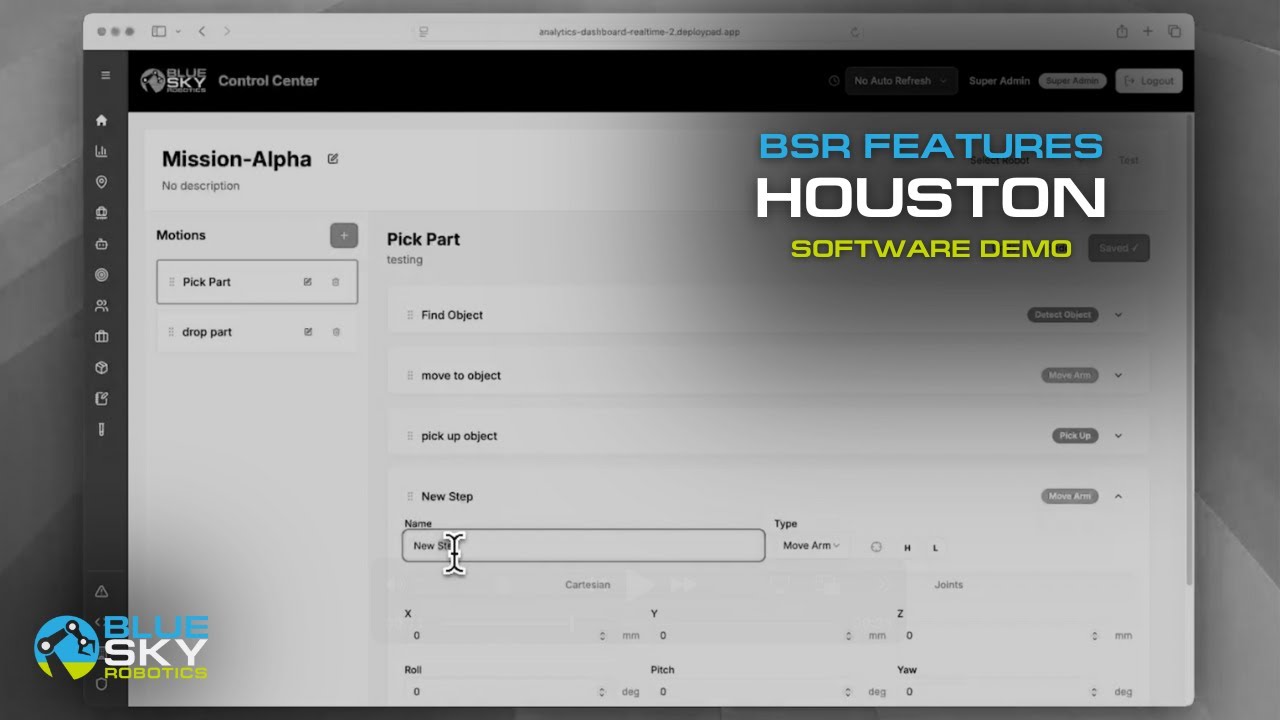
Every arm in the lineup connects to Blue Sky Robotics' automation software for mission building, vision integration, and application programming without requiring dedicated robotics engineers.
Cobot vs. Industrial Robot: When Each Makes Sense
The decision between a cobot and a traditional industrial robot comes down to three factors: required speed, required payload, and whether the application involves human proximity.
Choose a cobot when your throughput requirement is under 1,000 cycles per hour, your payload is under 30 kg, you need to work in proximity to human operators, or you need the flexibility to redeploy the arm between tasks or locations. Cobots also win on total cost of ownership when you factor in the absence of safety fencing, reduced integration labor, and easier reprogramming.
Choose a traditional industrial robot when you need maximum speed (above 1,500 cycles per hour), very heavy payloads (above 30 kg for most applications), or a highly controlled, fixed process where collaborative features add no value and every dollar of capital should go toward raw performance.
For the majority of small to mid-size manufacturing and logistics operations, the cobot is the right answer at every price point in the Blue Sky Robotics lineup.
Getting Started
The Cobot Selector matches payload and use case to the right arm in under two minutes. The Automation Analysis Tool models ROI against your actual labor cost before you make any commitment.
Browse the full Fairino lineup and UFactory lineup with live pricing, or book a live demo to see an industrial cobot running in your application context. To learn more about industrial cobots and automation solutions, visit Blue Argus.
FAQ
What is the difference between a cobot and an industrial robot?
A cobot is designed to operate safely in shared spaces with human workers using built-in force limiting, speed monitoring, and contact detection. Traditional industrial robots are faster and can handle heavier payloads but require physical separation from people through caging and guarding. Cobots trade some raw speed for flexibility, safety, and lower total deployment cost.
How much does an industrial cobot cost?
Industrial cobots from Blue Sky Robotics start at $3,500 for the UFactory Lite 6 and go up to $18,199 for the Fairino FR30 at 30 kg payload. Total system cost including tooling, vision, and integration runs $15,000 to $60,000 for most applications.
What industries use industrial cobots?
Manufacturing (automotive, electronics, medical devices, food and beverage), logistics and warehousing, packaging, pharmaceuticals, and aerospace are the primary verticals. Cobots are also expanding rapidly into healthcare labs, hospitality, and agriculture as the technology matures.