

Industrial Camera for Robots: What It Does and Why It Matters
- Apr 6
- 5 min read
Updated: Apr 13
Consumer cameras and industrial cameras are built for entirely different jobs. A phone camera is optimized for color, low light, and convenience. An industrial camera is optimized for precision, repeatability, and the ability to function reliably in dusty, bright, vibration-prone production environments around the clock.
When a robot arm needs to see, an industrial camera is what it uses. The camera captures the scene, the vision software processes the image data, and the robot controller acts on the result. The quality of that camera, and how well it is matched to the application, determines whether the system works reliably or constantly fights calibration, misreads, and failed picks.
This post explains what makes a camera industrial-grade, which types are used in robotic applications, what they enable in practice, and how they fit into a complete cobot automation cell.
What Makes a Camera Industrial-Grade
Industrial cameras differ from standard cameras in several meaningful ways.
Robustness- Industrial cameras are built to withstand factory conditions:
vibration, dust, humidity, variable lighting, and temperature swings. Most carry IP ratings (IP67 is common) that certify they can survive dust and water exposure without degrading performance.
Precision over aesthetics- Industrial cameras are engineered for accurate, repeatable data rather than visually pleasing images. They prioritize consistent exposure, minimal distortion, and stable calibration over color richness or dynamic range.
Depth capability- Many industrial cameras used in robotics are 3D cameras, meaning they capture depth information in addition to a standard image. This depth data, typically delivered as a point cloud, is what allows a robot arm to determine where an object is in three-dimensional space, how it is oriented, and what shape it has.
Integration standards- Industrial cameras communicate over Gigabit Ethernet and support open standards like GigE Vision and GenICam, making them compatible with a wide range of robot controllers and vision software platforms without proprietary lock-in.
The Main Types of Industrial Cameras Used in Robotics
Not every application needs the same camera technology. Three types dominate robotic vision applications.
Structured light 3D cameras project a known pattern of light onto the scene and measure how it deforms across the surfaces it hits. This produces a dense, highly accurate 3D point cloud. Structured light cameras handle a wide range of surface types, including reflective metal parts, dark materials, and objects with complex textures. Mech-Mind's Mech-Eye DEEP-GL is a structured light camera designed specifically for large field-of-view applications like palletizing, where the camera needs to cover a full pallet footprint from a fixed overhead mount and recognize cases with patterned, printed, or uneven surfaces.
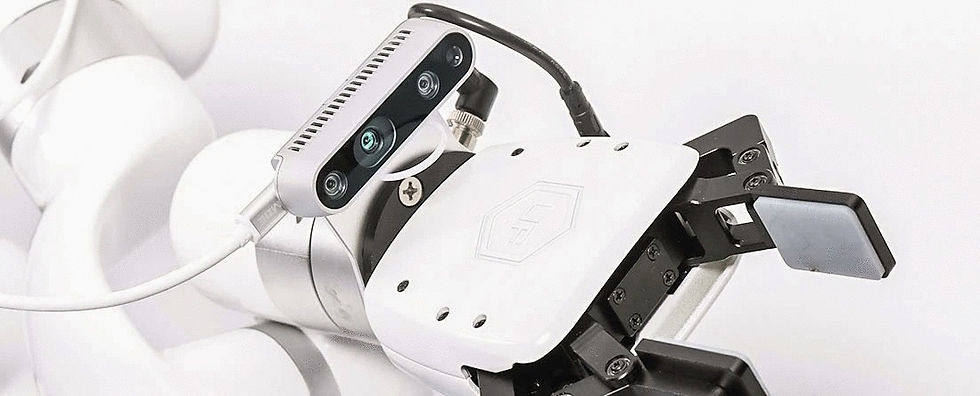
Stereo vision cameras use two offset lenses to calculate depth from image disparity, similar to how human eyes perceive distance. They are compact, affordable, and well suited for cobot applications where the camera mounts on or near the arm. The Intel RealSense D435 and Luxonis OAK-D-Pro-PoE are the most widely deployed stereo cameras in cobot setups. UFactory's ufactory_vision SDK supports both natively across the xArm and Lite 6 lineup.
2D machine vision cameras capture flat images without depth data. These are the right tool for applications that do not require spatial awareness: barcode reading, label verification, color sorting, and presence detection. They are significantly cheaper than 3D cameras and sufficient for a large category of inspection and identification tasks.
What Industrial Cameras Enable When Paired with a Cobot
The Mech-Mind mixed-case palletizing case study is a useful illustration of what a well-matched industrial camera unlocks in a real production environment. The customer operated a logistics transfer center where cases of many different sizes, with patterned and textured surfaces, arrived randomly and needed to be palletized at high speed. A fixed-program palletizer cannot handle that variability. A 3D camera-guided system can.
The Mech-Eye DEEP-GL camera captured precise 3D images of the incoming cases. Vision software calculated the dimensions and positions of each case, planned an optimal stacking pattern that maximized pallet stability and space utilization, and determined the sequence in which cases should be picked. The system also tracked partial pallets across interruptions so the robot could resume stacking without restarting. Collision detection planned each trajectory automatically to avoid interference with camera brackets and surrounding structure.
The outcome was a workstation that ran stably at high throughput with no human interaction.
The same camera and software architecture applies equally to bin picking, machine tending, and assembly alignment. The industrial camera is the sensor layer that makes all of it possible.
Matching the Camera to the Cobot
Every arm in the Blue Sky Robotics lineup supports industrial camera integration. The right camera depends on the application, and the right arm depends on the payload and reach the task requires.
For light-duty vision applications, the UFactory Lite 6 ($3,500) pairs with stereo cameras like the RealSense D435 through UFactory's open-source vision SDK. This is the lowest-cost starting point for teams building their first vision-guided cell.
For production pick and place, bin picking, or inspection tasks, the Fairino FR5 ($6,999) supports both stereo and structured light cameras through ROS and open API integration. Its 5 kg payload and 924 mm reach handle the majority of light-to-medium vision-guided applications.
For palletizing and heavy bin picking where a structured light camera covers a large overhead field of view, the Fairino FR10 ($10,199) provides the 10 kg payload and reach to run a production palletizing cell reliably alongside an industrial-grade 3D camera.
Getting Started
Use our Cobot Selector to match an arm to your application, or explore our automation software to see how Blue Sky Robotics' computer vision tools fit into a complete camera-guided cell. When you are ready to see it working, book a live demo. To learn more about computer vision software visit Blue Argus.
Browse our full UFactory lineup and Fairino cobots with current pricing.
FAQ
What is an industrial camera?
An industrial camera is a camera built for production environments rather than consumer use. It prioritizes precision, durability, and consistent calibration over image aesthetics, and typically includes depth-sensing capability for robotic guidance applications.
Do I need a 3D industrial camera or will a 2D camera work?
It depends on the task. If your robot needs to locate objects in three-dimensional space, grip parts in different orientations, or pick from unstructured bins, a 3D camera is required. If the task is limited to reading codes, checking labels, or detecting whether something is present, a 2D camera is sufficient and significantly cheaper.
Can I use a consumer depth camera like an Intel RealSense with a production robot?
Yes, for many applications. The RealSense D435 is widely used in cobot deployments and is officially supported by UFactory's vision SDK. For more demanding applications involving reflective parts, very high pick rates, or harsh environments, an industrial-grade structured light camera is the more reliable choice.