

How to Build an Automated Material Handling System That Actually Works
- 4 days ago
- 4 min read
Most conversations about automated material handling stop at the robot arm. Which arm, what payload, what reach. Those are important questions, but they are not the first questions. A robot arm sitting in a cell with nothing feeding it, nothing receiving from it, and no software coordinating its decisions is not an automated material handling system. It is an expensive fixture.
A real automated material handling system is the combination of hardware, software, and process design that moves material through a facility reliably, without constant human intervention. The robot arm is one component. Understanding how the others fit together is what separates a deployment that runs from one that gets abandoned three months in.
This is a planning guide for manufacturers who are ready to move past "should we automate?" and into "how do we actually build this?"
The Four Components Every System Needs
Regardless of scale, every functional automated material handling system contains four layers. Get all four right and the system runs. Miss one and the others cannot compensate.
The handling mechanism. This is the robot arm, and the choice here depends entirely on the weight and geometry of what is being moved. A 3 kg cobot arm is not interchangeable with a 20 kg one. The arm needs to be sized for the heaviest part it will handle at the furthest point in its reach, not at the center of its work envelope where load ratings are highest. Undersizing the arm is the single most common spec mistake in first deployments.
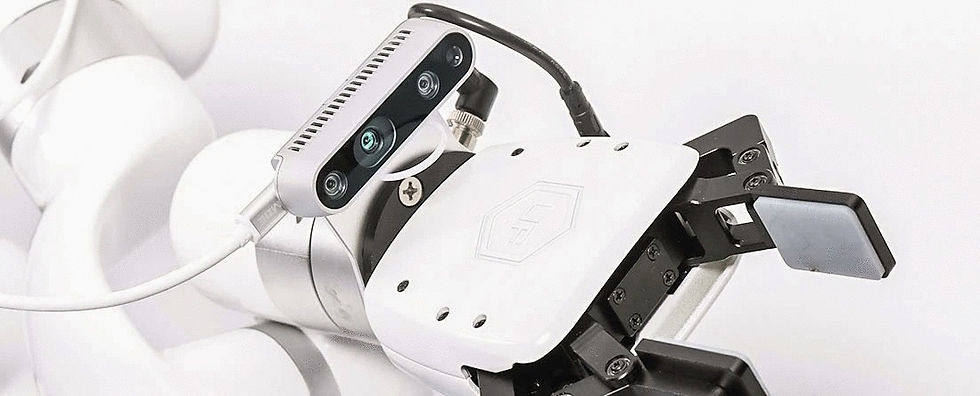
The end-of-arm tooling. The gripper is what actually contacts the material, and it is frequently treated as an afterthought. It should not be. A parallel jaw gripper, a vacuum cup, a soft adaptive gripper, and a magnetic end-effector all handle different materials differently. The wrong gripper on the right arm produces the same result as the right gripper on the wrong arm: parts dropped, cycles stopped, confidence lost. Define the gripper before finalizing the arm, not after.
The sensing layer. The system needs to know where the material is. For fixed-position applications where parts arrive in a known location every time, a simple presence sensor or trigger input may be sufficient. For any application involving variable part positions, bin contents, or incoming material with real-world variation, a 3D vision system is required. This is not optional equipment for most real-world material handling tasks. It is what allows the robot to adapt rather than fail when the world does not match its programming.
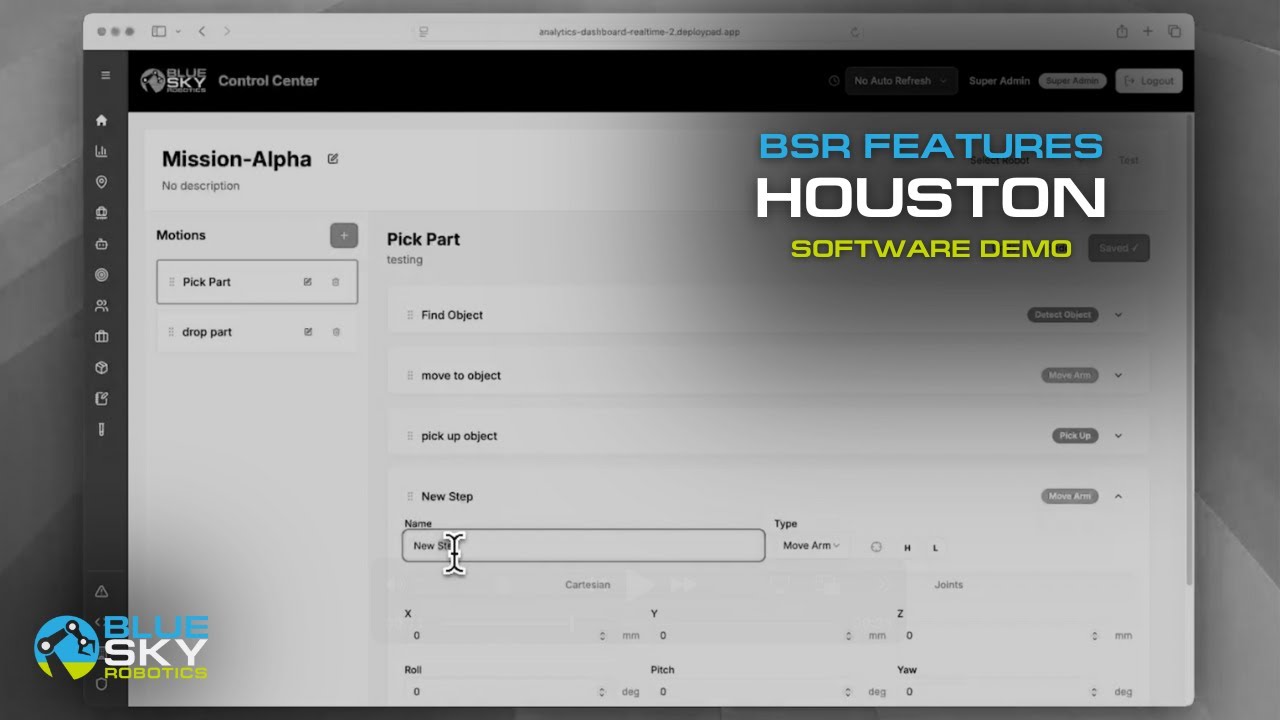
The control and software layer. Something needs to coordinate the arm, the sensors, the gripper, and any upstream or downstream equipment. In small deployments this is often the robot's own controller running a programmed sequence. In more complex systems it involves mission-building software that manages decision logic, tracks cycle counts, handles exceptions, and communicates status to operators or management systems. Blue Sky Robotics' automation software handles this coordination layer for UFactory and Fairino deployments, covering pick-and-place logic, vision integration, and workflow sequencing without requiring custom code from scratch.
Planning the System Before Buying Anything
The most expensive mistakes in automated material handling happen during procurement, not installation. They happen because buyers select hardware before they have mapped the process the hardware is supposed to serve.
Before specifying a single component, answer these questions in writing:
What is the heaviest part this system will ever handle, and at what distance from the robot base? This determines minimum payload and reach requirements with a safety margin built in.
How does material arrive at the pick point? Conveyor, tote, pallet, bin, or manually placed? Each arrival method has implications for vision requirements, gripper selection, and cycle timing.
Where does material go after the robot handles it? The receiving side of the operation needs to be designed with the same care as the pick side. A robot that palletizes faster than the downstream line can absorb creates a new bottleneck rather than eliminating one.
What happens when something goes wrong? Parts jam, bins run empty, vision systems lose the object in poor lighting. Every automated material handling system needs defined exception handling: what the robot does when it cannot complete a cycle, and how operators are notified.
Documenting answers to these questions before vendor conversations begin produces a specification that drives the right procurement decisions rather than a wish list shaped by whatever the salesperson demonstrated last.
Sequencing the Deployment
For manufacturers building their first automated material handling system, trying to automate everything at once is the fastest path to a failed project. The approach that consistently works is narrower.
Start with one station, one task, and the highest-volume repetitive motion in that task. Get it running reliably before expanding. The lessons learned in the first cell: gripper tuning, vision calibration, exception handling, operator interaction, inform every subsequent cell far more efficiently than any planning document.
Blue Sky Robotics carries the full payload range needed to scale this way. The UFactory Lite 6 ($3,500) is the right starting point for a first tabletop cell handling parts under 600g. The Fairino FR5 ($6,999) and Fairino FR10 ($10,199) cover production-level material handling up to 10 kg. The Fairino FR16 ($11,699) and Fairino FR20 ($15,499) handle the heavier end-of-line palletizing and depalletizing work that typically carries the highest labor cost and injury risk in a facility.
Because every robot in the lineup runs the same software and API structure, expanding from one cell to several does not require starting from scratch each time. The process knowledge transfers. The integration patterns repeat.
Where to Start the Conversation
The Automation Analysis Tool at Blue Sky Robotics is built to evaluate a specific material handling process and return real numbers on feasibility and payback. The Cobot Selector narrows the robot choice once the process is defined. And if you want to walk through your specific system design with someone who has built these cells before, book a live demo with the Blue Sky Robotics team.
The robot arm is one component. The system is the investment.