

Factory Automation System: What It Is and What It Actually Does for Your Business
- Apr 6
- 4 min read
Updated: Apr 13
A factory automation system is exactly what the name suggests: a coordinated set of machines, sensors, controllers, and software that runs manufacturing processes automatically, without requiring a human to intervene at every step.
Most manufacturers already use some level of automation. Conveyors, PLCs, and fixed machinery have been part of factory floors for decades. What has changed is the accessibility and flexibility of the technology. Robot arms that once cost $150,000 and required a dedicated integration team now start at $3,500 and can be deployed by an in-house technician. Vision systems that once required custom development now run on open software platforms with graphical interfaces. The result is that factory automation is no longer a large-manufacturer advantage. It is an option for any operation willing to look at it clearly.
This post explains what a factory automation system consists of, the five core benefits it delivers, and how Blue Sky Robotics' cobot lineup fits into a practical automation strategy.
What a Factory Automation System Consists Of
A full factory automation system is not a single product. It is a coordinated set of components working together across the production process.
Sensors monitor conditions in real time: part presence, machine status, temperature, pressure, and dimensional accuracy. They are the inputs that tell the system what is happening at any given moment.
Controllers process that sensor data and issue commands. PLCs (programmable logic controllers) are the most common controller type in manufacturing, coordinating conveyors, machines, and robot arms in a defined sequence.
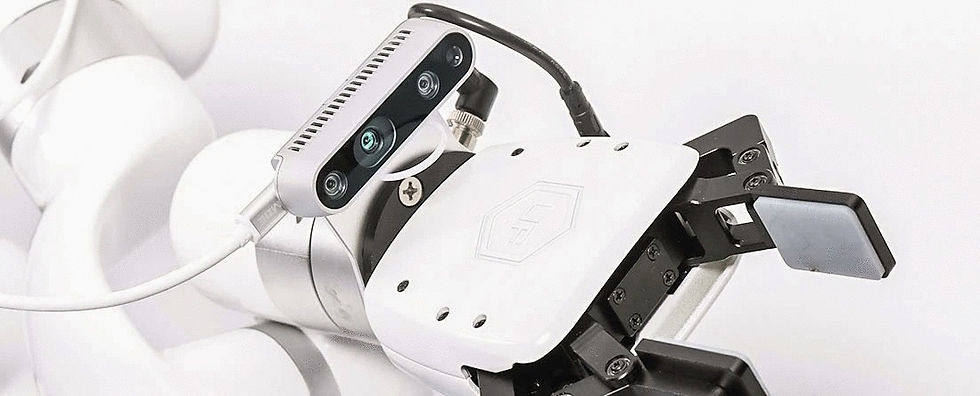
Robot arms are the physical execution layer. They pick, place, assemble, inspect, weld, palletize, and handle materials based on instructions from the controller, increasingly guided by 3D vision systems that allow them to adapt to variable conditions rather than just following fixed paths.
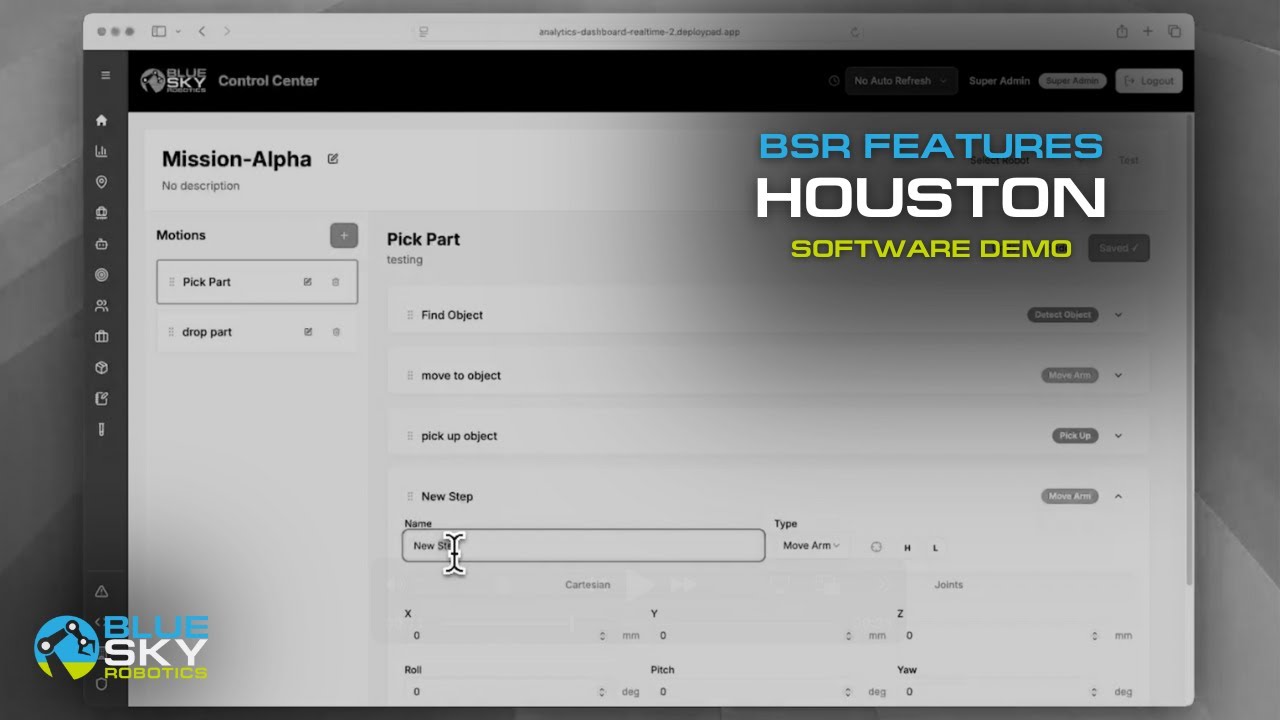
Vision and software tie the system together. Computer vision identifies objects, measures dimensions, detects defects, and feeds that data to robot controllers and manufacturing execution systems. Automation software manages scheduling, data collection, and process orchestration across the whole cell.
All five components can be deployed incrementally. Most factories do not automate everything at once. They start with one cell, prove the ROI, and expand.
Five Benefits That Make the Case
1. Efficiency and quality control. Automated systems run at consistent speed without the variability that fatigue, distraction, and shift changes introduce into manual processes. Built-in sensors detect errors at the point they occur rather than downstream, where the cost of finding a defect is significantly higher. The result is fewer rejects, less rework, and a more predictable output rate.
2. Lower cost per unit. Automation does not eliminate labor costs immediately, but it does change where labor is applied. When robot arms handle repetitive pick and place, palletizing, or machine loading tasks, the people previously doing those jobs can move to roles that require judgment, problem-solving, and oversight. Output goes up. Cost per unit goes down. In most deployments, payback periods run between 12 and 24 months depending on shift structure and labor cost.
3. Customization and flexibility. Modern factory automation systems, particularly those built around cobots and vision-guided software, can adapt to product changes faster than traditional fixed automation. Reprogramming a cobot for a new SKU takes hours rather than days. Vision systems identify objects rather than requiring them to be presented in a fixed position, which means the system handles variability without manual intervention. This flexibility is what makes automation practical for small and mid-size manufacturers running multiple product lines.
4. Waste reduction. Automated systems use precise, repeatable movements that minimize material overage and scrap. Sensors track consumption at each stage, making it possible to identify where material is being lost and correct it. Quality inspection at the point of production catches defects before they become finished goods, reducing the cost of the defect from a shipped product problem to a caught-in-process correction.
5. Workplace safety. Robot arms take over the tasks most likely to cause repetitive strain injuries, lifting injuries, and exposure to hazardous conditions. Vision-guided cobots are designed to detect objects in their path and stop or slow before contact, allowing them to work alongside people without full safety caging. Fewer injuries mean lower workers' compensation costs and better retention in physically demanding roles.
Where Cobots Fit In
Cobots are the most accessible entry point into a factory automation system for operations that are not yet running large-scale industrial automation. They are affordable, flexible, and deployable without major facility modifications.
The UFactory Lite 6 ($3,500) is the lowest-cost starting point for automating a light-duty task: simple pick and place, basic inspection, or machine loading in a low-volume cell. It is a practical first step for a manufacturer that wants to learn how automation works before committing to a larger investment.
The Fairino FR5 ($6,999) and Fairino FR10 ($10,199) cover the majority of production-grade factory automation tasks: pick and place, material handling, case packing, palletizing, and vision-guided inspection. Both integrate with standard PLC environments and support open APIs for connecting to broader factory automation software.
For the heaviest applications, the Fairino FR20 ($15,499) and Fairino FR30 ($18,199) extend payload capacity to handle bulk materials, heavy cases, and demanding cycle requirements.
Getting Started
Use our Automation Analysis Tool to model the ROI of automating a specific process in your facility. The Cobot Selector helps identify the right arm for your payload and reach requirements. When you are ready to see it working, book a live demo. To learn more about computer vision software visit Blue Argus.
Browse our full UFactory lineup and Fairino cobots with current pricing.
FAQ
What is a factory automation system?
A factory automation system is a coordinated set of sensors, controllers, robot arms, and software that runs manufacturing processes automatically. It replaces or supplements manual labor on repetitive, physically demanding, or precision-critical tasks, improving speed, consistency, and quality.
How much does factory automation cost?
Entry-level automation with a single cobot starts under $5,000 for a basic cell. Production-grade cells with vision systems, end-of-arm tooling, and integration work typically run $15,000 to $60,000 depending on complexity. That compares favorably to traditional industrial automation integrations, which often start at $100,000 and go significantly higher.
Is factory automation right for small manufacturers?
Yes, and increasingly so. Cobots starting at $3,500, open-source vision software, and simplified programming interfaces have brought factory automation within reach of operations that would have been priced out of the technology five years ago. The key is starting with one well-defined task, proving the ROI, and expanding from there.