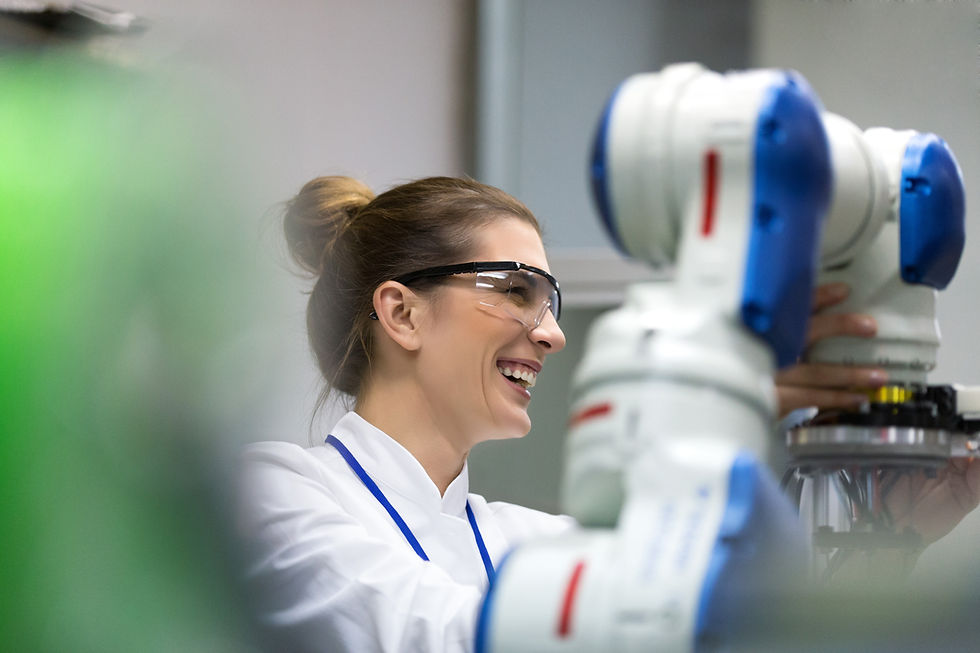
Exploring UR Robots: Modern Automation for Every Industry
- Blue Sky Robotics

- Nov 10
- 4 min read
Collaborative robots from Universal Robots have reshaped how companies approach automation, bringing human-centered design and plug-and-produce flexibility to tasks that once required heavy, fixed machinery. By enabling safer interaction between people and machines, these systems drive efficiency and closer collaboration across manufacturing floors, distribution centers and clinical settings. At their core, a ur robot is a collaborative arm engineered for repeatable precision and quick redeployment, making automation achievable for businesses of many sizes.
Recent advances in intuitive programming, embedded safety features and modular end-effectors make UR systems easy to integrate with existing processes while maintaining regulatory and workplace safety standards. That combination of adaptability and accessibility matters now more than ever, manufacturers and warehouses face labor shortages, demand for customization and pressure to reduce cycle times while maintaining quality. The next section defines the class of UR cobots and their core capabilities, then moves into industry applications, enabling technologies, real-world deployments and practical steps for implementation.
Understanding UR Robots and Collaborative Automation
Universal Robots (UR) produces compact, easy-to-program collaborative robots, cobots—designed to operate safely alongside human workers rather than behind safety fences. This approach to collaborative robotics emphasizes force-limited joints, intuitive teach interfaces, and modular end-effectors, which reduce integration time and make advanced automation accessible to businesses of all sizes.
Unlike traditional industrial robots that prioritize speed and isolation, UR robots balance performance with safety and adaptability: their lightweight design, built-in sensors, and simple programming let teams redeploy them across assembly, pick-and-place, inspection, and lab automation tasks with minimal engineering overhead. By enabling close human-robot collaboration, UR cobots increase productivity and workplace safety, allowing people to focus on complex decisions while robots handle repetitive or hazardous work, and their compatibility with vision systems, grippers, and fleet management software drives efficiency across manufacturing, logistics, and healthcare.
Applications of UR Robots in Manufacturing
UR cobots are now common on production floors, taking on repetitive, ergonomically challenging, or high-precision duties that free human workers for higher-value tasks. For example, UR robots routinely perform assembly and material handling, precision welding, and packaging operations, tasks where their repeatability, compact footprint, and easy redeployment deliver measurable throughput gains without major changes to existing line layouts. Their collaborative design also lets them work safely alongside people in mixed workflows, reducing the need for extensive guarding and floor redesigns.
Real-world implementations highlight how quickly UR robots can improve efficiency and reduce downtime: manufacturers often report faster cycle times, fewer quality defects, and shorter changeovers after adding cobots into cell-level automation. Ease of programming and integration is a major factor in these outcomes, intuitive teach pendants, drag-and-drop software, and a rich ecosystem of URCaps allow small and medium-sized enterprises to deploy solutions without in-house robotics engineers. Combined with innovations such as force-limited safety, lightweight modular arms, and open interfaces for third-party tooling, UR robots make scalable, low-risk automation accessible to businesses of all sizes.
UR Robots in Warehousing and Logistics
Universal Robots’ collaborative arms are increasingly used to add agility to warehouse workflows, allowing teams to reconfigure stations for picking, packing and internal transport without major capital projects. Their role in enabling flexibility in warehouse operations, from high-density picking to conveyor-side sorting and goods-to-person transport, helps operations adapt to seasonal peaks and SKU variability while preserving human oversight.
A key reason UR cobots integrate smoothly into logistics environments is their interoperability with existing warehouse management systems (WMS) and automation stacks; open APIs, standard industrial protocols and an ecosystem of URCaps plugins let integrators connect cobots to inventory databases, conveyors and vision systems with minimal custom code. That plug-and-play connectivity, combined with intuitive programming and teach pendant workflows, shortens commissioning time and lets teams iterate automation tasks as processes change.
Beyond flexibility and integration, UR robots deliver measurable benefits in safety and cost reduction: collaborative safety features (force-limited joints, safety-rated stops) and integrated sensing reduce workplace injuries and the need for extensive guarding, while automation lowers manual error rates and increases throughput, improving operational costs and ROI. Scalable and accessible to small-to-large businesses, these technological advances position UR cobots as practical tools for logistic teams aiming to boost efficiency without disrupting existing systems.
The Automation Revolution is Here
The landscape of the industrial sector is ever-evolving, with collaborative robots playing a pivotal role in this change. These advanced technologies serve as crucial bridges between traditional automation systems and human-centric industrial processes. The adoption of cobots signifies a monumental shift in how industries operate, promising enhanced efficiency and productivity.
As industries continue to adopt collaborative robots, the potential for innovation and growth is enormous. Cobots not only improve operational effectiveness but also support a safer and more flexible working environment. This shift marks the beginning of an exciting era where humans and robots function in harmony, driving industries towards new heights.
Looking to the future, the role of collaborative robots will only grow more significant. They are set to revolutionize industries in ways previously unimaginable, offering unprecedented opportunities for creativity and innovation. As this technological revolution continues, the collaboration between humans and robots will shape a modern, efficient, and interconnected industrial landscape.