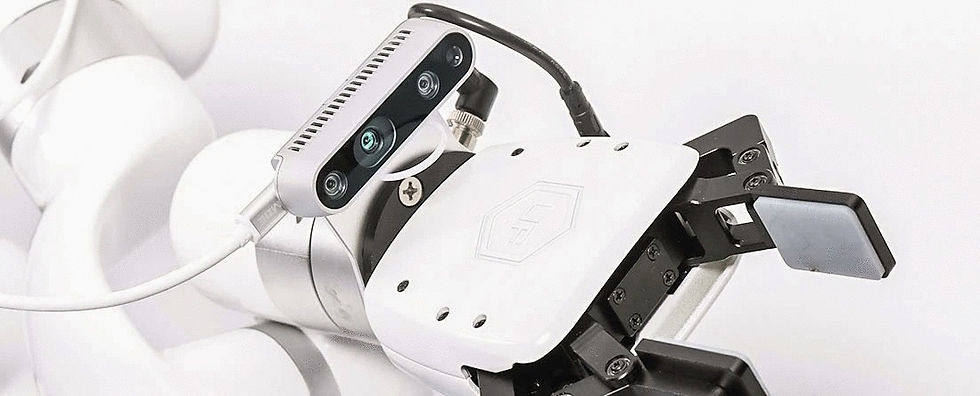


Electric Grippers: Precision Handling for Modern Automation
- Jan 26
- 5 min read
Electric grippers have emerged as a key innovation in modern robotics, delivering precise, adjustable, and energy-efficient handling where repeatability and delicate part control are essential. Across manufacturing, warehousing, and research environments, electric grippers are replacing traditional actuators because they offer fine force control, programmability, and lower operating costs. For Blue Sky Robotics’ audience, this means faster changeovers, less product damage, and clearer performance metrics for automation projects.
Unlike pneumatic systems that rely on compressed air and fixed force profiles, electric solutions provide repeatable position and force control, simpler integration with motion systems, and improved energy use. Understanding these differences will help teams evaluate trade-offs, choose the right end effector, and plan integration and maintenance to maximize uptime. In the following article, we will explore how these devices work and the core design choices that determine their performance.
How Do Electric Grippers Differ from Pneumatic Grippers?
Electric grippers use integrated electric motors or servos to drive fingers or jaws, providing precise, adjustable motion and closed-loop force control that suits delicate and variable tasks. Pneumatic grippers, by contrast, rely on compressed air and simple valves for actuation, offering robust, fast motion but with coarser force control and greater baseline energy use from compressors. As manufacturers, warehouses, and labs move toward more flexible automation, electric grippers have gained traction for their fine control, repeatability, and energy-efficient idling compared with traditional pneumatic systems.
On performance metrics, electric grippers generally deliver superior force control and positional precision, operate more quietly, and often consume less overall energy because power is applied only during motion or holding; pneumatics can be faster in simple open-loop tasks but tend to be noisier and less efficient. Electric solutions also integrate more readily with digital control systems and higher-level robotics software, simplifying tasks like force feedback, motion profiling, and sensor fusion. The trade-offs are clear: electric grippers introduce greater system complexity and higher upfront cost, and may require more specialized maintenance, whereas pneumatic systems are mechanically simpler and cheaper initially but can incur higher operating and infrastructure costs over time.
What Are the Key Advantages of Electric Grippers?
Electric grippers have emerged as a key innovation in modern robotics, delivering markedly higher precision and repeatability than traditional pneumatic systems. Unlike air-driven grippers whose variability depends on compressibility and regulator settings, electric actuators offer tightly controllable motion profiles that improve pick-and-place accuracy across thousands of cycles. This consistency has driven faster adoption of electric grippers in manufacturing, warehousing, and research environments where tight tolerances and repeatability are critical.
One major advantage is the ability to finely adjust gripping force, allowing a single electric gripper to handle fragile items such as electronics or soft packaging without mechanical changeovers. Built-in sensors and diagnostics provide real-time feedback and automation data, enabling closed-loop control, force-limited gripping and inline quality monitoring that reduce product damage and increase yield. These capabilities make electric grippers well suited for collaborative robots and automated cells that require both sensitivity and robust performance.
Electric grippers also improve energy efficiency and lower operating costs by eliminating dependence on central air compressors, reducing both power draw and maintenance overhead. Their lower energy footprint and networked diagnostics support sustainability goals and seamless smart factory integration, enabling predictive maintenance and data-driven optimization across IoT-enabled production lines. Together, reduced utility costs, simpler infrastructure, and improved automation transparency explain the growing shift from pneumatic to electric solutions.
Which Industries Commonly Use Electric Grippers?
Electric grippers have become indispensable across manufacturing sectors where delicate, repeatable handling is essential, from assembling electronics and precision instruments to installing automotive components. Compared with traditional pneumatic systems, electric grippers deliver finer force control, programmable motion profiles, and better energy efficiency, making them ideal for tasks that demand consistency and minimal part damage. Their precise, adjustable gripping and feedback-enabled operation enable higher yields and faster changeovers on modern assembly lines.
Beyond factory floors, electric grippers are widely used in warehouses and logistics centers for accurate package handling and high-speed sorting, and they are increasingly relied upon in laboratories and research settings where clean, repeatable motion is vital for testing and sample handling. Integrators often pair electric end effectors with collaborative robots to enable human-safe automation in small-scale operations, allowing flexible deployment without extensive safety infrastructure. Looking ahead, the most notable trends are the rise of adaptive grippers that conform to variable parts and AI-driven manipulation systems that optimize grip strategy in real time, further expanding electric grippers’ applicability across industries.
Frequently Asked Questions
Can electric grippers handle heavy-duty industrial tasks?
Modern electric grippers can handle medium-to-heavy parts when designed with the right motor torque and mechanical robustness, and specialized models with high-force servos are routinely deployed for heavy component handling on industrial assembly lines. Compared with traditional pneumatic systems, electric grippers provide precise, adjustable force control, improved energy efficiency, and easier integration with robotic control, factors that are driving their growing adoption in manufacturing, warehousing, and research environments for heavy-duty automation tasks.
Are electric grippers more expensive than pneumatic ones?
Electric grippers typically carry a higher upfront cost than pneumatic ones because they incorporate motors, sensors, and electronics that enable precise, adjustable gripping and integrated motion control, representing a key innovation in modern automation. However, they often deliver lower total cost of ownership over time through reduced energy consumption, less maintenance (no compressed-air infrastructure), and improved process control and throughput, which is why their adoption is growing in manufacturing, warehousing, and research environments.
How do electric grippers enhance precision in robotic systems?
Through high-resolution servo control and integrated force and position sensors, electric grippers deliver accurate, repeatable gripping forces and finely adjustable closure profiles that enable delicate handling and continuous feedback monitoring for consistent, damage-free manipulation. Compared with traditional pneumatic systems, their energy-efficient, programmable actuation and adaptive control make electric grippers increasingly adopted across manufacturing, warehousing, and research environments where precise, adaptive automation is essential.
Optimizing Robotics with Electric Grippers
Embodying precision, efficiency, and intelligence, electric grippers have grown to become a cornerstone in the realm of modern automation. They offer unmatched control and adaptability, opening up a world of possibilities across a variety of industries. From handling delicate components in manufacturing processes to aiding precision movements in robotics, these powerful tools lead the way in energy-efficient innovation.
As we look to the horizon of expanding automation, manufacturers and integrators would do well to galvanize their workflows with electric gripping solutions. Not only are these devices robust, but they also crystallize long-term cost savings and catapult industry standards for repeatable high-quality output. Lean into the future of robotics with electric grippers and unlock the true potential of your automation workflows. By adopting these innovative tools today, we can collectively charge towards a future of smart, sustainable, and efficient production.