



Depalletizing with a Cobot: The Automation Win Most Small Manufacturers Miss
- Apr 6
- 4 min read
Updated: Apr 13
Walk into the receiving area of almost any manufacturing facility or distribution center and you will find the same scene: someone breaking down incoming pallets by hand, layer by layer, lifting cases that weigh anywhere from 20 to 50 pounds, repeating that motion hundreds of times per shift, at a pace that slows steadily as the shift progresses.
Depalletizing is physically punishing, difficult to staff, and almost entirely predictable as a process. Those three facts together make it one of the strongest candidates for robotic automation in any facility. It is also, historically, one of the last places small manufacturers look because the systems designed for it have been sized and priced for 3PLs and beverage companies running thousands of cases per hour.
That calculus has changed. A cobot arm with the right payload and a 3D vision system can handle depalletizing at a price point that makes sense for a facility receiving twenty pallets a day, not two thousand.
Why Depalletizing Is Harder to Staff Than It Looks
The depalletizing task looks simple from a distance. Pick a box off a pallet, set it on a conveyor. Repeat. In practice, the combination of factors that make it hard to automate are the same ones that make it hard to staff reliably.
Incoming pallets are not uniform. Case sizes vary across SKUs. Stacking patterns change by supplier. Layers compress unevenly in transit. Boxes arrive damaged, skewed, or partially collapsed. A person handles all of this variation intuitively, adjusting grip and approach angle on every pick without being told to. A poorly designed automated system would stop at the first unexpected configuration.
The physical toll is significant. Repetitive heavy lifting at varying heights, from floor level to above shoulder height as the pallet empties, produces musculoskeletal injuries at a rate that drives turnover and workers compensation costs. According to the Bureau of Labor Statistics, material handling roles consistently rank among the highest for workplace injury rates in manufacturing and warehousing.
The combination of physical demand and inconsistency makes depalletizing genuinely hard to fill, harder to retain, and increasingly expensive to run manually as labor markets have tightened.
How a Cobot Handles It
Modern robotic depalletizing cells solve the variability problem through 3D vision. An overhead camera scans each pallet layer, maps the position and orientation of every case in the field of view, and feeds that spatial data to the robot controller. The arm calculates the best grasp point for each individual case, picks it, and places it on the downstream conveyor or staging area.
When the layer pattern shifts, when a box is skewed, or when the pallet height changes as it empties, the vision system updates the pick plan dynamically rather than halting the cycle. This is what separates a vision-guided depalletizing cell from a fixed-position robot that stops the moment anything deviates from its programmed parameters.
Gripper selection matters as much as the vision system. Vacuum cup grippers handle smooth-sided cardboard cases well and are the most common end-of-arm tool for depalletizing. Adaptive grippers handle more varied surface types and packaging formats. For facilities receiving a wide SKU mix with different packaging materials, matching the gripper to the worst-case packaging scenario rather than the average case is the decision that determines whether the cell actually runs unsupervised.
What the Numbers Look Like
Depalletizing produces some of the strongest ROI cases in robotics automation because the labor cost it replaces is highly visible and the task runs on every shift without variation in its business justification.
A single manual depalletizer working two shifts is typically a fully-loaded annual labor cost of $70,000 to $90,000 depending on location, benefits, and overtime. A cobot depalletizing cell handles both shifts continuously, without fatigue-related slowdown in the second half of each shift and without turnover.
Payback periods for robotic depalletizing cells in light to medium duty applications typically run 12 to 18 months. Facilities running three shifts, or those with particularly high turnover in the role, often see faster returns.
Choosing the Right Cobot for Depalletizing
Payload is the critical specification. The robot must be able to handle the heaviest case it will ever encounter at the maximum reach distance required to clear the pallet edge. Undersizing the payload rating by even a few kilograms creates a cell that works on most picks and fails on the ones that matter.
The Fairino FR10 ($10,199) is the starting point for depalletizing applications handling cases up to 10 kg. It covers the majority of light consumer goods, packaged food, and general merchandise applications where case weights are moderate and the pallet footprint is standard.
The Fairino FR16 ($11,699) handles cases up to 16 kg and is the better choice for facilities receiving heavier product, including beverages, hardware, or industrial components packaged in larger cases.
The Fairino FR20 ($15,499) covers the heaviest end of cobot-range depalletizing at 20 kg payload, appropriate for high-density products or oversized cases that push the limits of what a person should be lifting in the first place.
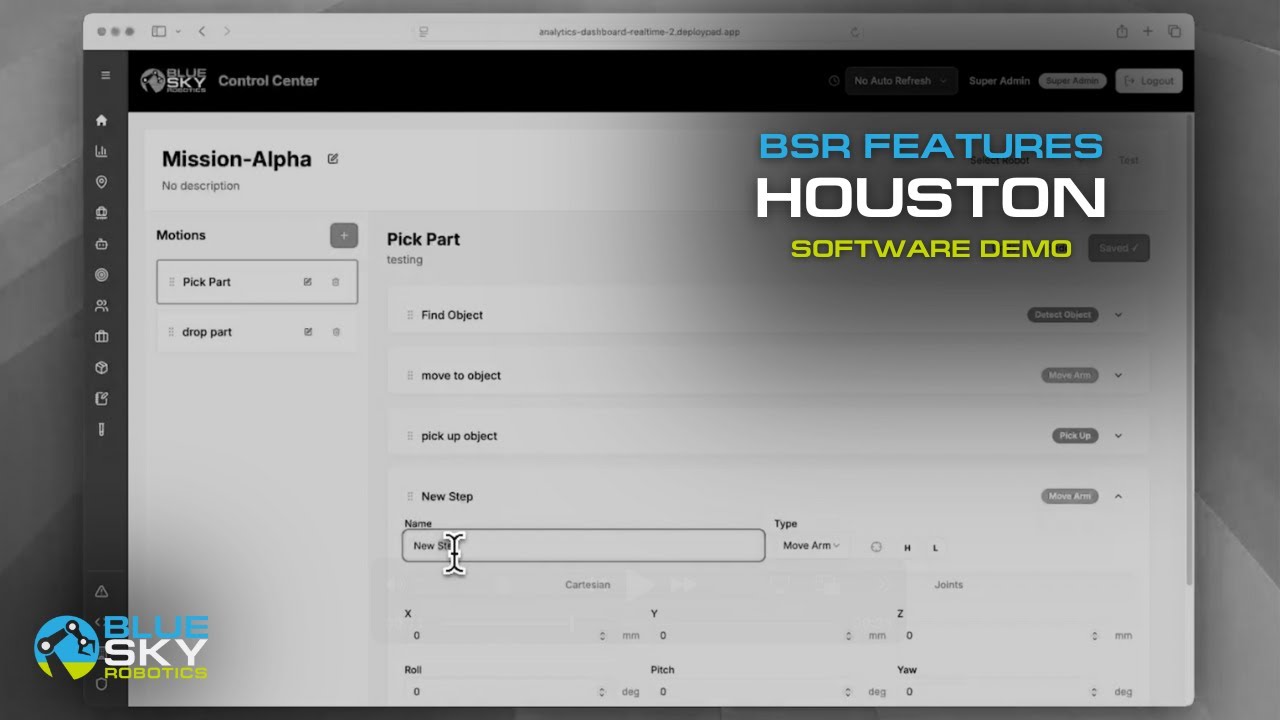
All three Fairino models support 3D vision integration through ROS2 and open APIs, and Blue Sky Robotics' automation software handles the mission logic connecting the vision system to the pick sequence without custom programming from scratch.
Where to Start
If your facility has people breaking down incoming pallets manually on every shift, the automation case is already made. The question is which configuration fits your case weights, SKU mix, and floor layout.
The Automation Analysis Tool runs the numbers for your specific application. The Cobot Selector matches the right arm to your payload requirements. And if you want to see a depalletizing cell running on real cases before committing to anything, book a live demo with the Blue Sky Robotics team. To learn more about computer vision software, visit Blue Argus.
The hardest job in your receiving area is one of the easiest places to start automating.


