

Definition of Automated System: What It Means and Why It Matters in 2026
- May 29
- 5 min read
The term gets used constantly in manufacturing, logistics, and technology circles, but a clear definition of automated system is rarely offered. This post provides one, breaks down how automated systems are classified, and explains what that means in practical terms for manufacturers evaluating their next step in automation.
What Is an Automated System?
An automated system is a coordinated arrangement of technology, software, and mechanical components that executes tasks or processes with minimal or no human intervention. The defining characteristic is that the system follows predefined logic or learned instructions to perform work, make decisions within set parameters, and respond to inputs without requiring a person to direct each step.
In manufacturing, an automated system represents the convergence of robotics, software intelligence, and mechanical systems designed to execute production tasks with minimal human intervention. These frameworks transform traditional factory floors into responsive, data-driven operations that adapt to demand fluctuations, quality requirements, and efficiency targets.
The term "automation" itself was coined by D.S. Harder, the engineering manager at Ford, in the 1940s, to describe the automatic handling of parts between production steps. The concept has evolved considerably since then, but the core idea has not changed: using technology to do work that would otherwise require human action.
The Three Types of Automated Systems
The most durable classification of automated systems comes from industrial engineering and distinguishes three types based on how the system handles variety and changeover.
Fixed automation, also called hard automation, refers to a production facility in which the sequence of operations is fixed by the equipment configuration. The instructions are embedded in the hardware itself, through cams, gears, wiring, and tooling that cannot easily be changed. Fixed automation delivers high throughput and low per-unit cost, but it cannot adapt to different products.
Automotive transfer lines and high-speed bottling equipment are classic examples. It is best suited to very high-volume, single-product environments.
Programmable automation allows the system to be reconfigured for different products by reprogramming the control logic. A CNC machining center or a programmable logic controller (PLC) that operates a production line are examples. Products are typically made in batches, and changeover requires a programming or setup step between runs. This type handles more variety than fixed automation but still requires deliberate reconfiguration.
Flexible automation extends programmable automation by enabling changeovers to happen automatically, without stopping the line or requiring manual reprogramming. A flexible automated system can produce a mix of different products in sequence because the reprogramming occurs off-line, at a computer terminal, without disrupting production. Modern robotic cells with vision systems and recipe-based software represent flexible automation: the robot can switch from one part family to another by loading a new program, often in seconds.
The Components of an Automated System
Every automated system, regardless of type or industry, is built from a similar set of components organized into layers.
The physical layer includes the robots, conveyors, AGVs, actuators, and material handling equipment that actually move, assemble, sort, or package products. Actuators are the mechanical components that convert energy into motion or force, acting as the muscles of the system that translate control signals into real-world actions such as moving a robotic arm, pressing a part into place, or opening a valve.
The control layer sits above the physical layer and manages the physical assets through programmable logic controllers (PLCs), distributed control systems (DCS), and motion controllers. This layer translates high-level instructions into precise mechanical actions, coordinating timing, speed, and positioning across multiple devices simultaneously. PLCs are the most common control layer technology: specialized industrial computers built for heat, vibration, and electrical noise, continuously collecting data from sensors and executing programmed instructions to manage actuators and motors in real time.
The supervisory layer hosts human-machine interfaces (HMIs) and manufacturing execution systems (MES) that bridge the shop floor and enterprise planning systems. This integration enables real-time visibility into production status, quality metrics, and resource utilization. Above this sits enterprise software, including ERP systems and data analytics platforms, that connect the automated system to business-level decision-making.
How the Definition Has Evolved
The textbook definition of an automated system has remained stable for decades, but the practical reality of what automated systems can do has changed dramatically. Modern manufacturing automation uses robotics, control systems, and software to enhance precision, efficiency, and consistency in ways that were not possible even five years ago.
Artificial intelligence and machine learning now power adaptive systems that optimize parameters without explicit programming. These algorithms analyze historical performance data to predict optimal settings for new production runs, reducing setup time and accelerating time-to-quality. Industrial IoT connectivity creates comprehensive operational visibility, with every sensor, actuator, and controller generating data that feeds analytics platforms for predictive maintenance and real-time process adjustment.
Software-defined automation is one of the most significant architectural shifts underway in 2026. Traditional automated systems embedded control logic in dedicated PLCs tied to specific machines. Software-defined automation moves that control logic to software platforms running on servers or in the cloud, separating industrial control from the physical machines. This makes the entire system far more flexible, easier to update, and capable of integrating AI and digital twin tools without replacing hardware.
According to PwC's Global Industrial Manufacturing Sector Outlook 2026, the share of industrial manufacturers who expect to highly automate key processes will more than double by 2030, from 18% to 50%. Among the most agile, future-fit companies, that share is expected to reach 65%. The report notes that manufacturers must treat AI and automation as a system, not a set of isolated projects, to unlock the full productivity opportunity.
What This Means for Manufacturers Starting Out
Understanding the definition of an automated system matters because it changes how you approach the buying decision. Fixed automation is fast and cheap per unit, but inflexible. Programmable automation handles variety but requires planned changeovers. Flexible automation, which is where most modern robotic arms and cobot cells fall, handles variety on the fly and scales as your product mix changes.
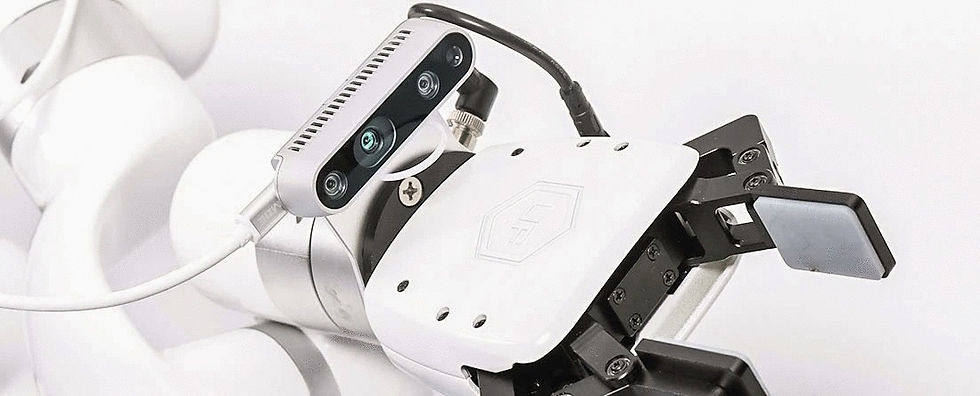
For most small and mid-sized manufacturers, flexible automation is the right starting point. A cobot arm with vision-guided pick-and-place, machine tending, or inspection capability is a flexible automated system: it can be reprogrammed for new parts, integrated with conveyor and material handling systems, and expanded as throughput grows. The entry point is lower than most manufacturers expect, with systems starting at $6,099 for the robot arm itself.
Use the Automation Analysis Tool to evaluate which type of automated system makes sense for your specific application, or book a live demo to see a flexible automated system running in a real production cell. To learn more about Blue Sky Robotics’ computer vision platform, visit Blue Argus.
Conclusion
An automated system, in its most complete definition, is a layered arrangement of physical equipment, control logic, and software that performs work with minimal human intervention. Fixed, programmable, and flexible automation represent points on a spectrum of capability and adaptability. In 2026, the distinction that matters most for manufacturers is between rigid systems locked to a single product and flexible systems that can handle variety, integrate with vision and AI, and grow alongside the business.
Blue Sky Robotics deploys flexible automated systems through its Blue Argus vision platform, paired with Fairino and UFactory cobot arms starting at $6,099. Explore the full robot lineup or use the Cobot Selector to find the right arm for your application.