



Computer Vision vs Machine Learning: What's the Difference and Why It Matters for Robotics
- Apr 6
- 5 min read
Updated: Apr 13
If you have spent any time researching robot automation, you have encountered both terms. Computer vision. Machine learning. They come up in the same conversations, sometimes used interchangeably, which creates genuine confusion for anyone trying to understand what is actually powering a vision-guided robot cell.
They are related but not the same thing. Understanding the distinction helps you ask better questions of vendors, evaluate automation software more clearly, and understand what a robot system can and cannot do. This post explains both terms, how they differ, how they work together in industrial robotics, and what it means for a manufacturer considering a vision-guided cobot.
What Computer Vision Is
Computer vision is a field of artificial intelligence focused on giving computers the ability to interpret and understand visual information. Images, video, point clouds, depth maps, computer vision systems process all of these to extract meaningful information about the world.
In industrial robotics, computer vision does the work of perception. It takes raw image data from a camera and answers questions like: What object is in this image? Where is it located? How is it oriented? Does it have a defect? What are its dimensions? The output of that processing is the information a robot needs to act.
Computer vision encompasses a wide range of techniques, from classical methods like edge detection and template matching to modern deep learning-based approaches. The key point is that computer vision is about understanding visual data, whatever method is used to do it.
What Machine Learning Is
Machine learning is a broader category of artificial intelligence in which systems learn patterns from data rather than following explicit rules written by a programmer. Instead of a developer specifying exactly what a cat looks like, a machine learning model is trained on thousands of images of cats and learns to recognize them on its own.
Machine learning is not specific to vision. It is used in demand forecasting, fraud detection, language translation, and countless other applications that have nothing to do with images. In robotics, machine learning shows up in path planning, grasping strategy optimization, anomaly detection, and predictive maintenance, in addition to its prominent role in vision systems.
The relationship between computer vision and machine learning is that modern computer vision heavily relies on machine learning, particularly deep learning, to achieve the kind of flexible, robust object recognition that industrial applications require. But computer vision also uses non-machine-learning methods, and machine learning is used in many contexts that have nothing to do with vision.
How They Work Together in a Robot Vision System
A practical robot vision system for pick and place or inspection combines both in a layered architecture.
The camera captures the scene. Classical computer vision algorithms handle low-level processing: filtering noise, correcting for lens distortion, aligning point cloud data. Machine learning models then handle higher-level recognition: identifying which object is in the scene, classifying its type, detecting defects, or determining grasp points on irregularly shaped parts.
The result is fed to path planning software, which may also use machine learning to optimize the robot's trajectory for speed and collision avoidance. The robot controller executes the movement.
Mech-Mind's software stack is a useful example of how this layered approach works in practice. Their Mech-Vision platform handles image processing and object recognition, combining classical computer vision with AI-powered deep learning models for applications like bin picking, palletizing, and inspection. Their Mech-DLK deep learning toolkit allows operators to train custom models for specific objects without requiring machine learning expertise, making the capability accessible to manufacturers who are not AI specialists.
Why the Distinction Matters for Manufacturers
Understanding the difference between computer vision and machine learning has practical implications when evaluating automation software.
Flexibility vs. rigidity- A system that relies entirely on classical computer vision without machine learning is faster to set up for specific, well-defined tasks but struggles when parts vary in appearance, orientation, or condition. A system that incorporates machine learning handles variability better and improves over time as more data is collected.
Setup requirements- Machine learning models require training data. For common objects like cardboard boxes or standard industrial parts, pre-trained models often work out of the box. For unusual parts or specialized defects, custom training is needed. Understanding this upfront helps set realistic expectations for deployment timelines.
What "AI-powered" actually means- Many automation vendors use the phrase AI-powered vision without being specific. The meaningful question is whether the system uses machine learning for object recognition and whether that model can be retrained or fine-tuned for your specific parts without needing an AI team to do it.
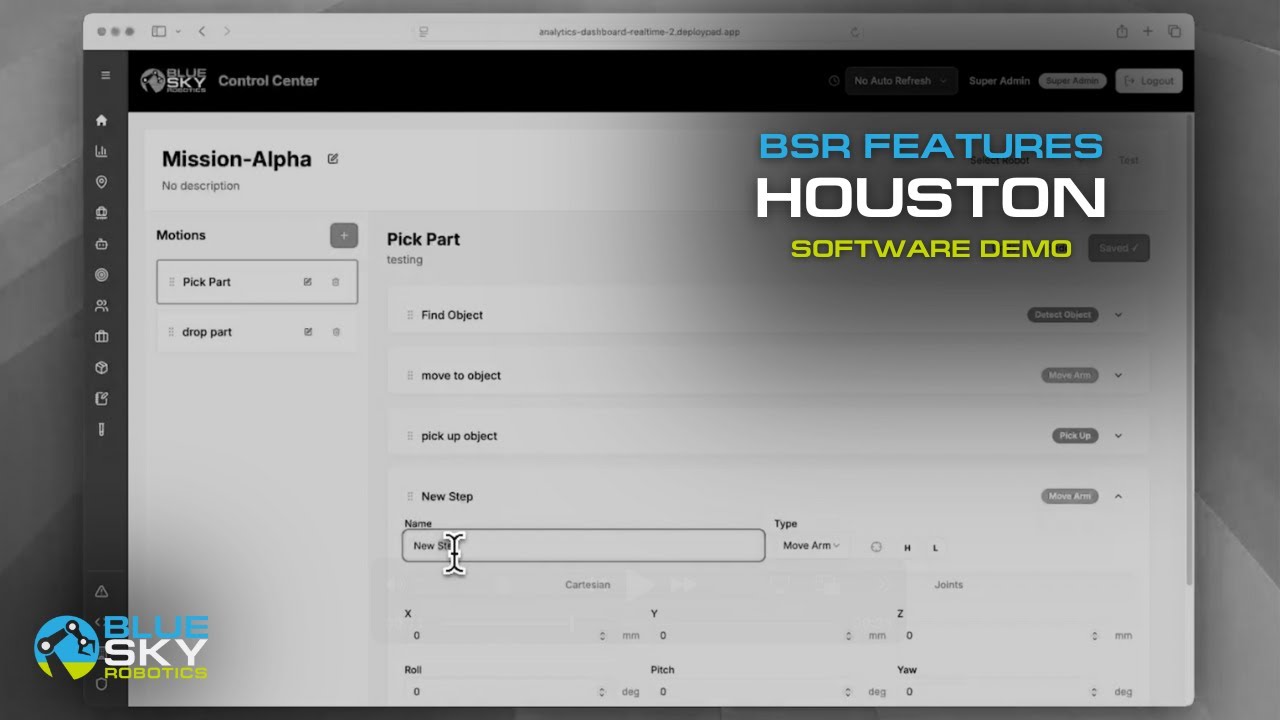
Blue Sky Robotics' automation software is built around computer vision and mission building tools that are designed to be accessible to manufacturers without deep technical expertise. Every arm in our lineup supports integration with vision systems that combine classical and machine learning-based computer vision, giving you the flexibility to start simple and add intelligence as your application demands it.
Which Cobots Support Vision and AI Integration
The robot arm itself does not run computer vision or machine learning. Those processes happen on a separate computing platform. The arm receives coordinates and movement commands as output. What matters for integration is that the arm supports open APIs and communication standards that allow vision software to send those commands reliably.
Every arm in the Blue Sky Robotics lineup meets that requirement. For entry-level vision applications, the UFactory Lite 6 ($3,500) supports UFactory's open-source vision SDK with ready-to-run examples. The Fairino FR5 ($6,999) and Fairino FR10 ($10,199) provide the payload and ROS compatibility needed for production-grade vision and AI-guided automation.
Getting Started
Explore our automation software to see how Blue Sky Robotics' computer vision and mission-building tools work alongside our cobots. Use the Cobot Selector to match an arm to your application, or book a live demo to see a vision-guided cell in action. To learn more about computer vision software visit Blue Argus.
Browse our full UFactory lineup and Fairino cobots with current pricing.
FAQ
Is computer vision the same as machine learning?
No. Computer vision is focused on interpreting visual data. Machine learning is a broader approach where systems learn patterns from data rather than following explicit rules. Modern computer vision relies heavily on machine learning, but the two are distinct fields with significant overlap.
Do I need machine learning to use a vision-guided robot?
Not necessarily. Simple vision tasks like barcode reading, presence detection, and basic dimensional checks can be handled with classical computer vision without machine learning. More complex tasks like bin picking of irregular parts, defect detection on variable surfaces, or recognizing multiple SKUs benefit significantly from machine learning models.
Can I use AI vision without a team of data scientists?
Increasingly yes. Modern vision platforms like Mech-Mind's Mech-DLK allow operators to train custom object recognition models through graphical interfaces without writing code. Pre-trained models for common object types work out of the box for many standard applications.


