



Clear Object Handling: Why Transparent Parts Break Robot Vision (And How to Fix It)
- Apr 6
- 5 min read
Mention clear object handling to a robotics engineer and the reaction is immediate recognition. Transparent and translucent parts are widely understood in the vision-guided robotics community as one of the hardest material categories to automate reliably. The industries that handle them most heavily, pharmaceuticals, food and beverage, logistics and e-commerce, have often assumed that vision-guided picking of clear parts simply was not viable.
That assumption is changing. Understanding why clear objects cause problems for 3D cameras, what the technical approaches to solving the problem look like, and which real-world applications are now automatable helps manufacturers in these industries make better decisions about where robotic automation fits in their workflow.
Why Clear Objects Break 3D Camera Systems
The problem with transparent and translucent materials is not a limitation of any one camera technology. It is a fundamental consequence of how those materials interact with light.
Every common 3D sensing approach, structured light, time-of-flight, and stereo vision, relies on light behaving predictably when it strikes the surface of an object. The camera or sensor emits or observes light, that light reflects off the object's surface in a measurable way, and the system calculates depth from that reflection.
A clear object does not behave this way. Some of the incident light passes straight through the material rather than reflecting. Some bounces off internal surfaces at unexpected angles. Some scatters in directions the sensor is not positioned to capture. The small, unpredictable amount of light that returns to the sensor from a truly transparent surface produces what engineers describe as floating points, noise, and missing surface data in the resulting point cloud.
The consequence in practice: the 3D reconstruction of a clear object is incomplete, unstable, or entirely absent. A robot relying on that data to calculate grasp points receives either no viable pick pose or an inaccurate one. The cell either halts waiting for a valid detection or, worse, attempts a pick based on corrupted data and misses or damages the part.
Translucent materials present a related but slightly different challenge. They scatter more light than transparent materials, which means the sensor captures more return signal, but that signal is diffuse and inconsistent rather than clean and geometrically precise. Point clouds of translucent objects often have the right general shape but with significant noise and incomplete coverage at surfaces where translucency is strongest.
Industries Where Clear Object Handling Matters Most
Pharmaceuticals. The pharmaceutical industry handles an unusually high concentration of transparent and translucent materials: saline IV bags, glass vials, ampoules, blister packs with clear plastic backing, and syringes. Piece picking and sorting of these items historically required manual handling because vision systems could not reliably locate and orient them. As pharmaceutical logistics operations scale and labor becomes harder to source, the inability to automate clear object handling becomes a production capacity constraint.
Food and beverage. Clear plastic containers, bottles, shrink-wrapped multipacks, and transparent pouches appear throughout food and beverage production and distribution lines. End-of-line packing operations that handle a mix of opaque and transparent packaging need vision systems capable of handling both material types without separate cells for each.
Logistics and e-commerce fulfillment. Polybags, clear bubble wrap, and transparent packaging are common in high-volume piece picking environments. A fulfillment cell picking mixed SKUs where some items are opaque and some are clear or translucent needs vision that does not fail selectively on a subset of the inventory. The throughput impact of even occasional clear object failures adds up quickly in high-velocity operations.
Electronics and precision parts. Clear protective packaging, transparent trays, and translucent carriers appear throughout electronics assembly and kitting operations. Parts staged in clear carriers or blister packs require the same pick accuracy as parts in opaque containers, but present the same optical challenges.
What Technical Approaches Actually Work
Several approaches have emerged for handling clear objects in vision-guided robotics, each with trade-offs in cost, complexity, and the range of transparent materials they address.
Specialized imaging modes. Some 3D camera systems now include specific operating modes designed for transparent and translucent materials. These modes adjust how the camera projects and captures structured light to maximize the usable return signal from clear surfaces. Rather than attempting to capture the full point cloud of a clear object, they optimize for the geometry that is measurable, producing cleaner and more complete point clouds than standard modes even if coverage is not perfect. The practical result is a system that can locate and orient clear objects well enough for reliable grasp planning where standard modes would fail entirely.
Combined 2D and 3D data. For applications where the exact 3D geometry of a clear object is less critical than its location and approximate orientation, combining 2D image data with 3D depth data can fill the gaps that the depth sensor alone cannot capture. The 2D image provides edge and contrast information that remains detectable on many clear materials even when the depth data is sparse. Vision software that fuses both data sources can produce viable pick poses from combined information that neither source provides alone.
Deep learning-based recognition. For high-mix picking environments where clear objects appear alongside opaque ones in the same bin or tote, deep learning models trained on large datasets including transparent packaging materials can recognize and localize clear objects by their shape boundaries and context even when point cloud data is incomplete. This approach handles the overlapping, randomly oriented, and partially obscured clear objects that are common in logistics piece picking. Throughput in well-configured systems handling mixed SKU populations including clear materials can reach high volumes at each workstation, making this approach viable for production-scale logistics automation.
Surface treatment as a practical workaround. For controlled production environments where clear parts can be treated before the vision step, applying a light matte spray or diffuse coating to transparent surfaces temporarily makes them behave like opaque materials for the duration of the scan. This is a practical solution for inspection and precision measurement applications where part handling is already controlled, though it is not viable for high-volume picking operations where parts cannot be individually pre-treated.
Matching Clear Object Applications to the Right Robot
The robot arm in a clear object handling cell needs to match the payload and reach requirements of the specific application, just as in any other vision-guided deployment.
For pharmaceutical piece picking of light items like blister packs, small vials, and pouches, the UFactory Lite 6 ($3,500) handles the payload range with a compact footprint suited to controlled picking cells. For heavier pharmaceutical packaging, IV bags, and larger containers, the Fairino FR5 ($6,999) provides the payload and repeatability for production-level picking.
For logistics and e-commerce fulfillment where mixed SKU picking includes clear polybags and transparent packaging, the Fairino FR5 ($6,999) and Fairino FR10 ($10,199) cover the range of item weights typically encountered in piece picking operations.
For food and beverage end-of-line packing where clear containers and multipacks reach heavier weights, the Fairino FR10 ($10,199) and Fairino FR16 ($11,699) handle the payload requirements.
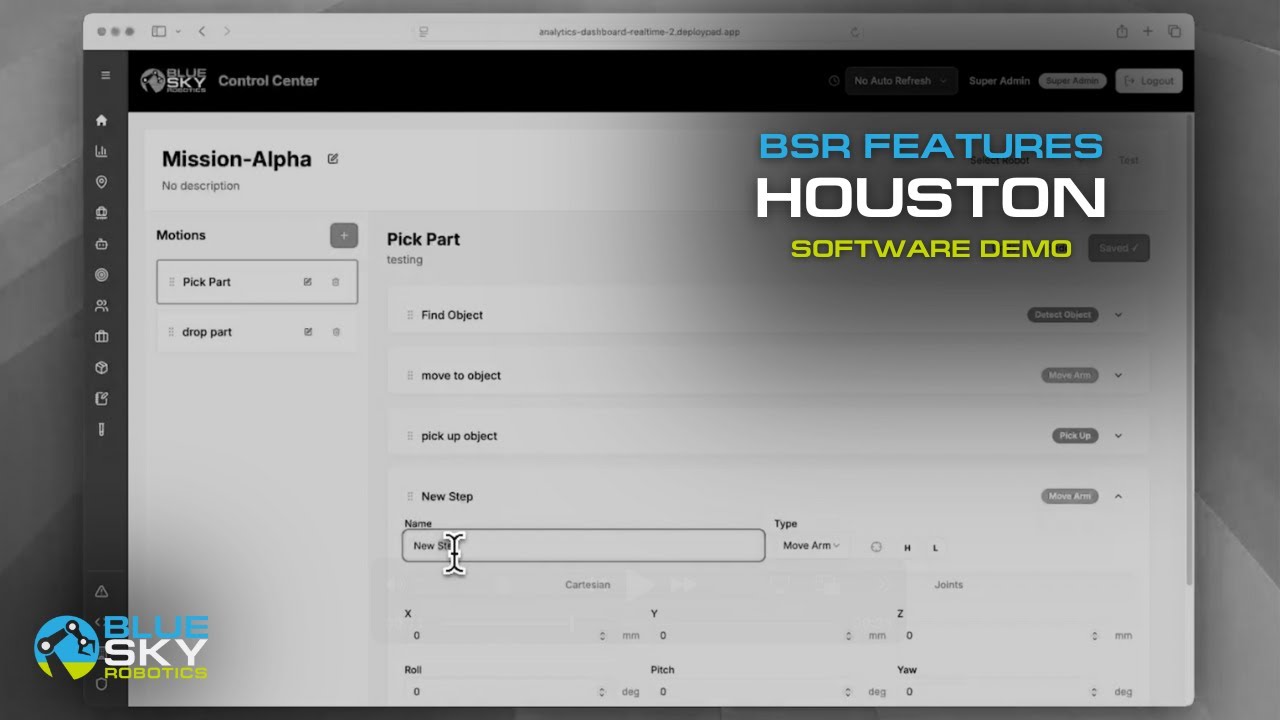
Blue Sky Robotics' automation software handles the vision integration and mission logic that connects the camera's output to robot motion in a single platform, reducing the integration complexity that clear object applications add to an already technically demanding vision configuration.
Where to Start
If your operation handles clear or translucent materials and has assumed robotic automation is not viable, that assumption is worth revisiting. The Automation Analysis Tool evaluates your specific application for feasibility. The Cobot Selector matches the right arm to your payload and task. And if you want to see how a vision-guided cell handles your specific material type before committing to hardware, book a live demo with the Blue Sky Robotics team. Clear objects used to be the category that stopped automation conversations. Increasingly they are not.


