



Camera Robots: What a Complete Vision-Guided Cell Actually Costs
- Apr 6
- 4 min read
Updated: Apr 13
When manufacturers search for camera robots, they are usually looking for one number: what does this cost? The answer they find almost everywhere is frustrating. Industry guides quote $40,000 to $150,000 for a complete cobot system. Robot vendors with hidden pricing require a sales conversation before they tell you anything. The number that gets quoted rarely matches what the manufacturer actually ends up spending.
The confusion comes from a real problem. A camera robot is not a single product. It is a system: a robot arm, a camera, a gripper, mounting hardware, software, and the integration work that makes them function together. Each of those components has its own cost, and the total depends on which components your specific application requires.
This post gives an honest, component-by-component breakdown of what a complete camera robot cell costs at each payload tier, using Blue Sky Robotics' published prices. No request-a-quote vagueness. The numbers are on the table.
What a Camera Robot System Actually
Includes
Before getting to numbers, it helps to know what you are buying. A complete camera robot cell for a production application typically includes six distinct components. Understanding each one prevents the most common budgeting mistake: pricing only the robot arm and discovering the rest of the system costs as much again.
The robot arm. This is the moving component that picks, places, loads, or inspects. Payload and reach determine which arm fits the application. This is the largest single line item and the one most buyers focus on correctly.
The camera. The depth sensor that gives the robot spatial awareness. For applications where parts are always in a known, fixed position, a camera may not be required at all. For any application involving variable part positions, bin contents, or mixed orientations, a 3D camera is essential. Camera cost varies widely by technology: entry-level depth cameras suitable for many light manufacturing applications cost $300 to $1,500. Mid-range industrial structured light systems run $3,000 to $8,000.
The gripper. The end-of-arm tool that contacts and holds the part. Parallel jaw grippers for rigid parts, vacuum cups for smooth-surfaced items, and soft grippers for delicate or flexible materials. A standard parallel jaw gripper costs $800 to $2,500. Custom grippers for unusual geometries can run higher.
Camera mounting hardware. For eye-to-hand configurations, a fixed stand or bracket that holds the camera above the workspace. For eye-in-hand, a mounting bracket that attaches the camera to the robot's end-effector. Mounting hardware typically runs $65 to $500 depending on configuration and rigidity requirements.
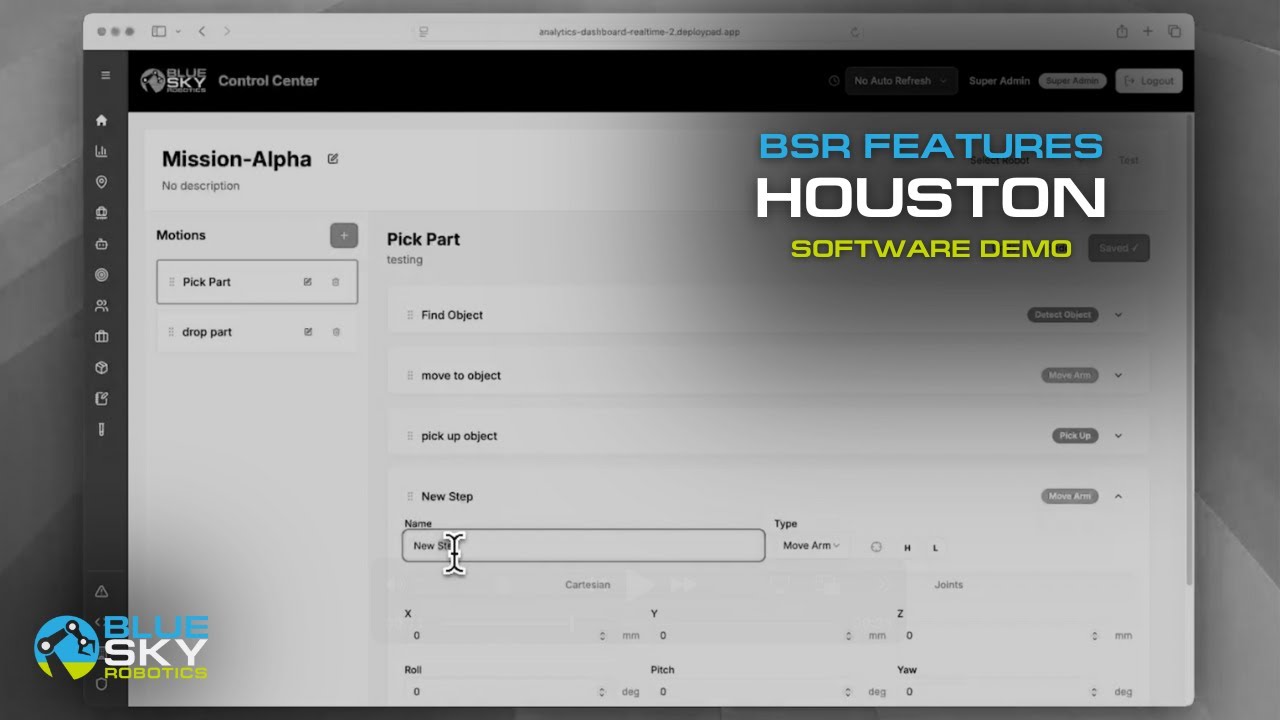
Software. The mission logic that connects the camera's depth data to the robot's motion commands. This is where the integration complexity either lives in a platform you configure or in custom code you build. Blue Sky Robotics' automation software handles vision integration, pick-and-place logic, and workflow sequencing in a single platform designed for UFactory and Fairino deployments.
Integration and setup time. Not always a cash cost, but always a real cost. A straightforward eye-to-hand pick-and-place cell with a standard depth camera typically takes one to five days to set up for a first-time deployer. Hand-eye calibration, camera positioning, gripper tuning, and exception handling configuration are the setup steps that consume that time.
Complete System Cost by Tier
Here is what a complete camera robot cell costs at each payload tier using Blue Sky Robotics' live pricing. These are real numbers, not estimates.
Tier 1: Light tabletop applications under 600g
The UFactory Lite 6 at $3,500 is the robot arm. Add a depth camera ($400 to $800 for entry-level), a parallel jaw gripper ($800 to $1,200), and a camera mounting stand ($65 from BSR's camera stand product). Total system range: $4,765 to $5,565. This is a complete, working camera robot cell for small part inspection, light bin picking, and tabletop sorting.
Tier 2: Production-level picking and machine tending up to 5 kg
The Fairino FR5 at $6,999 handles the majority of production-level camera robot applications. Add a mid-range depth camera ($1,500 to $3,000), a gripper matched to the part ($1,200 to $2,500), and mounting hardware ($150 to $400). Total system range: $9,849 to $12,899. For operations replacing one manual picking or inspection position running two shifts, this cell typically pays back in under 12 months.
Tier 3: Heavier bin picking and machine tending up to 10 kg
The Fairino FR10 at $10,199 extends payload for metal parts, larger plastic components, and heavier subassemblies. With a mid-range industrial camera ($2,000 to $4,000) and gripper ($1,500 to $2,500), a complete camera robot cell in this tier runs $13,699 to $16,699. Well under the $40,000 to $75,000 entry-level cost quoted by most vendors for similar capability.
Tier 4: End-of-line palletizing and depalletizing up to 20 kg
The Fairino FR16 at $11,699 and Fairino FR20 at $15,499 handle high-payload applications where an overhead camera covers the full pallet work envelope. Camera systems for these applications typically run $2,000 to $5,000 for a structured light or ToF unit covering a wide field of view. Total system range for FR16: $14,699 to $19,199. Total for FR20: $18,499 to $21,999.
Where Camera Robots Are Not Necessary
Not every robot application requires a camera, and adding one to an application that does not need it adds cost without benefit.
If parts always arrive in a known, fixed position, fed by a fixture or precision conveyor, a robot without a camera picks them reliably. The camera becomes necessary the moment part position is variable, parts arrive in mixed orientations, or the application involves bin picking where parts are uncontrolled.
Understanding which category your application falls into before specifying a camera saves money and reduces setup complexity.
The Automation Analysis Tool evaluates your specific application and confirms whether vision is required, which camera technology fits the task, and what the complete system cost and payback look like for your operation. The Cobot Selector narrows the right arm. And if you want to see a complete camera robot cell running on your type of task before committing to any hardware, book a live demo with the Blue Sky Robotics team. To learn more about computer vision software visit Blue Argus.
A complete camera robot does not have to cost $40,000 before you add tooling and integration. At BSR's price points, it often costs less than a single month of the labor it replaces.


