



Bin Picking Vision System: How It Works and Which Cobot Is Right for the Job
- Apr 8
- 7 min read
Updated: Apr 13
Bin picking is one of the oldest unsolved problems in industrial automation. The challenge is deceptively simple to describe: reach into a bin of randomly oriented parts, pick one up, and place it somewhere useful. In practice, it is one of the most technically demanding tasks a robot can be asked to perform, and for most of the history of industrial robotics, it required either expensive custom engineering or a human hand.
That has changed. A modern bin picking vision system combines a 3D camera, AI-based object recognition, and collision-aware path planning into a cell that can handle randomly oriented parts across a wide range of shapes, sizes, and surface types without manual feeding or part-by-part fixturing. What required a custom integration project five years ago is now a deployable product.
The industries that benefit most, machined parts manufacturing, food and beverage, logistics, and electronics, are increasingly treating bin picking vision systems as a standard automation tool rather than a specialized one. This post covers exactly how a bin picking vision system works, what makes one reliable in production, and which robot arms Blue Sky Robotics recommends for the job.
What a Bin Picking Vision System
Actually Is
A bin picking vision system is the combination of sensing, software, and robot hardware working together to locate, select, and pick individual parts from an unstructured pile. Each component of the stack contributes something the others cannot provide alone.
The 3D camera - Mounted above or beside the bin, the 3D camera scans the contents and produces a point cloud: a three-dimensional map of every surface visible from the sensor's position. The density and accuracy of that point cloud determine how precisely the system can locate individual parts and distinguish between items that are close together or overlapping. Structured light cameras are the most common choice for bin picking because they produce the highest point cloud density, though the right sensor depends on the surface properties of the parts being handled.
The object recognition layer - Once the point cloud is captured, the vision software identifies individual parts within it. This is where AI-based recognition earns its value. A part in a bin can appear in thousands of different orientations, partially obscured by neighboring parts, and with varying amounts of surface visible from the camera angle. Deep learning models trained on the target part geometry handle this recognition reliably where rule-based matching algorithms fail on anything but the most controlled presentations.
The grasp planning layer - After identifying a target part and its orientation, the software calculates a viable grasp pose: the position and angle at which the robot's end-of-arm tool should approach the part. This calculation also runs collision detection, checking that the planned approach path and grasp position do not result in the robot or tool contacting the bin walls, neighboring parts, or any other obstacle in the workspace. The system selects the grasp candidate most likely to succeed and least likely to disturb the remaining parts in the bin.
The robot arm and end-of-arm tooling - The arm executes the planned grasp and places the part at the target location. The end-of-arm tool, typically a vacuum gripper, mechanical clamp, or compliant gripper depending on the part geometry, is sized and configured for the specific application. Tool selection has a significant effect on pick success rate and cycle time and is as important to get right as the vision system itself.
What Makes a Bin Picking Vision System Reliable in Production
The gap between a bin picking demo and a bin picking system that runs reliably across three shifts comes down to a small number of factors that are easy to overlook during evaluation.
Handling part overlap and occlusion - In a real bin, parts are rarely neatly separated. They overlap, stack, and partially hide each other. A reliable bin picking vision system handles partial occlusion by recognizing parts from whatever geometry is visible, not requiring a full unobstructed view of each item. Systems that fail on anything less than a clear, isolated part view will struggle in production from day one.
Singulation and restacking behavior - When a pick attempt displaces neighboring parts and changes the arrangement in the bin, the system needs to rescan before the next pick rather than acting on stale point cloud data. The software should trigger a rescan automatically after each pick and adjust its next target based on the updated bin state. Systems that do not handle this correctly accumulate positioning errors over the course of a bin cycle.
Failure recovery without operator intervention - A bin picking system will encounter grasps that do not succeed. The part slips, the vacuum seal is incomplete, or the approach angle is blocked by a part that moved between scan and pick. A production-grade system detects these failures through gripper feedback or downstream confirmation, and responds with a retry, an alternative grasp candidate, or a controlled release and rescan. Halting for a human on every failed pick is not a viable production behavior.
Cycle time across the full bin - Bin picking cycle time is not constant. The first pick from a full bin is typically faster than the last pick from a nearly empty one, where parts are spread out, lying flat against the bin floor, and harder to grasp cleanly. A reliable system maintains acceptable throughput across the full bin cycle, not just in the easy middle portion. This is worth testing specifically during any evaluation.
Where Bin Picking Vision Systems Deliver the Most Value
Machined parts and metal components - Fasteners, stampings, castings, and machined parts are the classic bin picking application. These parts typically arrive from upstream processes in bulk containers and need to be fed into assembly or inspection stations in a controlled orientation. Manual feeding is labor-intensive and ergonomically demanding. A bin picking vision system handles it continuously without fatigue.
Food and produce handling - Irregular shapes, variable sizes, and deformable surfaces make food products one of the more challenging bin picking applications, but modern AI-based recognition handles them well. Poultry pieces, fresh produce, baked goods, and packaged food items are all active bin picking applications in production today.
E-commerce and logistics fulfillment - High-mix piece picking from totes and bins is the core challenge of e-commerce fulfillment automation. A bin picking vision system that can identify and grasp any item in a mixed-SKU tote without a separate configuration for each product is what makes automated fulfillment viable at the SKU diversity levels that real e-commerce operations run.
Electronics and precision components - Small parts, connectors, and circuit board components handled in trays or bins require the high pick accuracy that a well-calibrated vision system delivers. The tolerance requirements are tighter than in most other bin picking applications, which places more demand on both the sensing resolution and the robot arm's repeatability.
Which Robots Work Best for Bin Picking
The right arm for a bin picking application depends on part weight, bin size, and the reach required to access the full bin footprint. Undersizing the arm payload to save cost is the most common hardware mistake in bin picking cell design, because vacuum grippers and mechanical end-of-arm tools add weight that eats into the usable lift capacity before the part is even picked.
For lightweight parts under 3 kg including tool weight, the UFactory Lite 6 ($3,500) handles the payload range in a compact tabletop footprint suited to controlled picking cells and electronics assembly applications.
For the majority of machined parts, consumer goods, and food products where combined tool and part weight falls under 5 kg, the Fairino FR5 ($6,999) is the most common starting point for a production bin picking cell. Its repeatability and ROS compatibility make it straightforward to integrate with vision software and conveyor systems.
For heavier components, bulkier food products, or applications where the end-of-arm tool itself is substantial, the Fairino FR10 ($10,199) provides the payload headroom to handle combined weights up to 10 kg without compromising pick speed or repeatability.
For the heaviest bin picking applications, including large machined parts, heavy castings, or multi-item grasps, the Fairino FR16 ($11,699) handles up to 16 kg with the reach needed to access a full-size industrial bin from a fixed mount position.
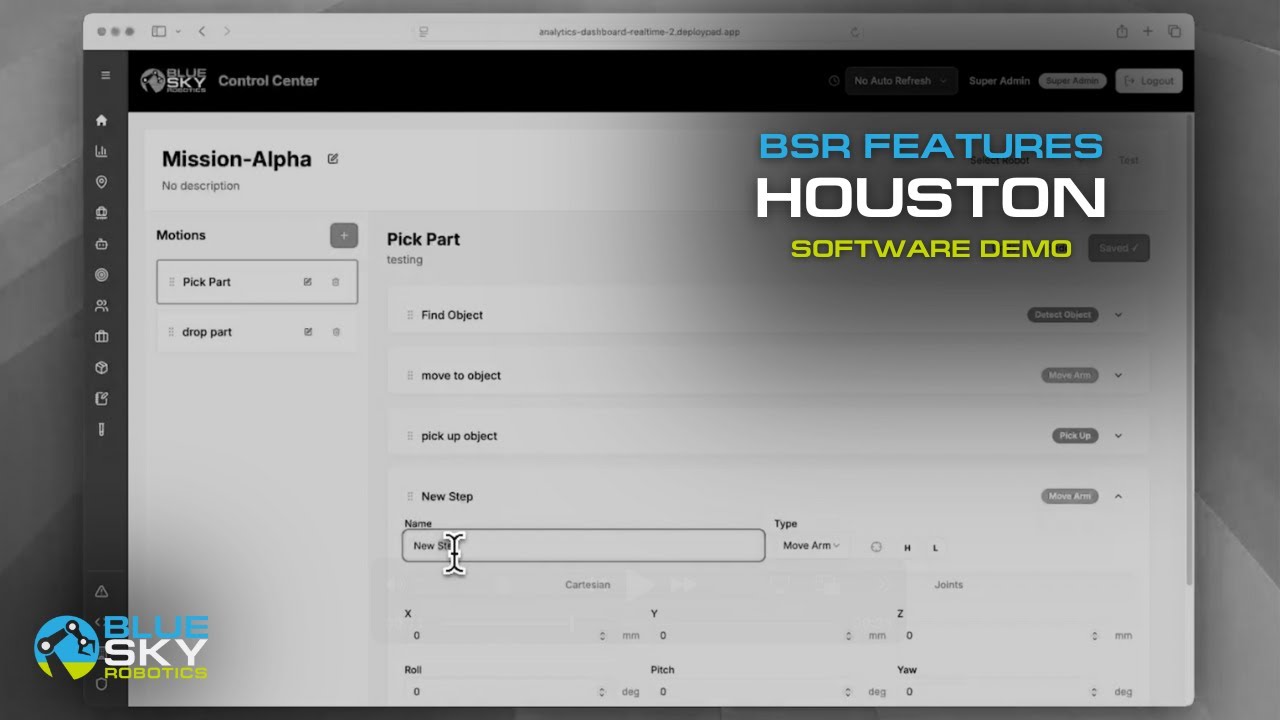
Blue Sky Robotics' automation software connects the vision system to robot motion in a unified platform, including the grasp planning, collision detection, and failure recovery logic that bin picking applications specifically require.
Where to Start
If your operation is manually feeding parts from bins and has assumed that bin picking automation is too complex or too expensive to be practical, the technology has moved significantly in the past two years. The Automation Analysis Tool evaluates your specific parts and environment for feasibility. The Cobot Selector matches the right arm to your payload and bin configuration. And if you want to see how a bin picking vision system handles your specific parts before committing to hardware, book a live demo with the Blue Sky Robotics team. To learn more about computer vision software visit Blue Argus.
Manual bin feeding solves the problem today. A bin picking vision system solves it every shift.
FAQ
What types of parts are hardest for a bin picking vision system to handle? Transparent parts, highly reflective or polished metal surfaces, and very dark light-absorbing materials are the most challenging for standard 3D cameras. Flexible or deformable parts are also difficult because their shape changes between the scan and the pick. For these material types, specialized camera modes, laser line profilers, or AI-based reconstruction approaches can extend what the system handles reliably.
How many SKUs can a single bin picking vision system handle?
It depends on the platform. Deep learning-based systems can be trained on multiple part types and switch between them based on which part is identified in the scan. High-mix environments with dozens of SKUs are achievable on capable platforms, though performance is typically strongest on parts the model has been specifically trained on. Blue Sky Robotics can scope what the onboarding process looks like for your specific part mix.
What is a realistic pick rate for a bin picking vision system?
Pick rate depends on part weight, bin size, grasp complexity, and how cluttered the bin is at each stage of the cycle. Well-configured systems on straightforward applications can reach several hundred picks per hour. Mixed-SKU, heavy, or geometrically complex applications typically run slower. Cycle time across the full bin, not just the easy middle portion, is the number worth evaluating.
Do I need a custom integration to deploy a bin picking vision system?
Not necessarily. Modern bin picking platforms with graphical interfaces and pre-built AI models for common part types have significantly reduced the integration burden. Blue Sky Robotics can help scope the right cell and support the setup without requiring a full third-party integration engagement, which is one of the factors that has brought bin picking from a custom engineering project to a deployable product.


