



Best Robotics Websites and Robotic Products for Industrial Buyers in 2026
- May 13
- 4 min read
If you are researching industrial robotics for the first time, the internet gives you two problems at once. There is too much content, and most of it is either too technical, too focused on enterprise-scale systems, or written by people trying to sell you something without telling you the price.
This guide cuts through that. Below is a practical map of the robotics websites worth bookmarking, the categories of robotic products that matter for small to mid-size manufacturers, and where to find transparent pricing on systems that actually fit a real production budget.
The Best Robotics Websites for Industrial Buyers
These are the resources worth reading regularly if you are evaluating automation or trying to stay current on the industry.
The Robot Report (therobotreport.com)
The most consistently reliable source for industrial robotics news. Covers cobot launches, market data, acquisition activity, and technology trends. Not product-focused, so you get editorial coverage rather than vendor marketing.
Robotics 24/7 (robotics247.com)
Strong on warehouse automation and logistics robotics. Good for coverage of AMRs, palletizing systems, fulfillment tech, and supply chain applications. Useful if your interest is in distribution or 3PL.
Association for Advancing Automation (automate.org)
The industry standards body for robotics. Their A3 Robotics section covers safety standards, buyer guides, and technical resources. Useful for compliance questions and understanding ISO/ANSI standards before you deploy.
International Federation of Robotics (ifr.org)
Publishes the most authoritative global robotics market data. Useful for understanding industry adoption rates, investment trends, and which sectors are automating fastest. Not a buying resource but valuable context.
Blue Sky Robotics Blog (blueskyrobotics.ai/blog)
The only resource on this list that publishes transparent pricing alongside technical content. Posts cover specific use cases, cobot comparisons, ROI calculations, and practical guides for manufacturers who are actively evaluating a purchase rather than just reading about the industry.
The Main Categories of Robotic Products
If you are new to industrial robotics, the product categories can be confusing. Here is how they break down for a manufacturer evaluating automation.
Collaborative Robot Arms (Cobots)
The most relevant category for small to mid-size manufacturers. Cobots are 6-axis robot arms designed to work alongside people without safety fencing, run on standard power, and be programmed without a dedicated robotics engineer. Price range for production-ready cobots starts around $6,000 and runs to roughly $18,000 for heavy-payload models.
Blue Sky Robotics carries two cobot lineups. UFactory xArm robots are compact, precise, and well suited to pick and place, assembly, and machine tending applications. Fairino robots cover a wider payload range from 3 kg up to 30 kg, with explosion-proof certification available across the line. You can browse both at the Blue Sky Robotics shop.
End Effectors
The gripper or tool attached to the end of the robot arm. The arm moves; the end effector does the work. Common types include two-finger parallel grippers for rigid parts, vacuum cup grippers for flat or smooth surfaces, and adaptive grippers for irregular shapes. End effector selection is often the deciding factor in whether a deployment works reliably.
Computer Vision Systems
A 3D camera and software that gives the robot the ability to see and respond to its environment in real time. Essential for bin picking, flexible pick and place, and any application where parts do not arrive in a perfectly consistent position. Blue Sky Robotics offers computer vision capabilities through Blue Argus, built to work with the full cobot lineup.
Automation Software
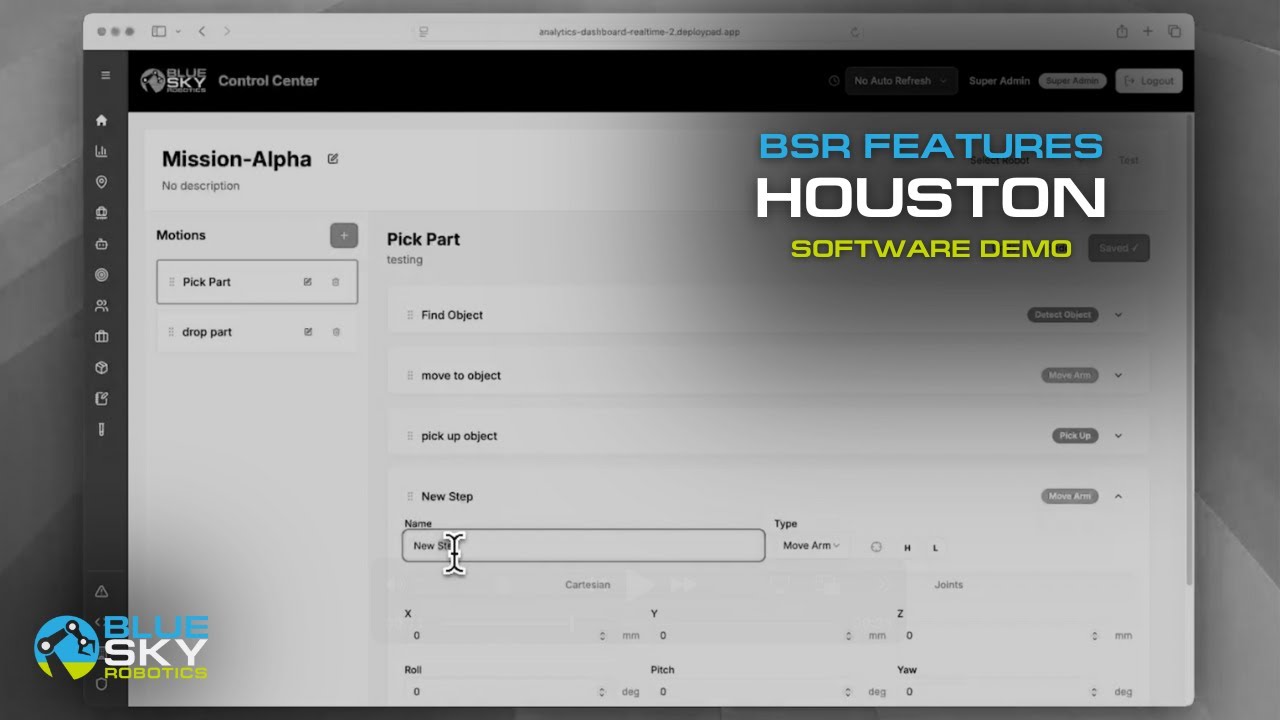
The platform that ties the robot, vision system, and end effector together into a working cell. Blue Sky Robotics' automation software includes mission building, computer vision integration, and an analytics dashboard for monitoring deployed systems.
Robotic Finishing Systems
For manufacturers doing spray painting, powder coating, or adhesive application, a dedicated finishing robot delivers consistent coverage without the health risks of manual spraying. Blue Sky Robotics' AutoCoat System handles paint, powder, and adhesives starting at $9,999.
How to Choose the Right Robotic Products for Your Operation
The most common mistake first-time buyers make is starting with the robot and working backward. The right order is:
Define the task precisely: what is being moved, how heavy is it, where does it start, where does it end
Identify the payload and reach requirements
Choose the robot arm that fits those specs at the lowest appropriate price point
Select the end effector for the specific part geometry
Determine whether vision is needed based on how consistently parts arrive
Blue Sky Robotics' Cobot Selector walks through this process and recommends the right arm based on your inputs. The Automation Analysis Tool takes it further and estimates ROI and payback period for your specific application.
To learn more about computer vision for your automation project, visit Blue Argus. To book a live demo and see how Blue Sky Robotics cobots perform on a real application, schedule time here.
Conclusion
The robotics industry produces a lot of content. Very little of it tells you what things actually cost or gives you a practical starting point for a real deployment. The resources listed above narrow the field to what is genuinely useful for a manufacturer evaluating automation in 2026.
When you are ready to move from research to hardware, Blue Sky Robotics publishes prices, ships cobots directly, and provides the software and support to make deployments work. Cobots start at $6,099 and go up from there based on payload.
Frequently Asked Questions
What are the best robotics websites for industrial buyers?
The Robot Report, Robotics 24/7, the Association for Advancing Automation, and the Blue Sky Robotics blog are the most useful for manufacturers evaluating industrial automation. The BSR blog is the only one that publishes transparent product pricing alongside technical content.
What robotic products do small manufacturers actually need?
Most start with a cobot arm, an end effector suited to their part geometry, and basic mission-building software. Computer vision is added when parts do not arrive in a consistent position.
Where can I buy robotic products with transparent pricing?
Blue Sky Robotics publishes prices on all cobot arms and accessories at blueskyrobotics.ai/category/shop-robot-arms. Cobots start at $6,099 for the Fairino FR3.
How do I know which cobot is right for my application?
Use the Blue Sky Robotics Cobot Selector at blueskyrobotics.ai/cobot-selector. It filters by payload, reach, and use case to recommend the right arm.


