


Automated Warehouse Robotics: Practical Guide 2026
- 1 day ago
- 4 min read
Automated warehouse robotics in 2026 covers a wider range of technology than it did five years ago, and at a wider range of price points. The global warehouse automation market is approaching $30 billion, with the robot arm and picking segment alone accounting for nearly 40% of that. More importantly for small and mid-size operators, the entry cost for a capable first deployment has dropped to the point where a single robot arm at a key workstation can pay back in under 18 months.
The challenge isn't finding technology, it's knowing which category of automated warehouse robotics fits your operation, what each layer of the system costs, and how to deploy without overcomplicating a first project.
The main categories of automated warehouse robotics
Autonomous Mobile Robots move goods through the facility. They navigate using onboard sensors and pre-mapped floor plans, carrying totes, shelves, or pallets between stations without a fixed track or human driver. AMRs address the travel time problem, in conventional warehouses, workers spend up to 60% of their shift walking. The AMR takes on that travel while the human focuses on the pick itself.
Robotic arms at fixed workstations handle the physical manipulation of items, picking, placing, packing, inspecting, and tending machines. A six-axis cobot mounted at a high-volume station runs consistently through every shift without fatigue, variation, or the compounding errors that come with repetitive manual work. When paired with a vision system, it adapts to variation in item position and orientation rather than requiring the environment to be perfectly controlled around it.
Goods-to-person systems combine AMRs or shuttle infrastructure with fixed pick stations, bringing inventory directly to the robot or human picker and eliminating both walking time and pick travel. These deliver the highest throughput but require more upfront infrastructure investment and facility planning than a standalone robot arm.
For most first-time automated warehouse robotics deployments, particularly at small and mid-size manufacturers and distributors, a robotic arm at a critical workstation is the right starting point. Lower cost, faster deployment, no facility redesign required.
Why vision is now a standard component
Early warehouse robotics required the environment to do a lot of work for the robot, parts had to arrive in exactly the right position, orientation, and spacing for the system to function reliably. That constraint limited where robots could be deployed and meant that any variation in infeed caused picking failures.
AI-driven computer vision removed that constraint. A camera above the pick station captures the scene before each cycle. Vision software identifies the item, determines its position and orientation in real time, and calculates the best grip point. The robot moves based on what it sees, not a preprogrammed coordinate, which means the system handles the kind of natural variation that any real warehouse operation produces.
For bin picking specifically, 3D vision adds depth perception to 2D identification, allowing the robot to locate items in a randomly stacked bin and plan a collision-free path to the best available pick. This capability is what allows a single robotic cell to handle mixed SKUs without requiring manual sorting or item-specific reprogramming between runs.
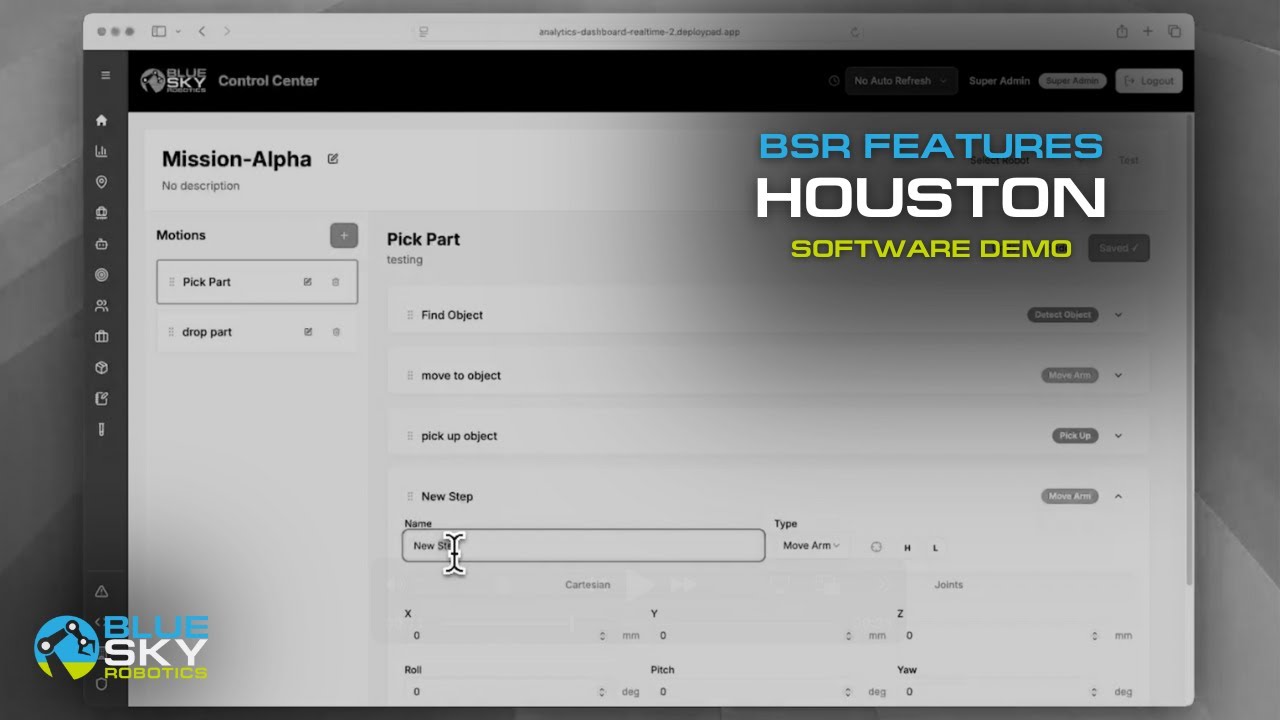
Blue Sky Robotics integrates computer vision directly into their automation software platform, which runs natively on UFactory and Fairino robot arms. Vision processing, motion planning, and task management are handled in one system, reducing setup complexity and total system cost for operations deploying their first automated warehouse robotics cell.
What automated warehouse robotics costs in 2026
The cost of the robot arm itself has dropped significantly. Blue Sky Robotics sells the UFactory xArm 5 at $6,000 and the xArm 6 at $9,500, capable six-axis cobots suited for most light to medium warehouse picking and handling tasks. The Fairino FR5 at $6,999 and FR10 at $10,199 cover similar ground with slightly different reach and payload profiles.
The arm is rarely the whole story. A complete automated warehouse robotics cell, arm, end effector, vision hardware, and basic integration, typically runs $15,000–$45,000 for a first deployment. That compares favorably to enterprise-grade integrated systems from major vendors, which start at $75,000 and scale substantially higher from there.
At a fully loaded labor cost of $30–$40 per hour, a single robot arm running one eight-hour shift typically pays back in 12–18 months. Running two shifts, or targeting a task that currently requires multiple workers, shortens that timeline considerably.
What 2025 taught us about deployment
The gap between a warehouse robotics deployment that works and one that underperforms rarely comes down to the hardware. A DHL survey from late 2025 found that while 44% of respondents had deployed warehouse robotics, only 34% of senior executives were fully satisfied with results. The consistent lesson across operations that struggled: they tried to automate too broadly too fast, or deployed without clearly defining the task the robot was solving.
The operations that see the strongest returns start with one specific, high-volume task, a picking station, a packing line, a material transfer, and deploy a single robot to solve it completely. Once that cell is running reliably and the ROI is confirmed, they expand. That sequence, define, deploy, validate, scale, is the most reliable path through a first automated warehouse robotics project.
Use the Automation Analysis Tool to identify your highest-ROI starting point, or the Cobot Selector to match a robot to your specific payload and reach requirements.
FAQs
Q: What is the difference between automated warehouse robotics and traditional warehouse automation?
A: Traditional warehouse automation, conveyors, sorters, fixed AS/RS systems, is rigid and infrastructure-heavy. It works well for high-volume, predictable workflows but is expensive to change. Automated warehouse robotics, particularly cobots and AMRs, is flexible: robots can be reprogrammed for different tasks, repositioned as needs change, and deployed in existing facilities without major construction. The tradeoff is throughput, fixed automation typically moves more volume per hour, while robotic systems offer more adaptability.
Q: How disruptive is a warehouse robotics deployment to existing operations?
A: A single robot arm at a fixed workstation can typically be deployed and operational within days without disrupting the rest of the operation. The physical footprint is small, no structural changes are required, and the robot runs alongside existing workflows rather than replacing them. Larger multi-robot deployments or goods-to-person systems require more planning, but the cobot approach is specifically designed to minimize operational disruption during installation.


