



3D Vision Systems: How It Works and Which Cobot Is Right for the Job
- Apr 8
- 6 min read
Updated: Apr 13
A robot without spatial awareness is a liability dressed up as an asset. It can move fast, lift heavy, and repeat indefinitely, but the moment a part lands slightly off-center or a case arrives at an unexpected angle, the whole cell stops producing and starts causing problems. The promise of automation is consistency. Fixed robots without vision deliver consistency only when everything around them is already consistent. That is a much harder condition to maintain than most operations realize before they deploy.
3D vision systems are what close that gap. They give a robot the ability to see its workspace in three dimensions, locate objects wherever they actually are, understand how they are oriented, and act on that information in real time. The result is a cell that handles the variability of a real production floor instead of one engineered to eliminate all variability in advance.
This post covers what a 3D vision system is made of, how the components work together, which industries are getting the most value from them, and which robot arms Blue Sky Robotics recommends for vision-guided deployments.
What a 3D Vision System Is Made Of
A 3D vision system is not a single product. It is a stack of hardware and software components that work together to give a robot spatial awareness of its environment. Understanding what each layer does helps clarify where performance comes from and where failures originate when something goes wrong.
The sensor - The camera or sensor array is the component that captures raw depth data. Structured light cameras project a known pattern onto the scene and calculate depth from how it deforms. Time-of-flight cameras measure how long emitted light pulses take to return. Stereo cameras triangulate depth from two offset lenses. Each technology has trade-offs in resolution, speed, and sensitivity to surface properties. The sensor choice determines the ceiling on what the system can detect and how accurately it can measure position.
The processing layer - Raw sensor data is not immediately usable by a robot controller. It needs to be processed into a point cloud, filtered for noise, and analyzed to identify objects and their spatial coordinates. This processing layer runs on dedicated hardware, either in the camera unit itself, in an external vision computer, or increasingly on edge computing platforms that sit inside the robot cell. Processing speed determines how quickly the system can generate a valid grasp pose and how tight the cycle time can be.
The vision software - Above the processing layer sits the software that does the actual work of interpretation: identifying objects, matching them against known models, calculating grasp poses, checking for collisions, and communicating pick instructions to the robot controller. This is where the intelligence of the system lives. A high-quality sensor paired with weak vision software will underperform. Strong vision software can compensate for some sensor limitations by using AI-based reconstruction and deep learning recognition to fill gaps in the point cloud data.
The robot controller integration - The final layer is the connection between the vision system output and the robot arm. The controller receives the grasp pose calculated by the vision software, plans the motion path, and executes the pick. How cleanly this integration is implemented determines how reliably the vision system and the robot arm work as a unified system rather than two separate components that happen to be in the same cell.
Where 3D Vision Systems Change the Outcome
Bin picking - Bin picking is the application that most clearly demonstrates what 3D vision systems make possible. Parts in a bin are randomly oriented, often touching or overlapping, and the robot needs to identify each one, select the most accessible target, plan a collision-free path around neighboring parts, and execute the pick without disturbing the rest of the bin. None of this is achievable without accurate depth data. With a well-configured 3D vision system, bin picking of machined parts, fasteners, consumer goods, and food products becomes a standard automation cell rather than an engineering challenge.
Palletizing and depalletizing - A 3D camera mounted above a palletizing cell gives the robot real-time information about case position and orientation on the conveyor and pallet surface. Mixed case sizes, angled items, and variable product presentation are all manageable without reprogramming. The system reads the scene on each cycle and adjusts accordingly. Blue Sky Robotics deploys vision-guided palletizing cells for operations across logistics, food and beverage, and manufacturing where case variability makes fixed automation impractical.
Quality inspection - 3D vision systems can measure part dimensions, detect surface anomalies, verify assembly completeness, and flag out-of-spec items at production speed. The system applies the same inspection standard on every part across every shift. For manufacturers running tolerance-sensitive parts or high-mix production lines where manual inspection is both inconsistent and expensive, vision-guided inspection is one of the clearest ROI cases in automation.
Painting and surface finishing - Blue Sky Robotics' AutoCoat system uses 3D vision to map the surface geometry of a part before the robot applies paint, powder coat, or adhesive. The robot adjusts its spray path to the actual surface of each part rather than following a fixed program, which reduces overspray, improves coverage consistency, and cuts rework on each run.
Kitting and mixed-SKU fulfillment - In e-commerce fulfillment and manufacturing kitting, 3D vision systems allow a robot to identify and pick any item in the inventory regardless of where it lands or how it is oriented. A single cell can handle dozens of SKUs without a separate configuration for each one, which is what makes vision-guided fulfillment practical for operations that cannot dedicate a robot cell to a single product type.
Which Robots Work Best with 3D Vision Systems
The vision system determines what the robot knows. The arm determines what it can do with that information. Matching both to the application is what makes a cell reliable in production rather than just in a demo.
For lightweight piece picking, pharmaceutical handling, inspection, and kitting, the UFactory Lite 6 ($3,500) provides a compact, affordable entry point with the repeatability required to act on vision system outputs accurately alongside human operators.
For general-purpose pick and place, bin picking, and mid-range palletizing across food, beverage, and consumer goods applications, the Fairino FR5 ($6,999) and Fairino FR10 ($10,199) cover the majority of part weights and reach a standard pallet footprint from a fixed mount position.
For heavier components, extended reach requirements, or end-of-arm tooling that adds weight to the payload calculation, the Fairino FR16 ($11,699) and Fairino FR20 ($15,499) provide the capacity without requiring a full industrial robot footprint or the integration overhead that comes with it.
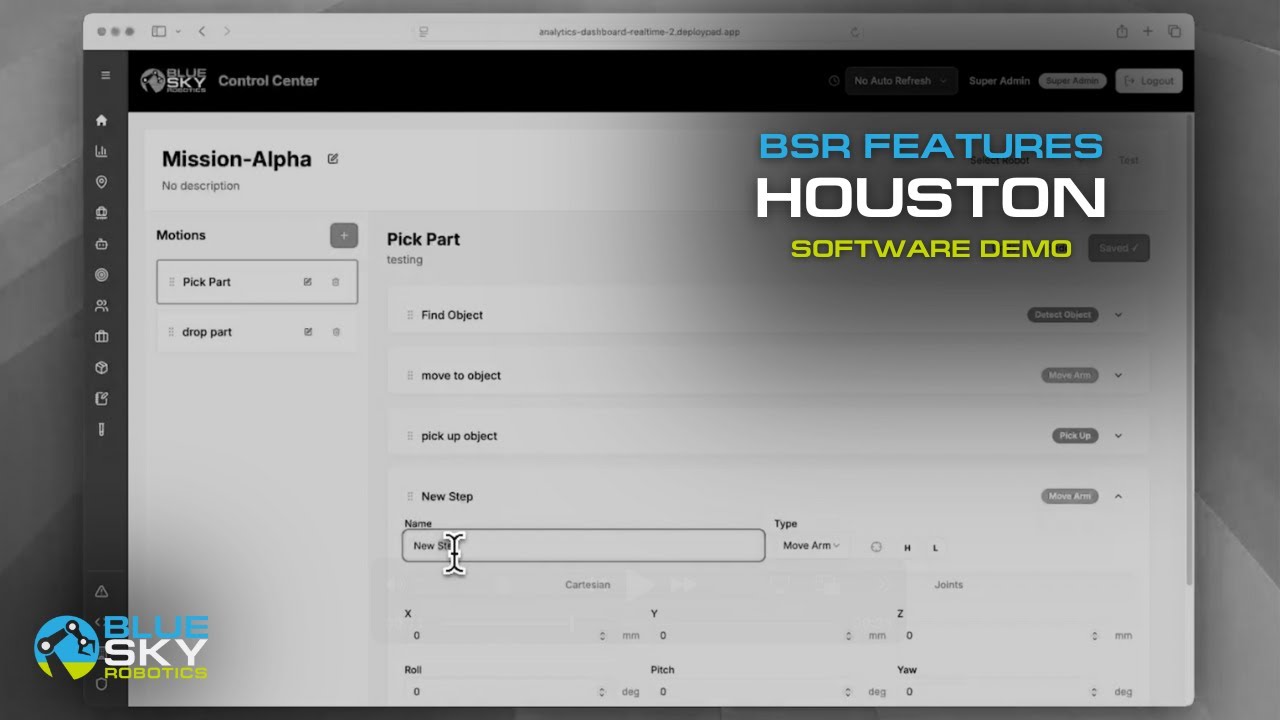
Blue Sky Robotics' automation software connects the 3D vision system output to robot motion in a unified platform, handling the integration layer between the vision stack and the robot controller that typically adds the most complexity and time to a vision-guided deployment.
Where to Start
If your operation is managing part variability, SKU changes, or inspection requirements manually and has assumed that a 3D vision system is too complex or too expensive to be worth exploring, that assumption is worth pressure-testing. The Automation Analysis Tool evaluates your specific application for feasibility. The Cobot Selector matches the right arm to your payload and workspace. And if you want to see how a 3D vision system performs on your specific parts and environment before committing to hardware, book a live demo with the Blue Sky Robotics team. To learn more about computer vision software visit Blue Argus.
Fixed automation tells the robot what the world looks like. A 3D vision system lets it see for itself.
FAQ
What is the difference between a 3D vision system and a standard machine vision system?
A standard machine vision system typically uses 2D cameras to capture flat images for tasks like barcode reading, label verification, and surface inspection in a single plane. A 3D vision system adds depth information, enabling the robot to locate objects in full three-dimensional space, handle variable orientations, and perform tasks like bin picking and palletizing that 2D vision cannot support.
How long does it take to deploy a 3D vision system?
Deployment timelines depend on the complexity of the application and how much existing infrastructure needs to be integrated. Straightforward pick and place or palletizing cells built on modern vision platforms with graphical interfaces can be operational in days to weeks. High-mix bin picking or custom inspection applications with many SKUs take longer to configure and validate. Blue Sky Robotics can help scope realistic timelines for your specific case.
Can a single 3D vision system handle multiple applications?
Yes, within the same cell. A 3D vision system configured for bin picking can also perform basic inspection tasks or verify part orientation before handoff to a downstream process. Combining functions in a single cell is one of the advantages of vision-guided automation over fixed systems, which typically require a dedicated configuration for each task.
What happens when a 3D vision system cannot generate a valid grasp pose? Well-designed vision software handles no-detect and low-confidence scenarios gracefully. The system can request a rescan, flag the item for manual handling, or trigger a conveyor nudge to reposition the item and try again. How the system behaves in these edge cases is as important as how it performs under ideal conditions, and it is worth evaluating specifically before committing to a platform.


