



3D Vision System for Manufacturing: What It Is and Why the Software Layer Matters
- Apr 8
- 4 min read
Updated: Apr 13
Most conversations about 3D vision for robots start and end with the camera. Which sensor to buy, how accurate its point cloud is, how it handles reflective surfaces. The camera matters, but it is only half the system.
A 3D vision system is the combination of a camera and vision software working together. The camera captures spatial data. The software interprets that data and converts it into robot commands. Both components are necessary, and the software layer is consistently underweighted in how manufacturers evaluate and budget for vision-guided automation.
This post explains what a 3D vision system actually consists of, how the software layer works, what manufacturing applications it enables, and how it connects to the cobots that act on its output.
What a 3D Vision System Is
A 3D vision system has two parts that must function as a unit.
The camera hardware captures the scene and produces raw data, typically a point cloud, a dense spatial map where every visible surface has an X, Y, and Z coordinate. The quality of this data depends on the sensor technology: structured light cameras handle the widest range of surface types and produce the most accurate point clouds for demanding manufacturing applications. Stereo cameras offer an affordable alternative for applications with less demanding surface conditions.
The vision software is where the intelligence lives. It takes raw point cloud data and performs the operations that make it actionable: image capture management, object detection and classification, pose estimation (determining an object's orientation in 3D space), grasp point calculation, and path planning command outputs to the robot controller. Without capable vision software, even the best camera produces data the robot cannot use.
How the Software Layer Works
Understanding what vision software does at each step clarifies why it is so critical to system performance.
Image capture control manages when and how the camera scans. The software triggers the camera at the right moment in the robot's cycle, applies exposure settings appropriate for the lighting environment, and handles the handshake between camera and robot controller.
Object detection and classification identifies what is in the point cloud. For manufacturing applications involving specific part types, this step uses machine learning models trained on the target parts. A well-trained model recognizes the part reliably across variations in orientation, partial occlusion, and lighting changes that would confuse simpler template-matching approaches.
Pose estimation calculates the exact 3D position and orientation of the detected object. This is the step that translates the camera's spatial data into a specific location the robot arm can target. Accuracy at this step determines whether the robot picks the part cleanly or misses it.
Grasp planning selects the optimal grasp point on the detected object and calculates the approach angle that avoids collisions with surrounding objects, the bin walls, or the robot's own structure. For bin picking and palletizing, this step runs continuously and adapts to the changing state of the bin or pallet after each pick.
Command output sends the calculated pick coordinates to the robot controller. This requires a clean integration between the vision platform and the robot's API or communication protocol.
Manufacturing Applications
The Mech-Mind article describes several concrete manufacturing applications that illustrate what a complete 3D vision system enables in production.
Random part sorting and palletizing. Steel plates, construction components, and auto parts arriving in random orientations need to be identified, sorted by type, and palletized correctly. A 3D vision system identifies each part's type and position, plans the pick sequence, and guides the robot to build a stable, correctly organized pallet without manual sorting upstream.
Precision locating for gluing and assembly. Swing bearings and similar components that require precise glue or grease application need to be located in 3D space before the robot can apply material accurately. The vision system identifies the part's exact position and orientation, and the robot applies material at the correct location and angle.
Machine tending with variable parts. Loading CNC machines or other equipment with parts of different sizes and shapes requires the robot to locate and orient each part correctly before presenting it to the machine. 3D vision handles the size and orientation variability without manual staging.
Quality inspection and measurement. 3D vision measures part dimensions, surface flatness, and assembly completeness inline at production speed, replacing dedicated measurement stations and catching defects before they move downstream.
Which Cobots Work with 3D Vision Systems
Every arm in the Blue Sky Robotics lineup accepts 3D vision system outputs through open APIs, Python SDKs, and ROS compatibility. The right arm depends on payload and reach for the specific application.
For entry-level 3D vision applications, the UFactory Lite 6 ($3,500) paired with a stereo camera and UFactory's open-source vision SDK is the most accessible starting point. For production-grade 3D vision manufacturing cells, the Fairino FR5 ($6,999) covers the widest range of tasks with 5 kg payload, 924 mm reach, and full ROS support for connecting to platforms like Mech-Mind's Mech-Vision and Mech-Viz. For heavier applications including vision-guided palletizing and bin picking of larger parts, the Fairino FR10 ($10,199) provides the payload needed for production throughput.
Getting Started
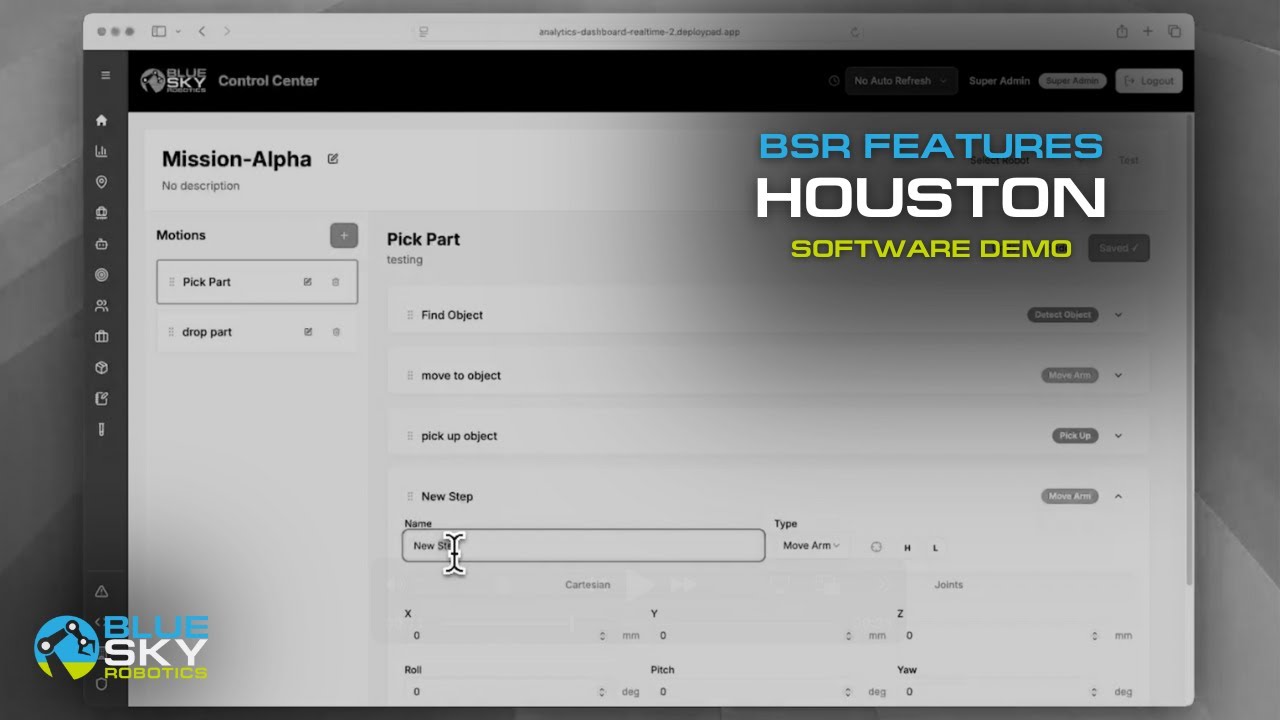
Explore our automation software to see how Blue Sky Robotics' computer vision and mission-building tools work alongside 3D cameras and our cobot lineup. Use the Cobot Selector to match an arm to your application, or book a live demo to see a complete 3D vision system in action. To learn more about computer vision software visit Blue Argus.
Browse our full UFactory lineup and Fairino cobots with current pricing.
FAQ
What is a 3D vision system?
A 3D vision system is the combination of a 3D camera and vision software that gives a robot the ability to perceive its environment spatially. The camera produces a point cloud; the software interprets it to identify objects, calculate their position and orientation, and generate pick or inspection commands for the robot controller.
Why does vision software matter as much as the camera?
The camera captures raw depth data. Vision software converts that data into robot commands. A capable camera paired with underpowered software produces unreliable outputs. A capable software platform extracts maximum value from the camera data and compensates for environmental variability that simpler systems cannot handle.
Can one 3D vision system work with different robot brands?
Yes, when the vision software supports standard communication protocols. Mech-Mind's Mech-Viz platform integrates with nearly all major robot arm brands. All UFactory and Fairino arms sold by Blue Sky Robotics support the open APIs and ROS interfaces required for this integration.


