



3D Robot Vision: How It Works and Which Cobot Is Right for the Job
- Apr 8
- 6 min read
Updated: Apr 13
A robot arm without vision is a tool that repeats. It executes the same motion to the same coordinates on every cycle, and it depends entirely on the surrounding environment staying exactly the same. That works in highly controlled, high-volume lines built around a single product. It does not work in the mixed-SKU, variable-presentation environments that most manufacturers and distributors actually operate in.
3D robot vision changes that dynamic. By equipping a robot with the ability to see its workspace in three dimensions, the system can locate objects wherever they are, understand how they are oriented, plan a grasp path, and execute the pick without any of it being hard-coded. The robot adapts to the environment instead of demanding the environment adapt to it.
The technology has matured significantly in recent years. The cameras, software, and integration platforms that power 3D robot vision are more capable, more affordable, and easier to deploy than they have ever been. Fairino cobots start at $6,999, and a complete 3D vision-guided cell is within reach for operations that previously assumed it was out of budget. This post covers how 3D robot vision works, where it delivers the most value, and which arms Blue Sky Robotics recommends for the job.
What 3D Robot Vision Actually Is
3D robot vision is the combination of depth-sensing cameras, processing software, and a robot controller working together to give a robotic arm spatial awareness of its environment. Unlike a standard 2D camera, which produces a flat image with no depth information, a 3D vision system produces a point cloud: a dense map of three-dimensional coordinates representing every surface in the scene.
The robot uses that point cloud to answer three questions before it moves: what is the object, where is it in space, and how should I approach it. The vision software identifies the target, calculates its position and orientation in all three axes, and generates a grasp pose the robot controller can execute. All of this happens in real time, often in under a second, before each pick.
The depth data itself comes from one of several sensing technologies. Structured light cameras project a known pattern onto the scene and calculate depth from how it deforms. Time-of-flight cameras measure how long emitted light pulses take to return. Stereo cameras use two offset lenses to triangulate depth from the difference between their images. Each has trade-offs in speed, resolution, and sensitivity to surface type, and the right choice depends on the application.
Why 3D Vision Makes Robots Dramatically More Useful
The gap between a robot with 3D vision and one without is not incremental. It is the difference between a system that can handle one carefully controlled scenario and one that can handle the variability of a real production environment.
Handling random part orientation - Without 3D vision, every part must arrive in a known position and orientation. With it, the robot scans the scene, identifies each part regardless of how it landed, and calculates the correct approach angle for a successful pick. Bin picking of randomly oriented parts is not possible without depth information.
Adapting to changeovers without reprogramming - When a product changes, a 3D vision system identifies the new item and adjusts grasp parameters through a graphical interface. Operators do not need to rewrite robot paths or call an integrator. The system recognizes what it is looking at and responds accordingly.
Enabling inspection at production speed - 3D robot vision can measure part
dimensions, detect surface anomalies, and verify assembly completeness inline at conveyor speed. The same cell that picks can also inspect, reducing the need for separate quality control stations and the manual labor that goes with them.
Supporting safe human-robot collaboration - 3D vision is also used to monitor the workspace around a collaborative robot. The system detects when a person enters the robot's operating zone and adjusts speed or halts motion automatically, enabling closer human-robot collaboration without physical barriers.
Where 3D Robot Vision Delivers the Most Value
Bin picking and kitting - This is the application where 3D robot vision has the highest impact. Parts in a bin are randomly oriented and often touching or overlapping. A 3D vision system identifies each part, selects the most accessible pick target, plans a collision-free path around neighboring parts, and executes the pick. Applications in machined parts, fasteners, electronics components, and consumer goods all benefit.
Pick and place on moving conveyors - 3D vision allows a robot to track and pick items off a moving conveyor without requiring them to be stopped, aligned, or presented in a fixed position. The system updates its grasp calculation in real time as the conveyor moves, enabling higher throughput with less upstream fixturing.
Palletizing and depalletizing - A 3D camera mounted above the work area gives the robot real-time information about case position and orientation on the conveyor and pallet surface. Mixed case sizes, angled items, and variable product presentation are all manageable. Blue Sky Robotics deploys vision-guided palletizing cells for operations across logistics, food and beverage, and manufacturing.
Quality inspection - Surface defects, dimensional out-of-spec conditions, missing components, and incorrect label placement are all detectable with 3D robot vision at production speed. The system applies the same inspection standard on every part, every shift, with a data trail that manual inspection cannot produce.
Painting and surface finishing - Blue Sky Robotics' AutoCoat system uses vision to map the surface of a part before the robot applies paint, powder coat, or adhesive. The robot adjusts its path to the actual geometry of each part rather than following a fixed spray pattern, reducing waste and rework.
Which Robots Work Best with 3D Robot Vision
The vision system tells the robot what to do. The arm determines what it is physically capable of doing. Matching the two correctly is what makes a cell reliable in production.
For lightweight piece picking, inspection, and collaborative applications, the UFactory Lite 6 ($3,500) provides a compact, affordable entry point with the repeatability needed for vision-guided work alongside human operators.
For general-purpose pick and place, bin picking, and mid-range palletizing, the Fairino FR5 ($6,999) and Fairino FR10 ($10,199) cover the majority of part weights and reach a standard pallet footprint from a fixed mount position.
For heavier components, extended reach requirements, or end-of-arm tooling that adds weight to the payload calculation, the Fairino FR16 ($11,699) and Fairino FR20 ($15,499) provide the capacity without a full industrial robot footprint.
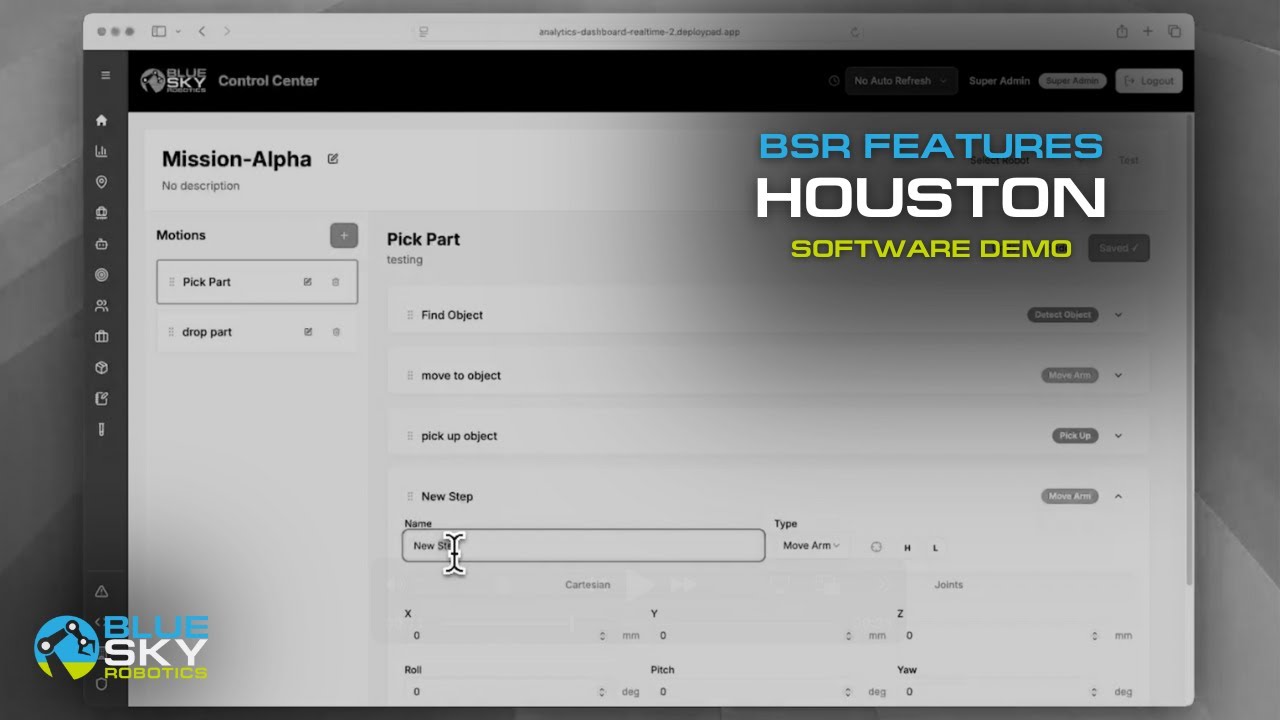
Blue Sky Robotics' automation software connects 3D vision output to robot motion in a unified platform, handling the integration layer that typically adds complexity and time to vision-guided deployments.
Where to Start
If your operation relies on manual picking, fixed automation, or has struggled to find a vision-guided solution that handles your specific environment, the Automation Analysis Tool is a practical starting point for evaluating feasibility. The Cobot Selector matches the right arm to your payload and workspace. And if you want to see how 3D robot vision handles your specific parts or application before committing to hardware, book a live demo with the Blue Sky Robotics team.
A robot without vision knows where things should be. A robot with 3D vision knows where they actually are. To learn more about computer vision software visit Blue Argus.
FAQ
What is the difference between 2D and 3D robot vision?
2D robot vision captures flat images and can identify objects, read labels, and detect surface features, but it cannot determine depth or three-dimensional orientation. 3D robot vision adds depth information, enabling the robot to locate objects in full three-dimensional space, handle variable part orientations, and perform tasks like bin picking that 2D vision cannot support.
How accurate is 3D robot vision?
Accuracy depends on the camera technology, working distance, calibration quality, and the reflectivity of the target surface. Well-configured structured light systems achieve sub-millimeter repeatability on standard opaque surfaces. Reflective, transparent, or translucent materials may require specialized camera modes or alternative sensing approaches to achieve reliable results.
Can 3D robot vision handle multiple different parts in the same bin?
Yes. Deep learning-based vision software can be trained to recognize and differentiate multiple part types in the same scene. The robot identifies each part individually, selects the best pick target based on accessibility and orientation, and adjusts its grasp parameters accordingly. This is common in kitting and mixed-SKU fulfillment applications.
Do I need a dedicated integrator to deploy a 3D robot vision cell?
Not necessarily. Modern vision-guided automation platforms with graphical interfaces and code-free configuration have significantly reduced the integration burden. Blue Sky Robotics can help scope the right cell and support the setup without requiring a full third-party integration engagement.


